Selling Pressure on Semiconductor and Export-Related Stocks
The Nikkei 225 average stock price (Nikkei Index), Japan's representative stock market index, hit an intraday high on the 7th before falling below the 40,000 mark. It closed at 39,598, down 1.23% from the previous day.
The Nikkei Index surged at the opening and rose to 40,472. This surpassed the intraday high of 40,314 recorded on the 4th, marking a new high in three days.
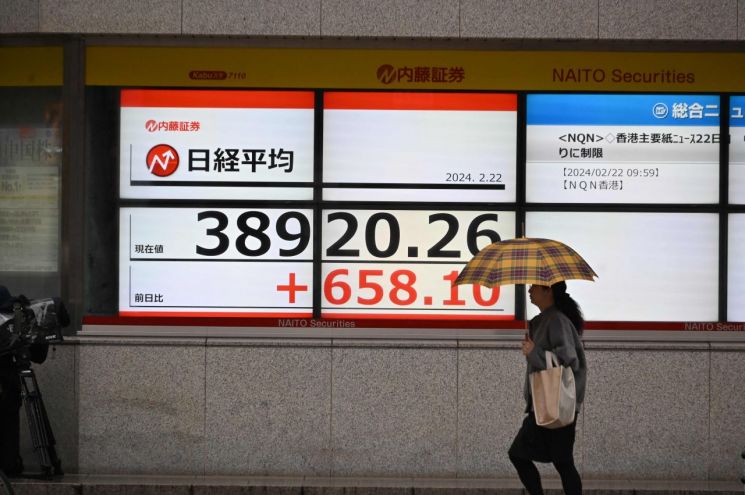 On February 22, a Tokyo citizen is passing in front of the stock index electronic board. [Image source=Yonhap News]
However, it then turned downward and fell below 40,000 at the close, three days after breaking through the 40,000 mark on the 4th.
The Nihon Keizai Shimbun analyzed that this was due to profit-taking selling in semiconductor-related stocks, which had been leading the market, as the Bank of Japan is expected to lift its negative interest rate policy this month. Additionally, selling appeared in export-related stocks amid expectations of yen appreciation. Meanwhile, buying interest was seen in bank and insurance stocks as interest rates are expected to rise.
On the morning of the same day, Junko Nakagawa, a policy board member of the Bank of Japan, stated at a financial and economic meeting in Shimane Prefecture that "a virtuous cycle of wages and prices can be expected."
Tokyo Electron, a leading semiconductor stock in the Tokyo market, fell about 3.8% that day. Advantest dropped 4.2%, and Kyocera declined 3.11%. In the representative export sector of automobiles, Toyota Motor fell 2.8%, and Nissan Motor dropped 4.78%.
© The Asia Business Daily(www.asiae.co.kr). All rights reserved.

















