"Female Characters Still Unable to Break Gender Stereotypes"
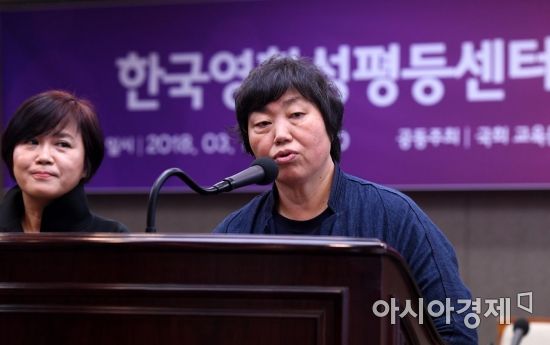 At the press conference held on the 12th at the Press Center in Jung-gu, Seoul, introducing the Korea Film Gender Equality Center Ddeunddeun and announcing its activity plans, Center Director Im Sun-rye is giving a greeting. On the left is Center Director Shim Jae-myung. Photo by Kim Hyun-min kimhyun81@
Gender imbalance in creative personnel and narratives in Korean films has regressed since the COVID-19 pandemic.
According to the "2023 Korean Film Gender Sensitivity Report" released by the Korean Film Council (KOFIC) on the 7th, among 35 commercial films with a production budget over 3 billion KRW released last year, only one film, Negotiation (director Im Soon-rye), was directed by a woman. Female directors accounted for 1 person (2.7%), female producers 22 (23.9%), female executive producers 13 (23.6%), female leads 9 (25.7%), and female screenwriters 12 (21.8%). Compared to the previous year, the number of female producers, executive producers, and leads increased, while the number of female directors and screenwriters decreased. The number of female cinematographers remained zero, unchanged from the previous year.
Among 183 films including low-budget commercial films and independent/art films, the proportion of female directors was 22.8% (49 people). Female producers numbered 77 (24.8%), executive producers 71 (31%), leads 81 (40.7%), screenwriters 67 (30.7%), and cinematographers 18 (8.1%). Compared to the previous year, the numbers of female directors, producers, and screenwriters increased, while executive producers, leads, and cinematographers decreased.
KOFIC analyzed, "While female directors have been notably active in independent and art films over the past few years, the gender imbalance among personnel involved in high-budget commercial films continues."
Among seven original films released on online streaming services (OTT) last year, there were no female directors or cinematographers. Female producers numbered 4 (50%), executive producers 3 (37.5%), female leads 5 (83.3%), and female screenwriters 1 (16.7%). Compared to the previous year, the numbers of female directors and screenwriters decreased, but the number of female leads increased. This was due to the release of female-led films such as Jung-E, Gilboksoon, and Ballerina last year. KOFIC stated, "It remains to be seen whether the prominence of female leads in OTT original films will be a temporary trend."
It was analyzed that investment in the film industry has shrunk since the COVID-19 pandemic, further reducing opportunities for women. KOFIC expressed concern, saying, "Gender balance in creative personnel and narratives in Korean films shows signs of regression after the pandemic. As overall investment in the film industry shrinks and production contracts, this trend is expected to continue."
Analyzing the top 30 box office films, the number of films passing the Bechdel Test for gender-equal character representation and those corresponding to stereotype tests increased. KOFIC analyzed, "Although the number of female characters increased quantitatively, narratively they failed to break free from gender stereotypes." They added, "Since 2016, gender imbalance in creative personnel and narratives in Korean films seemed to improve somewhat, but signs of regression have appeared after the COVID-19 pandemic. With overall investment shrinking and production contracting in the film industry, this trend is expected to continue."
© The Asia Business Daily(www.asiae.co.kr). All rights reserved.
















