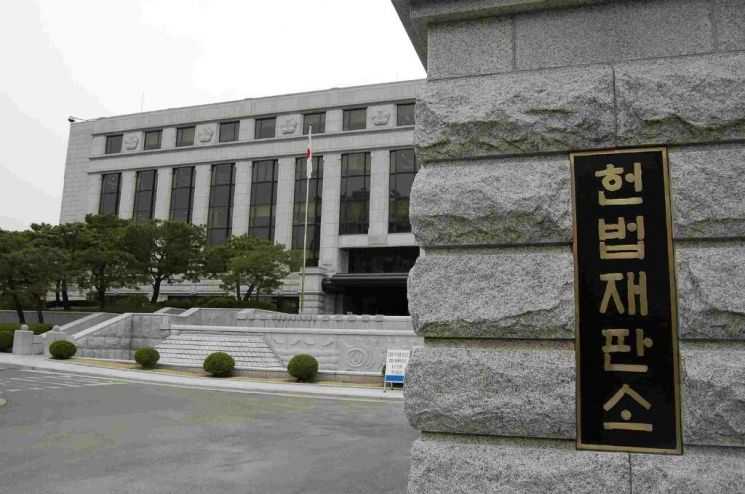
The Constitutional Court has ruled that a law that does not grant individual certified public accountants the qualification to act on behalf of employment insurance and industrial accident compensation insurance affairs does not violate the Constitution.
According to the legal community on the 7th, the Constitutional Court dismissed the constitutional complaint case regarding Article 33, Paragraph 1 of the Employment Insurance and Industrial Accident Compensation Insurance Act and Article 44 of the Enforcement Decree by a 5 (dismissal) to 4 (acceptance) vote.
Article 33, Paragraph 1 of the Employment and Industrial Accident Insurance Premium Collection Act stipulates that the qualification to act on insurance affairs on behalf of the employer's delegation is granted to organizations, corporations, other corporations meeting criteria prescribed by Presidential Decree, certified labor attorneys, or tax accountants. Article 44 of the Enforcement Decree, pursuant to the delegation of the law, specifies the concrete qualifications (such as having worked in the role for more than two years after registration) of corporations, labor attorneys, and tax accountants recognized as qualified to act on insurance affairs.
Accordingly, accounting firms can act on insurance affairs, but individual certified public accountants, unlike labor attorneys or tax accountants, do not have the qualification to act on insurance affairs.
The petitioners of this constitutional complaint filed the case in January 2020, arguing that not allowing individual certified public accountants to act on insurance affairs infringes on their freedom to choose their occupation.
Five Constitutional Court justices?Kim Ki-young, Moon Hyeong-bae, Lee Mi-seon, Jeong Jeong-mi, and Jeong Hyeong-sik?stated, "The challenged provisions restrict the petitioners' freedom to perform their occupation," but added, "How to specifically set the scope of those who can become insurance affairs agents can be determined by the legislature's discretion, considering the purpose and current status of the insurance affairs agency system, the characteristics of insurance affairs, the job relevance and expertise of related professional qualifications, the accessibility and convenience for employers, and the credibility and trustworthiness of the institution. When judging constitutionality, it is necessary to fully consider such legislative discretion."
These justices further explained, "In the case of individual certified public accountants, it is difficult to see a high relevance between their duties and insurance affairs agency work, and it is also hard to find a practical need to add them as insurance affairs agents due to ease of access for employers. Moreover, considering that accounting firms, to which many certified public accountants belong, can act as insurance affairs agents, the practical benefit of separately including individual certified public accountants as insurance affairs agents is relatively low. Therefore, it is difficult to regard the challenged provisions' exclusion of individual certified public accountants from insurance affairs agents as unreasonable beyond the legislature's discretion."
The five justices noted, "Insurance affairs agency work falls within the scope of certified labor attorneys' duties, so individual certified labor attorneys can be seen as having the expertise to act on insurance affairs. The inclusion of individual tax accountants in the scope of insurance affairs agents is because individual tax accountants have often handled bookkeeping and tax reporting for small business owners and also performed insurance affairs agency work. On the other hand, it is difficult to see a high relevance between the duties of individual certified public accountants and insurance affairs agency work."
On the other hand, Chief Justice Lee Jong-seok and Justices Lee Eun-ae, Lee Young-jin, and Kim Hyeong-du dissented, stating that the provisions violate the principle of proportionality and infringe on the petitioners' freedom to perform their occupation.
Although four justices supported acceptance, the number did not reach the required six votes for acceptance, so the five justices' dismissal opinion became the official opinion of the Constitutional Court.
A Constitutional Court official stated, "This is the first decision to determine the constitutionality of the provisions of the Employment and Industrial Accident Insurance Premium Collection Act and its Enforcement Decree that regulate the qualifications of institutions acting on employment and industrial accident insurance affairs."
© The Asia Business Daily(www.asiae.co.kr). All rights reserved.

















