'Directly Presided Over Central Disaster and Safety Countermeasures Headquarters Meeting During Doctors' Collective Action'
"While Number of Lawyers Increased 30-Fold, Number of Doctors Only Increased 7-Fold"
Yoon: "Claim That Medical Quality Declined in Healthcare Sector Is Wrong"
"Medical School Quotas Have Been Neglected for Nearly 30 Years"
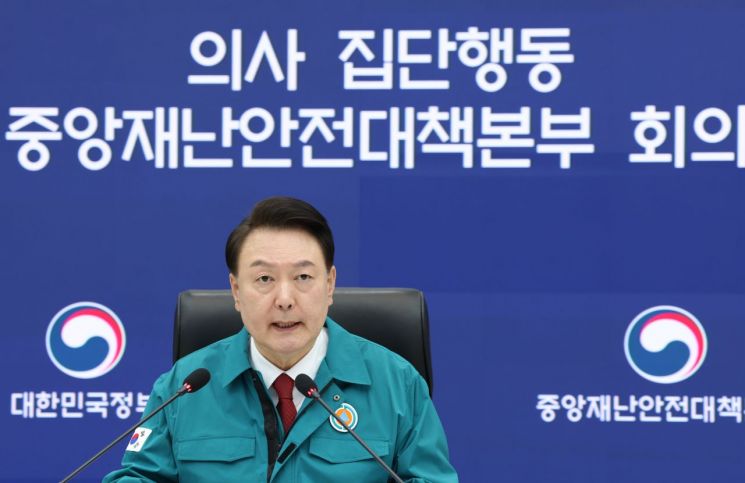 President Yoon Suk-yeol is speaking at the Central Disaster and Safety Countermeasures Headquarters meeting addressing the collective action of medical professionals, held on the 6th at the Central Disaster and Safety Situation Room in the Government Complex Sejong, Sejong Special Self-Governing City.
 [Image source=Yonhap News]
President Yoon Suk-yeol stated on the 6th, "While taking appropriate measures against doctors who neglect their responsibility for the lives and safety of the people, we will also strengthen the emergency medical system to fill their gaps and minimize the damage to the public." He strongly indicated that despite collective opposition from the medical community, he is determined to complete medical reform.
On the same day, President Yoon personally presided over the 'Central Disaster and Safety Countermeasures Headquarters (CDSCH) meeting on doctors' collective action' at the Government Complex Sejong, checking the emergency medical system in response to the doctors' collective action and discussing key medical reform tasks.
This was the first time this year that President Yoon personally chaired a CDSCH meeting. It is interpreted as showing a strong will to push forward medical reform while ordering all ministries to unite in responding to illegal collective actions.
President Yoon first expressed gratitude to the medical staff who stayed by patients' sides and to the public who cooperated and supported with mature civic awareness amid the situation where patients' lives are threatened and public inconvenience is increasing due to the doctors' collective action lasting more than two weeks.
Yoon: "The reality of operating a national emergency system due to the departure of residents is abnormal"
In particular, President Yoon raised his voice, saying, "It is abnormal that the public has to be anxious because residents in training have left, and a national emergency system must be activated. This proves that increasing the number of doctors is an urgent and important task."
He reiterated the shortage of doctors compared to the surge in medical demand and emphasized the need for an increase. President Yoon said, "Since the introduction of health insurance in 1977, South Korea's gross domestic product (GDP) has increased 116 times, and national medical expenses have increased 511 times, but the number of doctors has only increased sevenfold." He explained that during the same period, the medical school quota increased only 2.2 times from 1,380 to 3,058, indicating a significant shortage of doctors compared to the surge in medical demand.
President Yoon also cited the number of lawyers as an example. He pointed out, "During the same period, the annual number of lawyers increased 30 times from 58 to 1,725. As a result, our citizens receive high-quality legal services nationwide, but medical services have rather regressed."
Furthermore, President Yoon emphasized, "The medical reform the government is pursuing is based on expanding doctor training while resolving the concentration phenomenon where doctors flock to the metropolitan area and non-essential fields such as dermatology and cosmetic surgery."
The government announced plans to accelerate the implementation of essential medical package policies to quickly normalize the medical field in crisis. It mentioned that last week it unveiled a special law on medical accident handling and announced plans to expand the quota of professors at key national university medical schools by more than 1,000.
President Yoon said, "At today's CDSCH meeting, we intend to discuss measures to increase fees for emergency and high-difficulty surgeries and expand health insurance funding for essential medical care such as pediatrics and childbirth." He added, "We will strengthen compensation for severe heart diseases with high difficulty, promote post-compensation for high-risk mothers and neonatal intensive care centers, and introduce public policy fees for specialists dedicated to neonatal intensive care units in provincial areas to increase compensation starting from the most urgent fields."
"Presidential Medical Reform Special Committee to be launched promptly"
He promised to launch the Presidential Medical Reform Special Committee soon to discuss tasks requiring public debate.
President Yoon said that the increase in medical school quotas as a starting point for restoring regional and essential medical care has been confirmed even in educational settings. According to applications received from universities for next year's medical school quota increase, the total was 3,401, far exceeding last year's demand survey results.
He actively refuted claims from some in the medical community that rapid increases would degrade the quality of medical education by presenting specific statistics and objective evidence, calling them "completely false and incorrect claims."
He noted that the student quota per school in advanced countries is 243 in Germany, 221 in the UK, and 146 in the US, while South Korea's is relatively low at 77. Regarding faculty resources, the current student quota per full-time faculty member is only 1.6 on average, which is ample compared to the legal standard of 8 students per full-time professor. For example, at Ulsan University College of Medicine, the student-to-faculty ratio is 0.4, and at Sungkyunkwan University College of Medicine, it is only 0.5, indicating a very sufficient number of full-time professors.
President Yoon said, "The government's plan to increase quotas starting with small medical schools of 40 to 50 students aims to normalize medical education according to global standards." He added, "Medical school professors have consistently argued for increasing quotas at small medical schools to improve the quality of medical education."
He emphasized, "Concerns about medical school quotas and efforts to improve the quality of medical education have been virtually neglected for over 30 years. The government will enhance the quality of our medical education and elevate the capabilities of medical schools to meet global standards through medical reform."
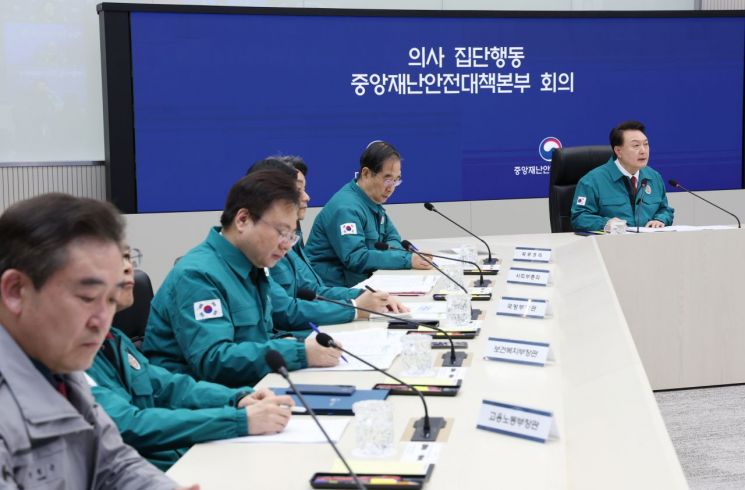 President Yoon Suk-yeol is presiding over the Central Disaster and Safety Countermeasures Headquarters meeting responding to the medical professionals' collective action at the Central Disaster and Safety Situation Room in the Government Complex Sejong, Sejong Special Self-Governing City on the 6th. [Image source=Yonhap News]
"We will correct the distorted hospital operation structure overly dependent on residents in large hospitals"
He also said he would correct the existing distorted hospital operation structure in which large hospitals have excessively relied on the sacrifice of young residents. President Yoon said, "Currently, among the 47 tertiary general hospitals nationwide, there are 8,724 residents in training, accounting for 37.5% of the total 23,284 doctors, which is a very distorted structure." He added, "We must correct and reform this hospital operation structure that threatens the health and lives of the people."
He promised to change to a specialist-centered workforce structure and actively utilize skilled physician assistants (PAs) to fundamentally reform the medical delivery system.
President Yoon strongly indicated that doctors who have left the medical field will be dealt with according to law and principles. He said, "The government gave doctors who repeatedly disobeyed work commencement orders a last chance, stating that if they return by February 29, no responsibility will be imposed. However, the majority of doctors still have not returned to patients' sides."
He continued, "Now, the government will take appropriate measures against doctors who neglect their responsibility for the lives and safety of the people, while strengthening the emergency medical system to fill their gaps and minimize public damage." To this end, pilot projects for physician assistants, deployment of public health doctors and military doctors, and support for personnel expenses for additional new hires will be implemented.
He emphasized that by expanding incentives when so-called 'Big 5' hospitals focus on severe patients and transfer non-severe patients to regional general hospitals and specialized hospitals, the distorted medical delivery system that has been neglected will be normalized.
President Yoon said, "The Minister of Health and Welfare should consult with related ministries to mobilize all available resources and prepare flawless responses to prevent harm to the public." He stressed, "The government will promptly resolve confusion in the medical field and push forward medical reform for the people without any wavering to ensure its completion."
He then received reports from the Ministry of Health and Welfare, Ministry of the Interior and Safety, Ministry of Education, and others on the trends and responses to the medical community's collective action, plans to strengthen compensation for essential medical health insurance, emergency medical operation status by local governments, medical school quota increase applications, and follow-up plans. Afterwards, discussions were held on the operation of emergency medical systems and emergency transport systems in provinces and cities.
At the CDSCH meeting that day, 13 ministries and agencies including Prime Minister Han Duck-soo, Deputy Prime Minister and Minister of Economy and Finance Choi Sang-mok, and Deputy Prime Minister and Minister of Education Lee Ju-ho attended from the government side. Seventeen provincial governors attended from local governments, and from the Presidential Office, Secretary General Lee Gwan-seop, Policy Chief Sung Tae-yoon, Senior Secretary for Social Affairs Jang Sang-yoon, Senior Secretary for Political Affairs Han Oh-seop, Senior Secretary for Public Relations Lee Do-woon, and Senior Secretary for Science and Technology Park Sang-wook were present.
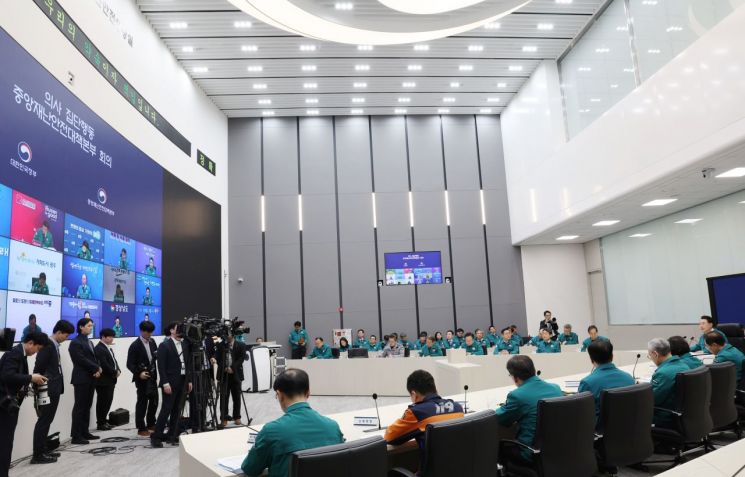 President Yoon Suk-yeol is presiding over the Central Disaster and Safety Countermeasures Headquarters meeting responding to the medical professionals' collective action at the Central Disaster and Safety Situation Room in the Government Complex Sejong, Sejong Special Self-Governing City, on the 6th. [Image source=Yonhap News]
© The Asia Business Daily(www.asiae.co.kr). All rights reserved.
![Clutching a Stolen Dior Bag, Saying "I Hate Being Poor but Real"... The Grotesque Con of a "Human Knockoff" [Slate]](https://cwcontent.asiae.co.kr/asiaresize/183/2026021902243444107_1771435474.jpg)


















