 A large hospital in Seoul, unrelated to the content of the article. Photo by Jinhyung Kang aymsdream@
It was found that 8 out of 10 Japanese medical workers have thoughts of quitting.
On the 5th, the All-Japan Prefectural and Municipal Workers Union (abbreviated as Jichino) conducted a survey of 3,590 union members working in medical fields (nurses, nursing assistants, midwives, pharmacists, etc.), and 79% responded that they have thoughts of quitting. Regarding when they want to quit, responses included always (15%), often (24%), and sometimes (40%). This rate has been on the rise, from 69% in 2022 to 72% in 2023, and 79% this year. The top reasons for wanting to quit were excessive workload, staff shortages, and dissatisfaction with wages.
Seven out of ten (72%) answered that they work outside of their scheduled hours, and among them, 89% said they did not apply for overtime pay due to reasons such as feeling pressured by the company. 72% of respondents reported experiencing staff shortages, with nurses particularly complaining about a shortage at 79%. More than half, 64%, expressed dissatisfaction with their income.
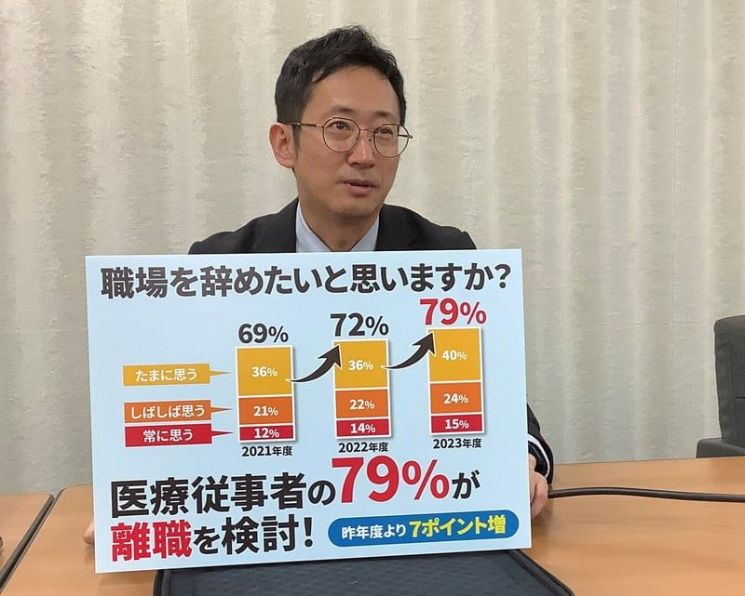 A representative from the All-Japan Prefectural and Municipal Workers Union is presenting the results of a survey conducted among medical staff. The panel shows that 79% of respondents expressed a desire to quit.
 [Photo by All-Japan Prefectural and Municipal Workers Union]
The proportion of people showing depressive symptoms rose by 9 percentage points from 27% last year to 36%. Among those with depression, 93% said they are considering changing jobs.
A Jichino official stated, "Although COVID-19 has ended, the survey results reflect issues such as excessive workload, staff shortages, and dissatisfaction with wages and treatment," adding, "Discussions on the reorganization and integration of public hospitals nationwide or the review of management styles may also be linked to employee anxiety." They continued, "To protect regional healthcare, securing medical personnel is necessary, and for this, improving wages and working conditions is essential," emphasizing, "It is necessary to ensure a definite wage increase even in public and publicly funded hospitals."
© The Asia Business Daily(www.asiae.co.kr). All rights reserved.
!["The Woman Who Threw Herself into the Water Clutching a Stolen Dior Bag"...A Grotesque Success Story That Shakes the Korean Psyche [Slate]](https://cwcontent.asiae.co.kr/asiaresize/183/2026021902243444107_1771435474.jpg)

















