Medical School Professors Also Shave Heads and Submit Resignation Letters
Acts Demonstrating Strong Will to Fight
"Shaving Heads Shows Commitment to the Cause"
As the collective resignation crisis of medical residents continues into its fifteenth day, medical school professors are protesting by submitting resignation letters or holding head-shaving ceremonies on the 5th. At a head-shaving event held in front of Kangwon National University College of Medicine in the morning, about ten professors from the university, led by Ryu Se-min, Dean of the College of Medicine and Graduate School of Medicine, and Yoo Yoon-jong, Associate Dean of Students, criticized the university's decision on the scale of enrollment increase and shaved their heads.
Earlier, Lee Pil-soo, president of the Korean Medical Association who had expressed his intention to resign, shaved his head in November last year in protest against the public discussion on expanding medical school quotas. In February last year, the “Health and Welfare Medical Solidarity,” composed of 13 health and medical organizations including the Medical Association and the Korean Association of Nursing Assistants, held a mass rally in front of the National Assembly condemning the ruling party's forced passage of the Nursing Act and Medical License Act. At this rally, Lee and representatives of the medical solidarity shaved their heads to reaffirm their determination, and street marches were also held. In December 2022, Lee also held a head-shaving ceremony to condemn the Supreme Court’s acquittal ruling on the use of ultrasound devices by Korean medicine doctors.
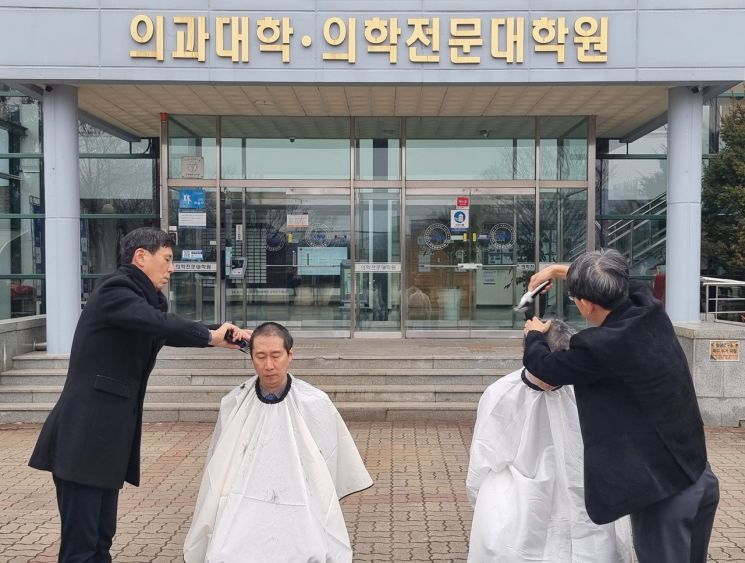 On the morning of the 5th, medical school professors are shaving their heads in front of the College of Medicine at Kangwon National University in Chuncheon, Gangwon Province, protesting the university's policy to increase enrollment.
 [Image source=Yonhap News]
Head-shaving primarily serves to demonstrate a strong will to fight and resolve to resist both internally and externally, while also strengthening solidarity. The origin of head-shaving lies in the political sphere and later spread to various sectors. During the intense period of candidate nominations for general elections, prospective candidates or supporters opposing nominations sometimes shave their heads in protest in front of party headquarters. Last month, the co-representative of the Incheon Citizens’ Coalition held a head-shaving ceremony demanding the establishment of a high court in Incheon. Bereaved families of the Itaewon tragedy shaved their heads demanding the promulgation of the Itaewon Tragedy Special Act, which was passed in the National Assembly under opposition party leadership.
Last year, about 20 politicians from the Jeonbuk region held a condemnation rally and shaved their heads in front of the National Assembly over the drastic cuts to social overhead capital budgets. The Namwon City Council and local figures shaved their heads urging the passage of the National Medical School Law. Kim Won-i and So Byung-chul, Democratic Party members representing Mokpo and Suncheon respectively, shaved their heads advocating for the establishment of new medical schools. In Gangwon Province, local figures shaved their heads demanding the passage of the Gangwon Special Act. In June last year, a member of the Wonju City Council performed a head-shaving act during a plenary session, which drew criticism as a political show.
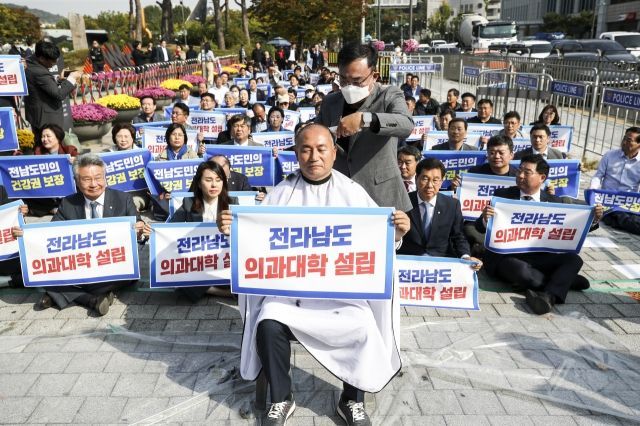 On the afternoon of October 18 last year, at a rally urging the establishment of a medical school in Jeollanam-do held in front of the Presidential Office in Yongsan, Seoul, Kim Won, a member of the Democratic Party of Korea, is shaving his head. [Image source=Yonhap News]
In civil society, last year the Buk-gu Girl Statue Peace and Human Rights Promotion Committee, a Gwangju residents’ group, resolved to stop Japan’s discharge of radioactive contaminated water into the ocean, and during the general strike of the Health and Medical Workers’ Union, representatives of the Busan National University Hospital union and irregular workers’ union each held head-shaving ceremonies.
In 2019, the British BBC published an article titled “Why Do Korean Politicians Shave Their Heads?” At that time, Hwang Kyo-ahn, leader of the Liberty Korea Party, shaved his head to stand at the forefront of the “anti-Jo Guk” front opposing the appointment of Minister of Justice Cho Kuk, and two female politicians also shaved their heads, attracting attention. The BBC explained, “In Korea, there is a long tradition of shaving one’s head as a form of protest,” adding, “This act is rooted in traditional Confucian teachings and has historically been regarded as a way to demonstrate dedication to a cause.” It noted that in the 1960s and 1970s, it was used as a form of protest against military dictatorship regimes, and now politicians and civic activists use it as a means of protest.
© The Asia Business Daily(www.asiae.co.kr). All rights reserved.
![User Who Sold Erroneously Deposited Bitcoins to Repay Debt and Fund Entertainment... What Did the Supreme Court Decide in 2021? [Legal Issue Check]](https://cwcontent.asiae.co.kr/asiaresize/183/2026020910431234020_1770601391.png)
















