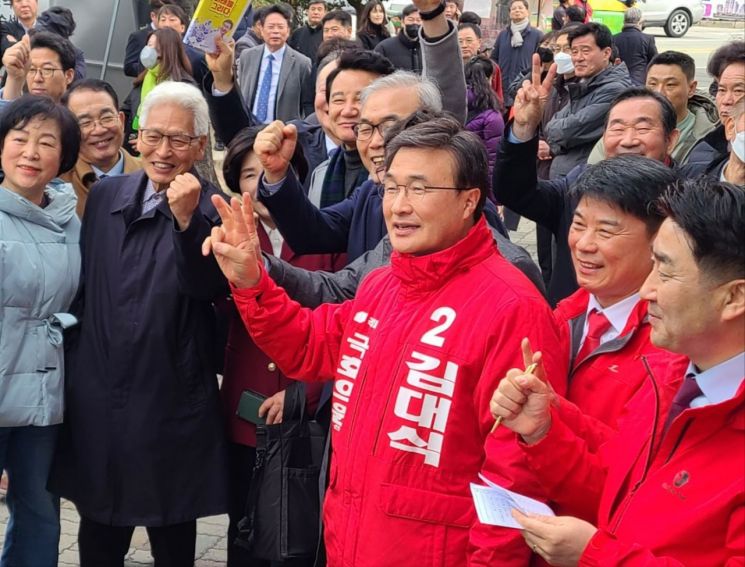
Kim Dae-sik, the People Power Party candidate, announced a pledge to attract a public institution specializing in safety and health to Sasang-gu.
Through his pledge, Kim promised on the 18th to take the lead in establishing infrastructure for industrial accident prevention in response to the enforcement of the Serious Accident Punishment Act and the strengthening of industrial safety and health policies.
He stated, “I empathize with the confusion and concerns of employers and workers due to the enforcement and expanded application of the Serious Accident Punishment Act,” adding, “Safety is no longer optional but essential, and it is an absolute necessity to have a protective network for national-level industrial accident prevention at this time.”
Kim also said, “We must create safer and healthier workplaces for the residents of Sasang-gu, who contribute to Busan’s economic development, and for all workers in Busan,” and pledged, “I will devote my efforts to attracting a government public institution to Sasang-gu.” He plans to establish either the Busan Northern Branch or the Western Busan Branch of the Korea Occupational Safety and Health Agency to continuously expand Busan’s industrial accident prevention infrastructure.
According to Kim Dae-sik’s communication camp and the Korea Occupational Safety and Health Agency, the Serious Accident Punishment Act was expanded to apply to workplaces with 5 to fewer than 50 employees as of January 27. This followed the death of Kim Yong-gyun at a thermal power plant in 2018, leading to a complete revision of the Industrial Safety and Health Act in January 2021, and the sequential enforcement and expanded application of the “Serious Act.”
As public awareness of industrial safety has increased day by day, the government announced a roadmap for reducing serious accidents over the next five years in line with the enforcement of the Serious Act in 2022, aiming to advance to an industrial safety advanced country. Efforts are focused on systematizing safety in the working environment and methods.
Candidate Kim Dae-sik pointed out the reality of insufficient safety infrastructure, saying, “Safety is more important than ever, and high safety demand is expected in industrial sites, but in Busan, only one government public institution is responsible for the safety of 1.15 million workers across all workplaces.”
He added, “There are 2 to 3 branches of the Korea Workers’ Compensation and Welfare Service, which is responsible for industrial accident compensation, and the Human Resources Development Service of Korea, which guides workers’ skill development, in Busan, but the ‘safety’ control tower, which is equally important, is lacking.”
According to the Busan Metropolitan Headquarters of the Korea Occupational Safety and Health Agency, as of September 2023, there are 180,000 workplaces and 1.15 million workers in the jurisdiction. Among them, the northern Busan area (Sasang, Gangseo, Buk-gu), where manufacturing and service industries are concentrated, has about 44,000 workplaces, accounting for 25% of the total, with 280,000 workers employed.
Regarding industrial accident status, Busan has had an average of about 6,500 accident victims annually over the past five years, with 100 deaths from accidents and diseases. The northern Busan area recorded about 2,000 accident victims and 30 deaths. Although the area accounts for about 25% of workplaces, it accounts for 30% of industrial accidents.
Kim said, “As of February this year, looking at Busan’s industrial accident prevention infrastructure, the Ministry of Employment and Labor has three branch offices (Busan Office, Eastern, and Northern Branches), but the Korea Occupational Safety and Health Agency is conducting prevention projects such as technical and financial support and education only through the Busan Metropolitan Headquarters,” and pledged, “I will ensure the establishment of at least one additional branch of the Korea Occupational Safety and Health Agency.”
© The Asia Business Daily(www.asiae.co.kr). All rights reserved.

















