Proportional Representation Decided by Document Screening and Interview
Different from Past All-Member and Central Committee Votes
Recommendation Committee: "Tight Schedule Due to Proportional Party Participation... Procedures Established"
The Democratic Party of Korea, which has been suffering from aftereffects due to nomination controversies, is now embroiled in a dispute over the proportional representation candidate selection method of its satellite party for proportional representation, 'The Democratic Union.' Unlike the previous method decided by voting of central committee members, the decision was made through interviews conducted by the Strategic Nomination Management Committee, leading to political criticism of 'closed-door nominations.'
On the 5th, Democratic Party lawmaker Woo Sang-ho pointed out via social media (SNS) that "Four years ago, the preliminary selection of proportional representation applicants was conducted through a vote by all party members, with the final ranking decided by a vote of central committee members. However, this time, the decision is made through the Strategic Nomination Management Committee's screening," adding, "This method is the old way where a small group decides candidates behind closed doors. It is far from innovation."
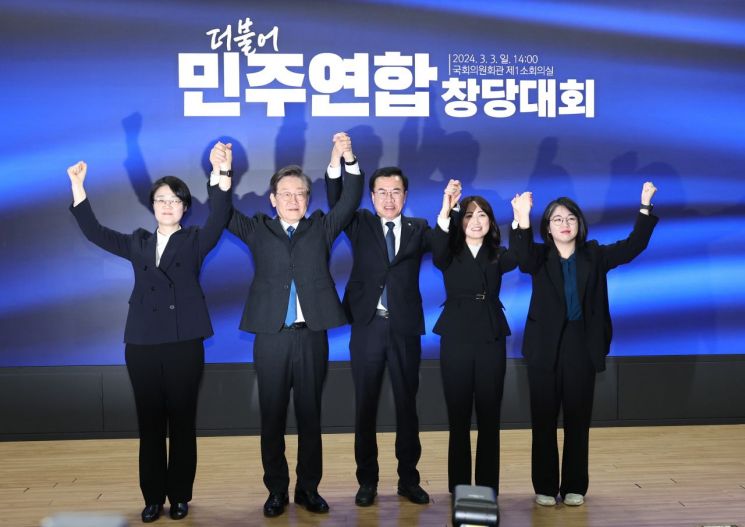
The Democratic Party, which planned to receive applications for proportional representation candidates until the 6th, is currently conducting application procedures in eight fields including women, welfare, and the disabled. Proportional representation candidates are selected through document screening and interviews conducted by external screening committee members. Unlike in the past, when proportional representation candidate selection was decided through votes by all party members and ranking confirmation at the central committee level, this time it is conducted at the Strategic Nomination Management Committee level and finalized through reporting to the Supreme Council.
Regarding this, Kim Seong-hwan, the secretary of the Democratic Party's Proportional Candidate Recommendation Committee, explained the selection method in a phone interview with Asia Economy on the same day. Kim said, "The proportional representation selection involves document screening and interviews, with only myself as an insider among the screening committee members; all others are external," and added, "The scoring sheets are used in the same way as before." He explained, "Four years ago, according to the party constitution and regulations, we were proceeding with procedures to nominate Democratic Party candidates but later joined the proportional party, so we could not stop the ongoing procedures at that time." He continued, "This time, the decision to participate in the proportional party was made first, but since the method of selecting proportional candidates was not decided, it was difficult to follow separate procedures according to the party constitution and regulations." He added, "We had to finalize candidates within two weeks. Despite the tight deadline, internal democratic procedures had to be followed, reflecting these circumstances."
Additionally, the nomination of Kwon Hyang-yeop, Democratic Party Policy Committee Vice-Chairman, for the women’s special district in the electoral district covering Suncheon-si, Gwangyang-si, Gokseong-gun, and Gurye-gun in Jeollanam-do, has also sparked controversy. Kwon, a former party official, was responsible for the schedule and accompaniment of Kim Hye-kyung, wife of Democratic Party leader Lee Jae-myung, during the last presidential election, raising suspicions that this connection influenced the nomination.
In response, the Democratic Party stated, "The candidate has no personal relationship with the leader’s spouse and was only appointed as deputy head of the spouse office in the presidential election campaign headquarters, not as a secretary." They introduced her background, saying, "She has worked as a party official for over 20 years, including as head of the Central Party Women’s Bureau and Digital Media Bureau, and served as Secretary for Balanced Personnel in the Presidential Secretariat under the Moon Jae-in administration and as chief secretary to the National Assembly Vice-Chairman." Regarding the designation of the electoral district as a women’s special district, the party rebutted, "Considering that there were no female lawmakers in the Jeonnam region, no female candidates participated in the primary for this general election, and the party constitution and regulations stipulate a 30% quota for female nominations, the Nomination Management Committee requested a strategic nomination of a female candidate in the district, which was reflected in the screening results."
© The Asia Business Daily(www.asiae.co.kr). All rights reserved.

















