JP Morgan "Stock Market and Bitcoin Show Signs of a Bubble"
Goldman "High Value in Growth Stocks"
There is a bubble debate on Wall Street regarding the recently continuing rally in the U.S. stock market. As the S&P 500 and Nasdaq indices hit all-time highs last week, strategists from two major investment banks, JP Morgan Chase and Goldman Sachs, have presented opposing views, drawing market attention.
With rising expectations for companies related to artificial intelligence (AI), the S&P 500 closed at 5137.08 on the 1st (local time), surpassing the 5100 mark for the first time. On the same day, the Nasdaq closed at 16,274.94. Although the market took a breather on the 4th (local time) with major indices falling from previous levels, market optimism remains strong, as evidenced by Nvidia's stock rising 3.6%.
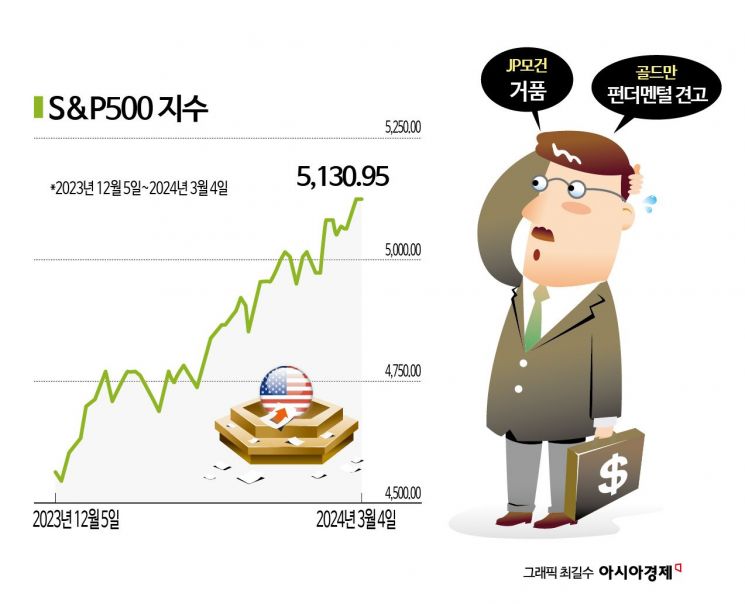
According to Bloomberg, Marco Kolanovic, Chief Market Strategist at JP Morgan Chase, analyzed that the recent market conditions, including the U.S. stock market rally and Bitcoin surpassing $60,000 for the first time since November 2021, signal that a bubble is building in the market. Generally, asset prices rising at an unsustainable pace are a precursor to a bubble. He warned that this situation is reminiscent of the late 1990s dot-com boom, when stock prices surged rapidly and then fell, or the post-pandemic boom after 2021.
In a memo sent to clients that day, Kolanovic stated, "The market is moving forward with low volatility and bubble formation." He added, "Despite rising bond yields and the fading expectation of rate cuts, stocks have risen this year. Investors may assume that the increase in yields reflects economic growth, but earnings forecasts for 2024 are declining, and the market seems too complacent about the cycle." Kolanovic also said, "Continued stock price increases risk further asset price inflation due to premature rate cuts or a resurgence of inflation," and "monetary policy may need to be maintained at a higher level."
On the other hand, David Kostin, a strategist at Goldman Sachs, argued that the high valuations of big tech stocks are supported by fundamentals. This differs from periods like the dot-com bubble when stocks surged beyond their actual value.
Kostin said, "Unlike the 2021 mindset of growing at any cost, investors are mostly paying high valuations for the largest growth stocks in the index," adding, "I believe the current value of the 'Magnificent 7' (the seven major tech stocks) is supported by fundamentals."
The companies leading the market this year include Nvidia, Meta, and Microsoft. According to data compiled by Bloomberg Intelligence, their earnings per share increased by a total of 59% year-over-year in the fourth quarter of last year.
Kostin noted that companies with a price-to-sales ratio above 10 account for about 24% of the total U.S. stock market capitalization. This is lower compared to 28% in 2021 and 35% during the dot-com bubble period.
However, he also pointed out a variable. He said, "Continued stock price increases could prolong monetary (tightening) policy," explaining, "There is a risk that early rate cuts could further inflate asset prices or cause inflation to rise again."
© The Asia Business Daily(www.asiae.co.kr). All rights reserved.

















