"Uncertainty Grows... Will Monitor Market Reaction After Inha"
A Federal Reserve (Fed) official expressed the view that after the Fed lowers the benchmark interest rate for the first time in the third quarter of this year, it will temporarily pause rate cuts to observe the policy's effects. It is anticipated that if inflation and the slowdown in the labor market stagnate or overheat beyond expectations, the Fed will adjust the pace of its monetary easing policy.
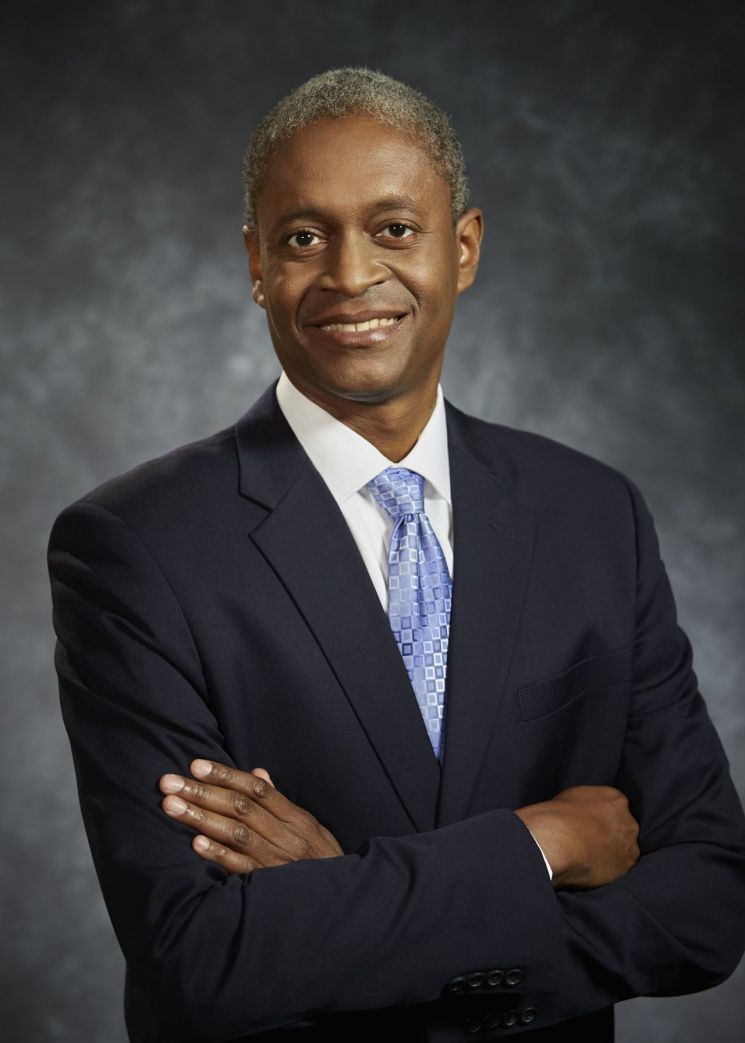
Raphael Bostic, President of the Federal Reserve Bank of Atlanta, stated on the Fed's website on the 4th (local time), "I do not expect them (the Fed) to cut rates consecutively," adding, "Given the uncertainty, it is better to take action first and then observe the responses of market participants such as businesses and households."
He also viewed that it would be appropriate for the Fed to cut rates twice by 0.25 percentage points each by the end of this year.
Previously, the Fed lowered rates in the mid-1990s, then held rates steady for three meetings before cutting rates again. In this tightening cycle, the Fed began 'elevator-style' rate hikes starting in March 2022. Based on President Bostic's outlook, if the Fed reverses its tightening policy this year, it is also expected that rate cuts could occur in a stepwise, 'escalator-style' manner. This implies that if the Fed returns to an accommodative monetary policy, predicting the magnitude and speed of rate cuts could become difficult.
President Bostic diagnosed that companies are currently in an overheated state, increasing spending and investment. He believes that if the Fed lowers rates in such a situation, new demand could surge sharply, leading to upward pressure on prices. He said, "In recent weeks, I have spoken with corporate decision-makers and heard about the optimism they expect," adding, "This threat, which I call suppressed overheating, is a new upside risk that must be thoroughly investigated in the coming months."
He reaffirmed the Fed officials' existing stance that more evidence of further inflation slowdown is necessary. He said, "More progress is needed to be fully confident that inflation is on a clear path to an average of 2%," and "Only when we gain this confidence will we feel it is the appropriate time to begin cutting the federal funds rate."
Regarding balance sheet reduction, which signifies quantitative tightening, he expressed the view that maintaining the current pace is desirable. President Bostic said, "In terms of quantitative tightening, we should maintain the current pace as long as possible," adding, "I think it is appropriate to return to normal after moving away from the most urgent moments."
President Bostic, who holds voting rights at this year's Federal Open Market Committee (FOMC), made these remarks ahead of Fed Chair Jerome Powell's semiannual monetary policy report scheduled for June 6-7. Following stronger-than-expected inflation data in January, Chair Powell is expected to reaffirm a cautious stance, indicating no rush to cut rates.
© The Asia Business Daily(www.asiae.co.kr). All rights reserved.
![Clutching a Stolen Dior Bag, Saying "I Hate Being Poor but Real"... The Grotesque Con of a "Human Knockoff" [Slate]](https://cwcontent.asiae.co.kr/asiaresize/183/2026021902243444107_1771435474.jpg)











