After Last Week's Rally, Market Takes a Wait-and-See Approach
Powell to Testify Before Congress on 6th-7th
February Employment Report to Be Released on 8th
The three major indices of the U.S. New York stock market are all falling in early trading on the 4th (local time). After last week's rally, during which the S&P 500 and Nasdaq indices reached all-time highs, the market is taking a breather. Investors are watching the market while awaiting messages from Jerome Powell, Chairman of the U.S. Federal Reserve (Fed), and employment data scheduled for this week.
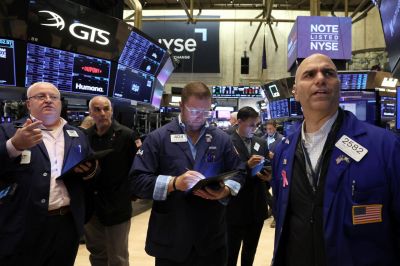
As of 9:35 a.m. at the New York Stock Exchange (NYSE), the Dow Jones Industrial Average is trading at 38,964.23, down 0.32% from the previous trading day. The large-cap focused S&P 500 index is down 0.13% at 5,130.25, and the tech-heavy Nasdaq index is down 0.18% at 16,246.25.
By individual stocks, ride-sharing company Lyft is up 6.91% following an upward revision of its target price by RBC Capital. Super Micro Computer and Deckers Outdoor are rising 15% and 3.44%, respectively, on news of their inclusion in the S&P 500 index this month. Apple is down 1.9%. On this day, the European Union (EU) Commission found Apple guilty of violating antitrust laws related to its music streaming service and imposed a fine of 1.84 billion euros (approximately 2.66 trillion Korean won). Following the news of the termination of the merger plan between JetBlue and Spirit Airlines, JetBlue rose 3.79%, while Spirit Airlines fell 8.82%.
The New York stock market has been rallying over the past few weeks amid growing expectations for artificial intelligence (AI). The Nasdaq index closed at 16,279.94 on the previous trading day, the 1st, setting a new all-time high both intraday and at the close. The S&P 500 also closed at 5,137.08, breaking through the 5,100 level for the first time.
David Kostin, Chief U.S. Equity Strategist at Goldman Sachs, said, "The recent rally has brought the market capitalization of very highly valued stocks to a level similar to the euphoric moments of 2021," but he added, "However, the current extreme valuation dispersion does not appear to be as widespread as in 2021."
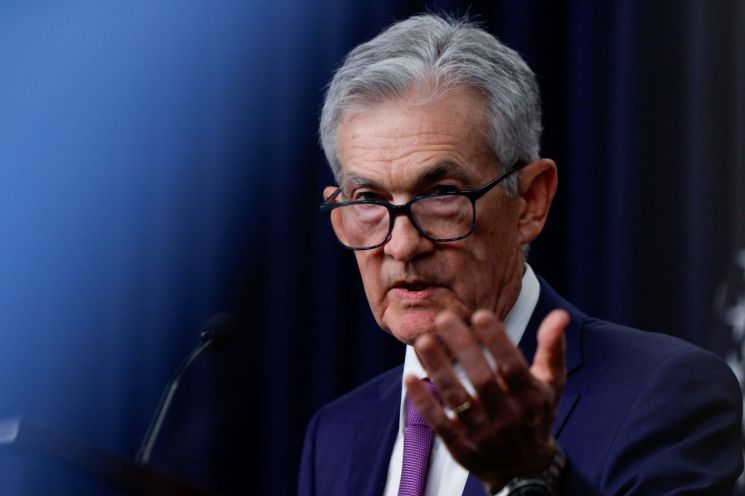
After digesting corporate earnings that exceeded expectations last month and hot inflation data, market attention is now focused on Chairman Powell's remarks and employment data. Powell is scheduled to appear before the House on the 6th and the Senate on the 7th for two consecutive days to report on monetary policy. He is expected to discuss the overall state of the U.S. economy, the fight against inflation, and his views on the timing of interest rate cuts. The market will likely try to gauge the Fed's future interest rate path through these remarks. Since the January inflation data came in stronger than expected, Powell is likely to reaffirm his stance against rushing rate cuts.
Anna Wong, an economist at Bloomberg Economics (BE), said, "Chairman Powell will send a signal to Congress that he will not rush rate cuts and maintain a hawkish stance," adding, "If financial conditions tighten further, pressure on the economy will continue, and monetary policy is more likely to have additional sustained (economic) effects."
The February employment report to be released by the U.S. Department of Labor on the 8th is also a key point to watch. The market expects nonfarm payrolls to increase by 200,000 last month, a significant decrease compared to January's 353,000. Above all, since January's U.S. nonfarm payrolls exceeded the forecast of 185,000 by more than double, confirming an overheated labor market, attention is on whether the February employment report will show signs of labor market cooling. The unemployment rate for February is expected to remain at 3.7%, the same as January.
The U.S. Department of Labor's January Job Openings and Labor Turnover Survey (JOLTS) and the private employment data from ADP for February will also be released on the 6th. The number of job openings in U.S. companies is expected to have decreased from 9.026 million in December last year to 8.895 million in January this year.
Government bond yields are rising. The U.S. 10-year Treasury yield, a global bond yield benchmark, is up 4 basis points (1 bp = 0.01 percentage points) to 4.22%, and the 2-year Treasury yield, sensitive to monetary policy, is up 4 basis points to 4.57%.
International oil prices are slightly rising on news that OPEC+ (the Organization of the Petroleum Exporting Countries (OPEC) member countries and non-OPEC allies) will extend production cuts until mid-year. West Texas Intermediate (WTI) crude is up 0.29% to $80.20 per barrel, and Brent crude is up 0.37% to $83.86 per barrel.
© The Asia Business Daily(www.asiae.co.kr). All rights reserved.
![Clutching a Stolen Dior Bag, Saying "I Hate Being Poor but Real"... The Grotesque Con of a "Human Knockoff" [Slate]](https://cwcontent.asiae.co.kr/asiaresize/183/2026021902243444107_1771435474.jpg)











