A child filed a lawsuit claiming that they were the true owner despite borrowing their mother's name, after a large inheritance tax was imposed on the apartment sale proceeds gifted by the mother before her death, but lost in the first trial.
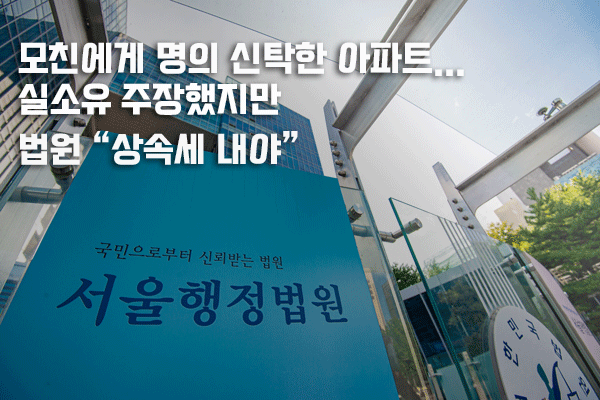
According to the legal community on the 3rd, the Administrative Division 5 of the Seoul Administrative Court (Presiding Judge Kim Sun-yeol) ruled against plaintiff A in the inheritance tax imposition cancellation lawsuit filed against Anyang Tax Office and Dongjak Tax Office on November 30 last year (2023GuHap51779).
After A’s mother B passed away, A reported 17.46 million KRW in inheritance tax in May 2020. However, the tax authorities imposed an additional inheritance tax and penalty of about 100 million KRW in November 2021, citing prior gifted assets. The investigation revealed that B had gifted 336 million KRW from the apartment sale proceeds to her children and grandchildren. It was also found that B had handed over checks worth about 50 million KRW, received as rental deposits from tenants, to her children.
In court, A argued that "the apartment was acquired under the mother’s name only (nominee trust)" and that "the sale proceeds and checks are personal assets and do not constitute prior gifted assets." In fact, in 2013, A had prepared a contract for the succession of rights and obligations for an apartment in Seoul that A owned and completed the ownership transfer registration to B. B sold the apartment in 2017 and received 375 million KRW as sale proceeds.
The court did not accept A’s claims. The court stated, "Since B completed the ownership transfer registration, unless there are special circumstances, the real estate is presumed to have been owned by B," and "there is no evidence to recognize a nominee trust."
Furthermore, the court said, "It appears that the plaintiff (A) completed the ownership transfer registration for convenience to assist the elderly decedent mother with tasks such as leasing the real estate, and there is no evidence to consider that the plaintiff held ownership of the real estate."
The court also found that A failed to explain why the sale proceeds were deposited into accounts of A’s siblings or children despite the apartment being A’s property. The court noted, "Checks and cash were withdrawn from B’s account, most of which belonged to the children and grandchildren," and "the plaintiff has not provided a convincing explanation as to why a significant portion of the sale proceeds of the real estate in question belonged to persons other than the plaintiff."
A filed an appeal against the first trial ruling.
Hong Yoon-ji, Legal Times Reporter
※This article is based on content supplied by Law Times.
© The Asia Business Daily(www.asiae.co.kr). All rights reserved.
![Clutching a Stolen Dior Bag, Saying "I Hate Being Poor but Real"... The Grotesque Con of a "Human Knockoff" [Slate]](https://cwcontent.asiae.co.kr/asiaresize/183/2026021902243444107_1771435474.jpg)
















