2024 Ministry of Agriculture, Food and Rural Affairs Major Business Promotion Plan
'Digital, Rural Space, and Generational' Three Major Transformations
The government has decided to significantly expand investments in farmland, funding, and housing for young people who wish to start businesses in agriculture and related industries this year. Additionally, in response to the crisis of rural extinction, it will introduce and refine systems such as tax benefits for second houses, promote the smooth implementation of ending dog meat consumption, realize animal welfare at the level of advanced countries, and foster pet-related industries.
The Ministry of Agriculture, Food and Rural Affairs (MAFRA) announced the '2024 Major Work Plan' containing these details on the 4th.
MAFRA evaluated that this year, advanced technologies and convergence with other industries are increasing youth employment and entrepreneurship in smart agriculture across the agri-food sector, while economic opportunities for urban residents are also expanding. On the other hand, high interest rates, high inflation, international instability, frequent and severe natural disasters are occurring. Moreover, issues such as rural population decline, aging, and weakening rural regional growth engines due to disparities between regions and industries are intensifying. To create a turning point for agriculture and rural areas facing both opportunities and crises, it is necessary to comprehensively innovate technology, workforce, and regulations, and thus this work direction was established.
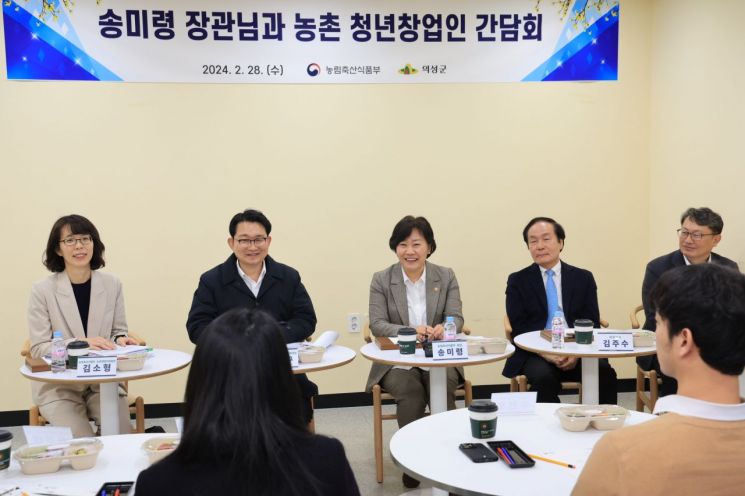 Song Miryeong, Minister of Agriculture, Food and Rural Affairs, visited Uiseong-gun, Gyeongsangbuk-do on the 28th of last month to discuss rural extinction issues with young entrepreneurs and to observe the workation operation status at 'Geumsujang,' a youth complex residential space prepared by Uiseong-gun.
First, MAFRA plans to focus on transforming agriculture into a high-income, advanced industry by promoting the convergence of advanced technologies such as information and communication technology (ICT) and artificial intelligence (AI) across the agri-food chain, nurturing young farmers, and creating synergistic effects with new industries like food tech.
In production sectors such as greenhouses, livestock, and open fields, the plan is to transition from first-generation smart agriculture centered on hardware to second-generation AI-based smart agriculture by disseminating excellent solutions (1,100 units, 6.2 billion KRW) focusing on production technology, pest control, and odor removal, and expanding breeding models by livestock type (7.9 billion KRW → 18 billion KRW). For rapidly growing vertical farms domestically and internationally, related regulations will be significantly improved to accelerate technological innovation, including extending temporary use permits for other purposes (8 → 16 years) and allowing installation on farmland within rural specialized zones.
The core of future growth industrialization in agriculture is youth. The goal is to nurture 22,000 young farmers this year, up from about 18,000 last year, by providing tailored support including farmland, facilities, funding necessary for youth entrepreneurship, and initial income needed for settlement. To this end, farmland supply through various methods such as public rental, lease rental, and lease-first-sell-later for young people will be expanded by 45% compared to last year. The number of agricultural start-up support targets will increase (4,000 → 5,000), the youth farmer preferential guarantee (95%) limit will be raised (300 million KRW → 500 million KRW per person), rental-type smart farms (9 → 13 locations), and rural housing (9 → 17 locations) will also be significantly increased. A one-stop service support system for young people wishing to start businesses in agriculture-related industries such as food processing, tourism, and dining will be established in June this year, and an additional fund (200 billion KRW) will be created to support start-ups and commercialization of young agri-food companies.
Furthermore, to enhance convergence and synergy effects between agriculture and the food industry, three food tech research support centers will be established, and dedicated funds (10 billion KRW → 20 billion KRW) and research and development projects (38 projects, 11.4 billion KRW) will be expanded. In the green bio sector, research and production base institutions (9 → 11) and venture campuses (4 → 5 locations) will be expanded.
To achieve K-Food+ exports of 13.5 billion USD, including K-Food and related industries, the plan is to foster key items and actively develop emerging markets. Along with nurturing a second strawberry industry and modernizing logistics systems (58.5 billion KRW), efforts will be made to attract international gourmet events and expand excellent Korean restaurants (13 → 30 locations). An agricultural diplomacy strategy to pioneer new markets such as Southeast Asia and the Middle East will be established in October this year. Additionally, based on achievements in summit diplomacy, exports of front- and back-end industries such as smart farm packages targeting emerging markets like the Middle East will be expanded to 3.5 billion USD.
Establishing Income and Management Safety Nets and Strengthening Food Security
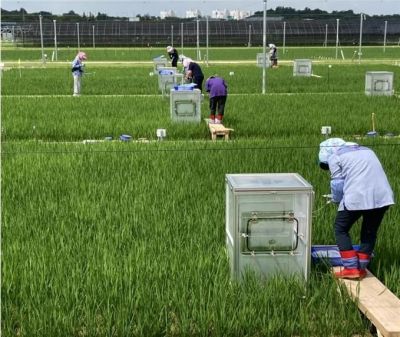
MAFRA will actively build a Korean-style income and management safety net by expanding risk management systems such as agricultural direct payments and disaster insurance. It also plans to continue increasing self-sufficiency rates focusing on strategic crops such as rice flour and wheat.
Specifically, a basic plan for the public interest direct payment system will be prepared in the second half of this year, including expanding various selective direct payment programs, and the number of items covered by import insurance will be increased (7 → about 10 items). In addition, improvements to recovery support for agricultural disasters will be prepared in cooperation with related ministries, including realistic damage recovery unit prices and additional support items to respond to extreme weather.
To alleviate the burden of rising operating costs due to raw material price increases, support will be provided for the price difference of inorganic fertilizer price hikes (28.8 billion KRW), loans for feed purchase funds for livestock farmers (1 trillion KRW), and fuel subsidies for facility farms (7 billion KRW). To ease labor shortages on farms, the allocation of foreign workers and public seasonal labor centers will be greatly expanded (19 → 70 centers), and worker dormitory installations (10 centers) will also be increased.
To raise self-sufficiency rates for major grains such as rice flour, the strategic crop direct payment unit price will be increased and items expanded, and production complexes and stockpiles will be enlarged. For rice, a three-stage supply stabilization system ('before transplanting - growth - post-harvest') will be established, and food aid and public stockpiles (400,000 → 450,000 tons) will be expanded. The popular 'Thousand Won Breakfast' program will have its support unit price and target recipients significantly increased so that more students can benefit.
Strengthening Management of Agricultural Products with Supply and Demand Instability
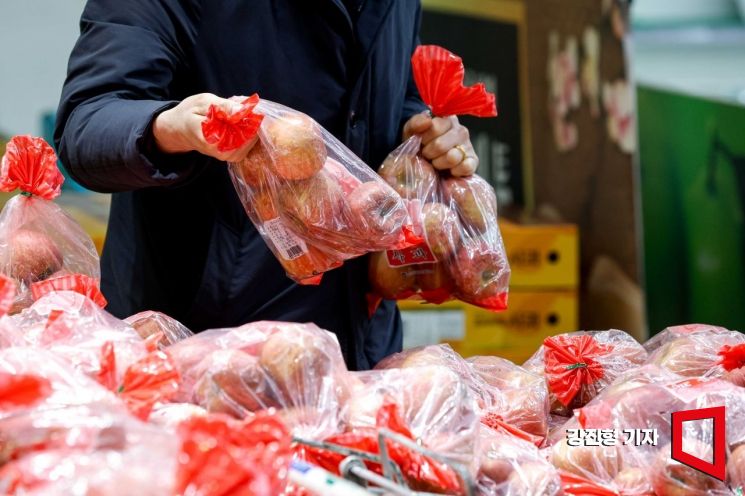 A customer is purchasing apples at Hanaro Mart Yangjae Branch in Seocho-gu, Seoul. Photo by Jinhyung Kang aymsdream@
To minimize difficulties faced by producers and consumers due to agricultural product price instability, supply and demand management, which previously relied on after-the-fact measures, will be transformed into a proactive and autonomous response system through cooperation with producers and local governments.
For apples and pears, which suffered severe cold damage last year, a growth management council (launched in January this year) will systematically respond to supply and demand instability factors such as weather, and preemptive measures such as wind fans and nutrients will be promoted. Additionally, a plan to enhance competitiveness in the fruit industry considering climate change, including expanding disaster prevention facilities, will be prepared within this month.
Items expected to have short-term supply instability will be the focus for expanding pre-management of appropriate cultivation areas (garlic, onion → winter radish added) and participating local governments (3 → 6 cities/provinces). The vegetable price stabilization system will be improved by raising compensation rates to increase farmer participation, and the Agricultural Commodity Management Act will be amended to clarify the roles and functions of self-help funds organizations. The online agricultural wholesale market will be activated to handle a scale of 500 billion KRW by increasing membership and volume, reducing distribution costs by about 10%.
To reduce agriculture's environmental burden, a carbon-neutral program that pays direct payments for low-carbon farming activities will be introduced for the first time (9 billion KRW). The eco-friendly concentrated districts will also be expanded (36 → 51 locations). In livestock, government-supported composting facility greenhouse gas reduction devices will be mandated (April this year), and biochar (2 → 3 locations) and energy facilities (8 → 10 locations) will be expanded to establish a low-carbon base in manure processing. Along with supplying feed that reduces greenhouse gases, the low-carbon livestock product certification target will be expanded to three species (from Korean beef to pork and milk).
Making Rural Areas Places to Live, Work, and Rest
MAFRA will transform the framework of rural policy based on the new rural policy platform, the Rural Spatial Planning System, to promote a virtuous cycle of inflow of human and physical capital, creation of jobs and socio-economic services, and revitalization of rural areas.
To expand the inflow of external population and capital into rural areas, systems such as activating lodging using vacant houses, extending experimental exceptions for lodging businesses, tax benefits for second houses in high-risk extinction areas (in consultation with related ministries), and introducing autonomous regulatory innovation zones will be introduced and refined. Farmland systems will also be improved to meet demand by lifting restrictions on promotion areas under 3 hectares (21,000 hectares) and allowing rural stay-type rest areas.
At the same time, full-scale restructuring will begin so that rural areas can become new opportunity spaces for all citizens. Rural agreements will continue to expand (75 → 95 agreements) centered on rural spatial planning, and the rural agreement system will be significantly improved, including integrated project support.
Ensuring Smooth Implementation of Ending Dog Meat Consumption and Realizing Advanced Animal Welfare
The government plans to raise animal welfare systems and infrastructure to advanced country levels based on the momentum of ending dog meat consumption and foster pet-related industries such as pet food and animal medical care as new growth engines.
To ensure the smooth implementation of ending dog meat consumption, MAFRA and provincial and municipal governments will establish dog meat consumption termination task forces to thoroughly carry out farmer reporting (~May) and submission of implementation plans (~August) according to the Special Act on Ending Dog Meat Consumption. Reasonable support measures for breeding farms will be prepared while communicating with related industries. The basic plan for ending dog meat consumption will be established in September this year.
By the end of the year, the '3rd Comprehensive Animal Welfare Plan (2025?2029)' will be formulated, containing mid- to long-term directions on strengthening penalties for animal abuse and reforming the medical system in line with raising animal welfare awareness. The implementation of newly introduced systems such as permits for raising dangerous dogs (April), temperament evaluation (April), pet behavior instructors (April), and registration of breeding parent dogs (April, with a two-year grace period) will be thoroughly prepared.
In the second half of this year, to systematically foster pet-related industries such as pet food and animal medical care, a 'Pet-Related Industry Promotion Act' will be prepared. Additionally, the standardization of animal hospital treatment procedures and expansion of posted treatment fee items (11 → 20 items) will be implemented, and the introduction of specialized veterinarians and advanced animal hospitals (secondary hospitals) will be considered to meet professional animal medical demands.
Song Mi-ryeong, Minister of Agriculture, Food and Rural Affairs, said, "Despite difficult conditions such as economic uncertainty, expectations for the development potential of agriculture and related industries and future-oriented agricultural policies are higher than ever. Based on three major transitions?digital transformation, generational transition, and rural spatial transformation?we will demonstrate leadership to solve field problems through proactive regulatory innovation, removal of silos, and inter-ministerial cooperation, and become a warm MAFRA that provides the best policies and services to the public."
© The Asia Business Daily(www.asiae.co.kr). All rights reserved.



















