'Birth Support Seoul Project' Initiative
20 Communities and 92 Locations Newly Selected
Expansion to 100 Communities Next Year
The 'Seoul-type Moa Daycare Centers,' a flagship childcare pledge project of Seoul City, will begin additional operations. A total of 92 daycare centers were newly selected across 20 autonomous districts and 20 communities, including daycare centers facing closure this year due to a decrease in enrolled children.
On the 4th, Seoul City announced that the recruitment of new communities for the 'Seoul-type Moa Daycare Centers' this year concluded with a competition rate of 3.3 to 1. The public recruitment was held from January 31 to February 13, and Seoul City finalized the selection of daycare centers through quantitative and qualitative evaluations based on current and target enrollment status, distance between daycare centers, specialized childcare operation performance, joint program business plans, and the willingness of autonomous districts to participate.
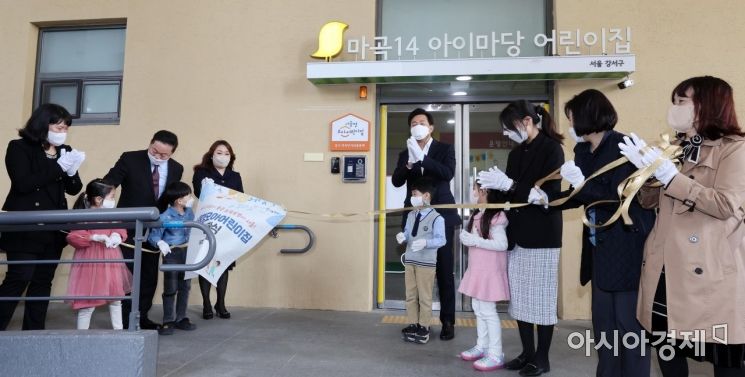 On the 22nd, Seoul Mayor Oh Se-hoon held a plaque ceremony for the Seoul-type Shared Daycare Center 'Moa Daycare Center' at Magok Complex 14, Aimadang Daycare Center in Gangseo-gu, Seoul. The Seoul-type Shared Daycare Center, a childcare pledge project by Mayor Oh Se-hoon, is a childcare model that groups 3 to 5 nearby national, public, private, and home daycare centers into one community to raise children together. Photo by Kim Hyun-min kimhyun81@
As a result, the 'Seoul-type Moa Daycare Centers' will expand from the existing 60 communities and 235 daycare centers to a total of 80 communities and 327 daycare centers. Seoul City plans to increase this to 100 communities next year.
The 'Seoul-type Moa Daycare Centers' is a new representative childcare model of Seoul City under Mayor Oh Se-hoon, which groups 3 to 5 national, public, private, and home daycare centers within walking distance into one community to raise children together. Following the 'Seoul City Childcare Mid- to Long-term Master Plan' announced in 2021, it has been gradually expanded from 14 communities in 8 districts in 2021, to 40 communities across all autonomous districts in 2022, and to 60 communities in 2023.
Notably, this year, six daycare centers (four communities) facing closure due to a decrease in enrolled children (enrollment fulfillment rate below 50%) were selected for the first time. Amid the increasingly serious low birthrate issue, it is expected that daycare centers struggling with a decline in young children will be able to provide high-quality childcare services without interruption through coexistence and cooperation with other daycare centers within the community.
Additionally, communities including daycare centers for children with disabilities and multicultural daycare centers (9 communities) were selected to practice 'walking with the vulnerable.' With participation from hub-type nighttime extension programs (8 centers) and dinner support daycare centers within the community, various benefits will be shared among the enrolled children in the community.
Programs linked with specialized institutions, such as parent coaching connected to child development centers and multicultural education outreach through Danuri Learning Centers, will also be operated. Seoul City will support each selected community with 5 million KRW for joint program operation costs and 500,000 KRW per daycare center for environmental improvement aimed at creating an eco-friendly environment. Kim Seon-soon, Director of the Seoul City Women and Family Policy Office, said, "The unique strengths of the 'Seoul-type Moa Daycare Centers,' such as cost reduction, shared enrollment, and joint implementation of childcare programs, are gaining attention and participation in the childcare field through word of mouth. This year, by newly selecting daycare centers facing closure due to the low birthrate, we expect to prevent childcare gaps and provide high-quality childcare services to enrolled children."
© The Asia Business Daily(www.asiae.co.kr). All rights reserved.
![Clutching a Stolen Dior Bag, Saying "I Hate Being Poor but Real"... The Grotesque Con of a "Human Knockoff" [Slate]](https://cwcontent.asiae.co.kr/asiaresize/183/2026021902243444107_1771435474.jpg)
















