Household Loan Balances at Major Banks Increase for 10th Consecutive Month in February... Growth Slows
Mortgage Loans Increase by 2.1744 Trillion KRW
Household Debt-to-GDP Ratio Ranks 4th After Switzerland, Australia, and Canada

The outstanding household loans of the five major domestic commercial banks have increased for 10 consecutive months until last month. With mortgage loan balances increasing by more than 2 trillion won, the total household loans rose by over 700 billion won. Although the increase was the smallest in eight months, given that South Korea's household debt-to-GDP ratio ranks among the highest in 42 advanced and emerging markets worldwide, there are calls for even more robust household debt management.
According to the financial sector on the 4th, the outstanding household loans of the five major commercial banks?KB Kookmin, Shinhan, Hana, Woori, and NH Nonghyup?stood at 696.0371 trillion won as of the 28th of last month, marking an increase of 722.8 billion won compared to the end of January.
The increase has significantly slowed compared to January, which had raised concerns about the government's household debt management measures. Household loans, which grew by 2.9049 trillion won (0.8%) in January, increased by 722.8 billion won (0.4%) last month. Considering the 633.2 billion won increase in June last year and the 4 trillion and 2 trillion won increases in November and December respectively, this is expected to be the smallest increase in eight months.
Most notably, the increase in mortgage loans, the main driver of household loan growth, has halved compared to January. As of the 28th of last month, the outstanding mortgage loans at the five major commercial banks totaled 536.4995 trillion won, up 2.1744 trillion won from the previous month. The increase in January was 4.4329 trillion won. Credit loans, which have been declining recently, decreased by 1.0954 trillion won.
The slowdown in household loan growth is partly attributed to the major commercial banks raising loan interest rates in line with the government's strengthened debt management policy. Shinhan Bank raised mortgage and jeonse loan rates by up to 0.50 percentage points on the 19th of last month, and Woori Bank increased mortgage and jeonse loan rates by up to 0.30 percentage points starting the 28th. KB Kookmin Bank raised the mixed mortgage loan rate by 0.04 percentage points.
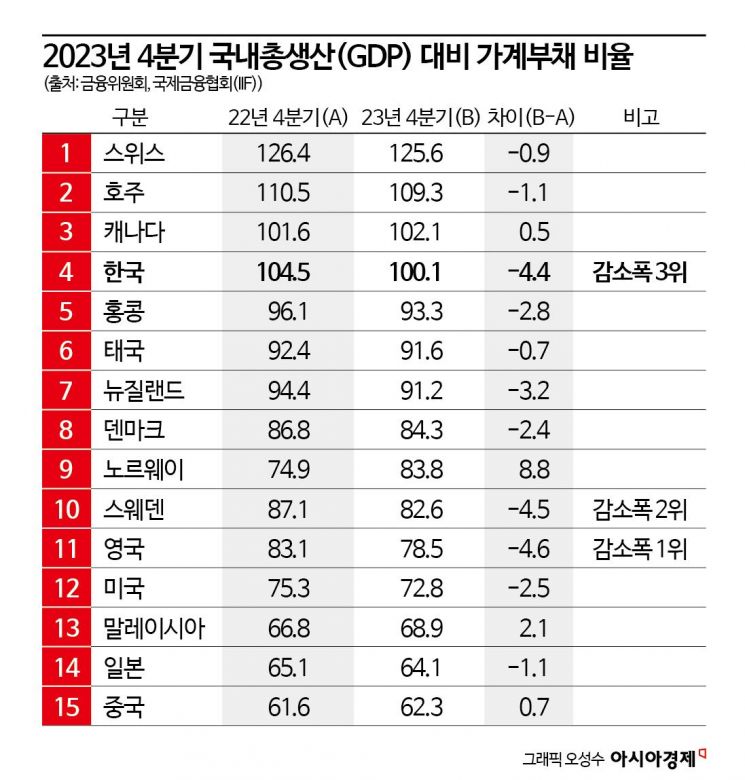
However, since the household debt-to-GDP ratio still exceeds 100%, more solid and sustainable measures are necessary. According to the database provided with the World Debt Monitoring Report by the Institute of International Finance (IIF), as of the fourth quarter, South Korea's household debt-to-GDP ratio was 100.1%, ranking fourth after Switzerland (125.6%), Australia (109.3%), and Canada (102.1%). The decrease in the household debt ratio over the past year was the third largest (-4.4 percentage points), following the UK (-4.6 percentage points) and Sweden (-4.5 percentage points). This figure compares 42 countries, including 12 advanced and 30 emerging nations.
Following South Korea, the household debt-to-GDP ratios were Hong Kong (93.3%), Thailand (91.6%), the UK (78.5%), and the US (72.8%). Consequently, South Korea has maintained its title as the country with the highest household debt level globally for four consecutive years since the onset of the COVID-19 pandemic in 2020.
© The Asia Business Daily(www.asiae.co.kr). All rights reserved.
![User Who Sold Erroneously Deposited Bitcoins to Repay Debt and Fund Entertainment... What Did the Supreme Court Decide in 2021? [Legal Issue Check]](https://cwcontent.asiae.co.kr/asiaresize/183/2026020910431234020_1770601391.png)
















