Creating a 'Flower Belt' in Eastern Seoul: From Bulamsan and Suraksan in Nowon-gu to Jungnangcheon in Jungnang and Dongdaemun-gu, Extending to Seongdong-gu and the Han River Area in Gwangjin-gu
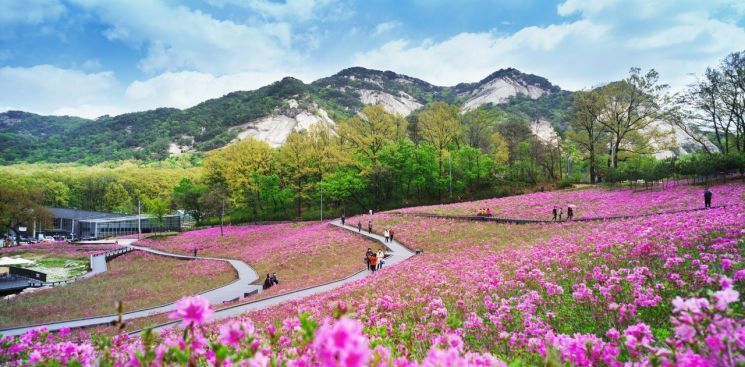
The northeastern areas of Seoul, including Nowon-gu, Jungnang-gu, Dongdaemun-gu, Seongdong-gu, and Gwangjin-gu, are expected to bloom into a city of flowers.
According to Seoul City and the autonomous districts, the 'City of Flowers Belt' in the northeastern part of Seoul, stretching from Bulam and Suraksan in Nowon-gu along Jungnangcheon to Jungnang-gu, Dongdaemun-gu, Seongdong-gu, and finally to the Han River in Gwangjin-gu, is anticipated to be in full bloom soon.
Nowon-gu has actively utilized its natural resources such as Bulam, Suraksan, and Jungnangcheon to establish a 'City of Flowers' early on.
In particular, since the inauguration of District Mayor Oh Seung-rok in the 7th local government term, he has consecutively recruited Choi Kwang-bin and Yoo Young-bong, former directors of Seoul's Green City Bureau, to create a city where residents can heal and relax.
As a result, Suraksan has been developed into an ecological city with features such as a butterfly garden and a healing center.
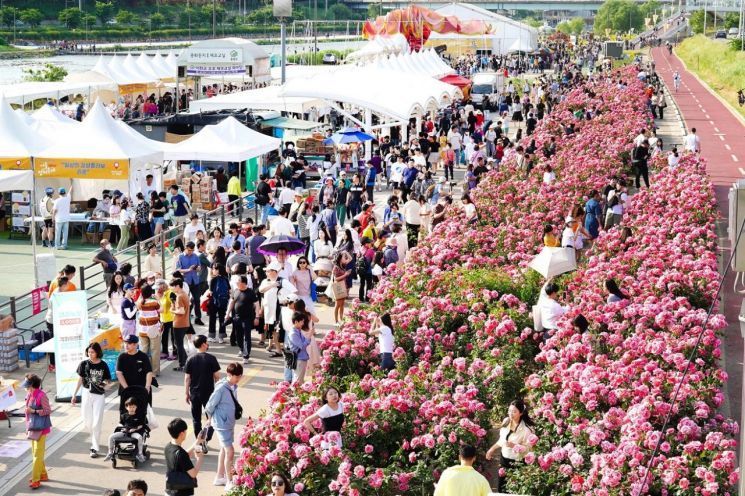
Since his inauguration in the 7th local government term, Ryu Kyung-gi, Mayor of Jungnang-gu, has been praised for developing the Seoul Rose Festival into a representative flower festival of Seoul by building a rose belt along Jungnangcheon.
The Seoul Rose Festival is Jungnang-gu's signature festival held every May. This year, under the theme of a festival led by residents, it was held against the backdrop of Jungnangcheon blooming with 10 million roses, attracting a total of 2.6 million visitors and generating approximately 14.6 billion KRW in direct economic impact, revitalizing the local economy.
Dongdaemun-gu, located west of Jungnangcheon, is focusing on creating a 'City of Flowers' under the leadership of Mayor Lee Pil-hyung in the 8th local government term.
Dongdaemun-gu (Mayor Lee Pil-hyung) is continuing to create spaces filled with flowers and trees throughout the city this year, following last year.
In January last year, the district presented a new blueprint for a garden city and held a proclamation ceremony for the 'City of Flowers.' In March of the same year, the 'Basic Plan for the City of Flowers' was completed, leading to the start of 'Creating a Pleasant Walking Environment' by decorating barren streets and idle spaces with flowers.
By planting evergreen trees, cornelian cherry trees, and colorful perennials in small plots and flower beds, 'small gardens in the city' were created throughout Dongdaemun-gu, brightening the streets. In early April, the first 'Dongdaemun-gu Spring Flower Festival' was successfully held along Jang-an Cherry Blossom Road, dyed pink with cherry blossoms, and around Jungnangcheon First Sports Park following the 'City of Flowers' proclamation.
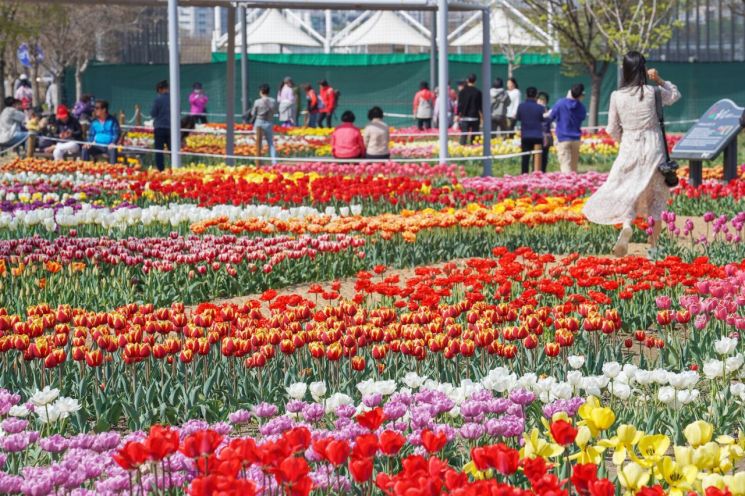
Under Jangpyeonggyo Bridge along the Jungnangcheon riverside, a 4,000㎡ 'Four Seasons Flower Garden' was created. Starting with the 'Tulip Garden' in full bloom in April, vibrant roses in May, and yellow cosmos and four-season roses in autumn attracted residents strolling along Jungnangcheon.
The 'Garden of Knowledge,' opened last September on the site of the Seoul Metropolitan Library (Dongdaemun) in Jeonnong-dong, was filled with autumn-appropriate flowers such as cosmos, zinnia, and cockscomb in themed spaces. For winter, LED landscape lighting highlighting the beauty of nature was installed, providing residents with new winter attractions. Twelve types of flower seeds, including rapeseed, poppies, and cornflowers sown last November, along with blue barley symbolizing spring, are expected to welcome residents this spring.
The district operates a 'Companion Plant Clinic Center' where 'plant caretakers' can resolve questions about plants and diagnose and prescribe treatments for wilting plants. Additionally, 'Dongdaemun-gu Village Gardeners' are being trained to cultivate the 'City of Flowers' together with residents.
This year, the district plans to create various attractions such as the 'Hydrangea Garden' at the Hwikyung-dong Recycling Sorting Center rest area, the 'Metasequoia Road' and 'Barefoot Trail' along Jungnangcheon, and an 'Artificial Waterfall' (with nighttime landscape lighting) at the open plaza of Baebongsan Neighborhood Park, providing residents with diverse sights and spaces to heal in urban nature. The district aims to become a 'walkable city' where greenery can be encountered everywhere just by stepping outside.
Mayor Lee Pil-hyung of Dongdaemun-gu stated, "Since last year's proclamation of the 'City of Flowers,' we have made great efforts to promote green projects that residents can feel, such as creating the 'Garden of Knowledge.' This year, we will do our best to create a beautiful and pleasant garden city in Dongdaemun-gu where flowers, trees, and people harmonize."
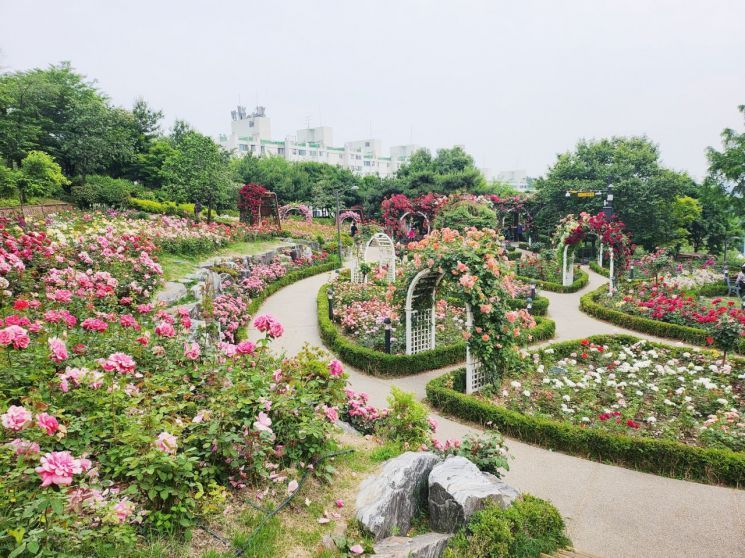
Seongdong-gu (Mayor Jung Won-oh) is promoting the 'Garden City Seongdong' project to create everyday gardens and connect green spaces throughout the district so that residents can enjoy gardens more closely.
Seongdong-gu is pursuing the creation of 'Garden City Seongdong' with four strategies: 'space,' 'nature,' 'connection,' and 'people.' By finding and creating gardens in small urban spaces, the district aims to fill the shortage of green spaces and connect fragmented green areas to allow residents to enjoy nature and leisure along rivers and mountains. Additionally, cultural programs involving residents will be linked to create an emotionally rich garden city.
The district plans to create everyday life gardens within a 5-minute reach for residents. Through urban redevelopment, new neighborhood parks and children's parks will be established, and specialized gardens will be created using vacant lots in front of public institutions such as the district office and Haengdang 1-dong Community Service Center, as well as village yards and empty houses near homes, providing residents with rest areas.
Seongdong-gu will actively utilize its advantage of having the longest waterfront in Seoul (14.2 km) to develop rivers near residential areas into complex cultural spaces where nature and leisure can be enjoyed simultaneously. Through ecological restoration and greening projects of Cheonggyecheon Stream, the naturalness of the riverside will be restored, and the vacant land along Jungnangcheon will be developed into a healing garden where the riverside atmosphere can be felt.
To enable residents to access green spaces more easily and quickly near their homes, green roads connecting forests, gardens, and rivers will be created. The district plans to improve accessibility to green spaces by maintaining street trees and expanding green belts, securing green spaces through various development projects, and organizing access systems to utilize green spaces as open areas. In the long term, the district intends to improve previously disconnected river access paths to enhance the utilization of riverside ecological resources.
Along the Han River in Gwangjin-gu, Seoul City will hold the 1st Seoul International Garden Expo this year.
Seoul City plans to create various themed gardens on a site of approximately 198,000 pyeong (about 653,000㎡) and offer them to citizens.
The city especially plans to open the Seoul International Garden Expo to the private sector, including companies such as Shinhan Bank, Samsung C&T, Hyundai Motor, and Starbucks, to create high-quality gardens.
Seoul City aims to develop the Han River gardens into a provincial garden, manage them, and eventually elevate them to a national garden, creating an internationally competitive garden that is second to none.
Mayor Oh Se-hoon of Seoul has a strong will to create 'Attractive Special City Seoul' by establishing gardens throughout the city, and plans to make greenery and flowers bloom all over Seoul.
© The Asia Business Daily(www.asiae.co.kr). All rights reserved.



















