Natural Cooling Through Air Circulation... "Players Will Be Comfortable"
Organizing Committee "Will Reduce Carbon Emissions by 50%"
The Olympic Village to be used for the Paris Summer Olympics and Paralympics, which will open this July, has been unveiled. Notably, the village does not have air conditioning installed.
On the 29th (local time), the Paris Olympic Organizing Committee received the keys to the Olympic Village from Solideo, the public organization responsible for constructing Olympic infrastructure, and held the official opening ceremony. The village, spanning the northern outskirts of Paris across Saint-Denis, Saint-Ouen-sur-Seine, and L'?le-Saint-Denis, covers a total area of 52 hectares, equivalent to about 70 soccer fields.
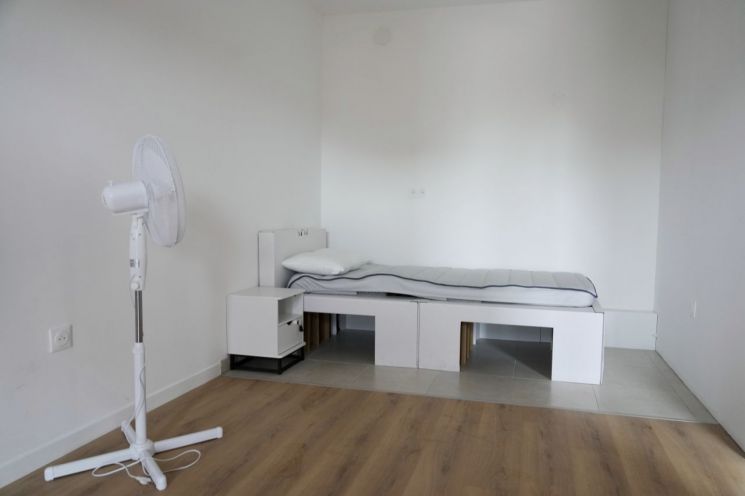
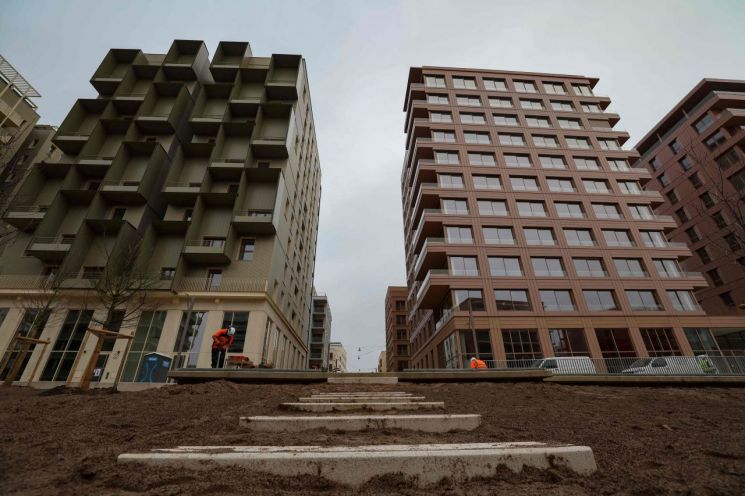
The complex consists of a total of 7,200 rooms and around 80 buildings, including athlete accommodations and auxiliary facilities. During the Olympics, 14,500 people will stay here, and during the Paralympics, 9,000 people.
Instead of installing air conditioning indoors, Solideo opted for a layout that promotes air circulation between buildings and diversified building sizes. Through this, they plan to achieve 'natural cooling,' maintaining indoor temperatures approximately 6 degrees Celsius lower than outside even during heatwaves.
An official from the Olympic Village explained, “If the outside temperature is 38 degrees Celsius, using fans can keep the indoor temperature between 26 and 28 degrees. Therefore, insulation facilities will not be necessary.”
In July last year, Thomas Bach, President of the International Olympic Committee (IOC), stated, “The Paris Organizing Committee has made great efforts to ensure athletes can stay comfortably without air conditioning,” adding, “The Olympic Village will be operated comfortably at temperatures 6 degrees or more below the outside temperature.” President Macron, who attended the opening ceremony, praised the project as “a century’s adventure,” saying, “You completed the work on time, within budget, and set an example socially and environmentally.”
The Paris Olympic Organizing Committee aims to reduce the total carbon emissions of the Olympics by 50% to realize an eco-friendly Games. To this end, they actively used bio-materials such as wood during construction to minimize carbon emissions and utilized clean energy sources like geothermal and solar power for electricity supply.
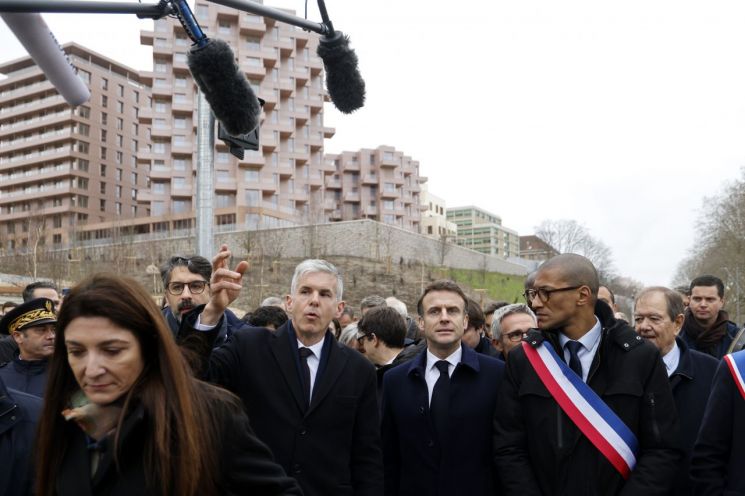 French President Emmanuel Macron is visiting and touring the Paris Saint-Denis Olympic Village on the 29th (local time).
 [Photo by Yonhap News, EPA]
Additionally, they announced plans to double the consumption of plant-based foods compared to the previous Games and prepare 60% of all meals served as plant-based. The organizing committee stated, “A total of 13 million meals will be provided during the Olympic and Paralympic periods, with about 60% of the diet being plant-based.”
Meanwhile, the organizing committee signed a contract with Airweave, the mattress supplier for the 2020 Tokyo Olympics, and decided to reuse the ‘cardboard beds’ that attracted attention at that time for the Paris Olympics. The committee explained, “They have been improved to be sturdier and easier to assemble, taking only 12 minutes to assemble in order without nails, screws, or adhesives.”
After the Olympics, the Olympic Village is scheduled to be repurposed from 2025 into general housing, student dormitories, hotels, and regular office spaces.
© The Asia Business Daily(www.asiae.co.kr). All rights reserved.
![From Bar Hostess to Organ Seller to High Society... The Grotesque Con of a "Human Counterfeit" [Slate]](https://cwcontent.asiae.co.kr/asiaresize/183/2026021902243444107_1771435474.jpg)


















