Election Districts Finalized Through Redistricting
Proportional Seats Reduced from 47 to 46
On the 29th, the National Assembly held a plenary session and approved the electoral district delimitation plan for the April 11 general election. While the number of proportional representation seats decreased by one compared to the 21st National Assembly, the 10 seats in the Jeonbuk constituency were maintained.
On the same day, the National Assembly held a plenary session and accepted the revision requests from the Special Committee on Political Reform, approving the amended Public Official Election Act redrawn by the National Assembly Electoral District Delimitation Committee. Of the 259 members present, 190 voted in favor, 34 against, and 35 abstained. With the electoral district delimitation completed 41 days before the general election, the 21st National Assembly avoided the stigma of the worst delayed processing in history.
The Delimitation Committee submitted the electoral district delimitation plan to the National Assembly on December 5 last year, but on this day, the ruling and opposition parties requested resubmission to the committee, arguing that it did not align with the purpose of the Public Official Election Act. The revised plan was approved within just four hours.
The newly prepared delimitation plan is based on increasing the number of constituency members from the current 253 to 254, while reducing the number of proportional representation members from 47 to 46. Originally, Jeollabuk-do, which was to lose one seat, was able to maintain its existing 10 seats by increasing proportional representation seats. Additionally, Seoul loses one seat, while Incheon and Gyeonggi Province each gain one seat. Partial division of autonomous districts, cities, and counties was allowed in areas such as Seongdong-gu in Seoul, Yangju-si in Gyeonggi, Chuncheon-si in Gangwon, Gunsan-si in Jeonbuk, and Suncheon-si in Jeonnam. As a result, electoral districts were finalized as Jung-gu Seongdong-gu Eul in Seoul, Dongducheon-si Yangju-si Yeoncheon-gun in Gyeonggi, Chuncheon-si Cheorwon-gun Hwacheon-gun Yanggu-gun in Gangwon, Gunsan-si Gimje-si Buan-gun in Jeonbuk, and Suncheon-si Gwangyang-si Gokseong-gun Gurye-gun in Jeonnam.
According to this delimitation plan, the number of members by city and province is set as follows: Seoul 48, Busan 18, Daegu 12, Incheon 14, Gwangju 8, Daejeon 7, Ulsan 6, Sejong 2, Gyeonggi 60, Gangwon 8, Chungbuk 8, Chungnam 11, Jeonbuk 10, Jeonnam 10, Gyeongbuk 13, Gyeongnam 16, and Jeju 3.
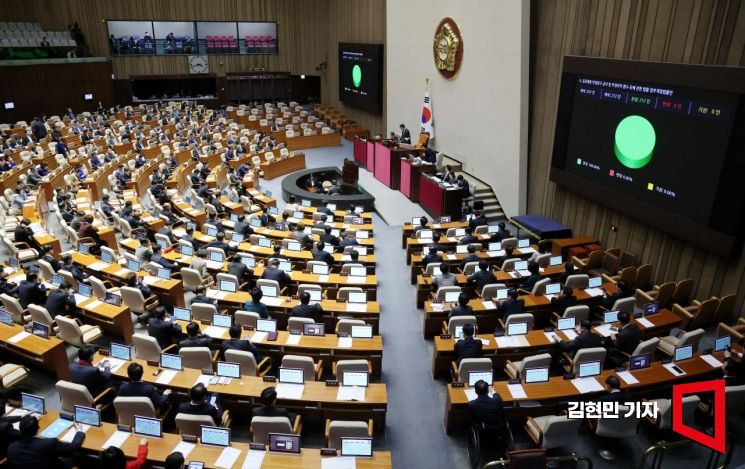 Speaker Jinpyo Kim is striking the gavel at the plenary session held at the National Assembly on the 29th. Photo by Hyunmin Kim kimhyun81@
Regarding the National Assembly's request for redelimitation, the Delimitation Committee stated that although it did not judge the request as a clear violation of the Public Official Election Act's purpose, "since the National Assembly's resubmission request imposes an obligation on our committee to resubmit the electoral district delimitation plan, we prepared a new delimitation plan reflecting the delimitation criteria agreed upon and notified by the political parties."
On the passage of the delimitation plan just 41 days before the election after brinkmanship negotiations between the ruling and opposition parties, the Delimitation Committee said, "In the future, it is necessary to clearly specify the delimitation criteria in the law or clearly define the entity responsible for deciding the delimitation criteria, thereby clarifying the authority and responsibility for electoral district delimitation. There must be no recurrence of situations where electoral districts are not finalized, causing significant disruption to the political decision-making of the people."
Before the amendment of the Public Official Election Act, National Assembly Speaker Kim Jin-pyo stated, "Under the current system where players make the rules of the game, it becomes increasingly difficult to decide how to conduct the election and how to delimit constituencies as the election date approaches." He argued, "The election system and electoral district delimitation should be finalized six months before the election, and if delimitation is not completed by then, the current election system and the original plan submitted by the National Election Commission's Delimitation Committee should be confirmed as is. Additionally, an election law amendment is needed to entrust the content of election system reform to external experts without conflicts of interest, including experts recommended by both ruling and opposition parties."
© The Asia Business Daily(www.asiae.co.kr). All rights reserved.

















