80 North Korean Defectors Tested Near Nuclear Test Site
Some Chromosome Alterations... Causality Not Proven
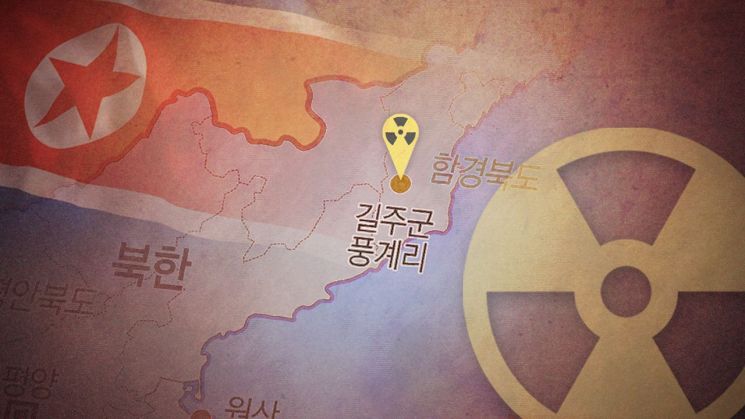
As a result of conducting radiation exposure tests on 80 defectors who lived near the Punggye-ri nuclear test site in North Korea and then entered South Korea, some were found to have chromosomal abnormalities.
However, since causes such as not only nuclear tests but also computed tomography (CT) scans, smoking, and old age could be factors, a causal relationship between radiation exposure from nuclear tests and chromosomal abnormalities has not been proven.
The National Radiation Emergency Medical Center of the Korea Institute of Radiological & Medical Sciences disclosed on the 29th the results of radiation exposure and radioactive contamination tests conducted last year on 80 defectors from eight cities and counties near the Punggye-ri nuclear test site (Kilju County, Hwadae County, Kimchaek City, Myonggan County, Myongchon County, Orang County, Dancheon City, Baekam County).
The examinations were conducted from May 15 to November 6 of last year.
First, in whole-body counter tests and urine sample analyses used to determine radioactive contamination, all 80 subjects showed no significant results. The whole-body counter test evaluates contamination by gamma rays, and the urine sample analysis evaluates contamination by alpha and beta-emitting radionuclides.
The report stated, "It is judged that there was no significant level of radioactive contamination in any of the subjects at the time of testing."
On the other hand, in the radiation exposure tests, 17 subjects were found to have dose values above the minimum detection limit in the stable chromosomal aberration test. For these individuals, an additional unstable chromosomal aberration test was conducted. As a result, two subjects showed results above the minimum detection limit.
The stable chromosomal aberration test evaluates lifetime cumulative radiation exposure, while the unstable chromosomal aberration test assesses radiation exposure within the past 3 to 6 months.
The two subjects who showed results above the minimum detection limit in the unstable chromosomal aberration test had previously undergone stable chromosomal aberration tests before 2016, which showed results below the minimum detection limit at that time.
The report explained, "(The two individuals) have no history of re-entry into North Korea after defecting, so the changes observed in this test are considered to be due to confounding variables after defection or medical radiation exposure."
It added, "(They) may have had recent radiation exposure or previous exposure with decreasing abnormal chromosomes. Considering the characteristics of the test that evaluates recent radiation exposure, it is highly likely that the results are unrelated to radiation exposure before the time of defection."
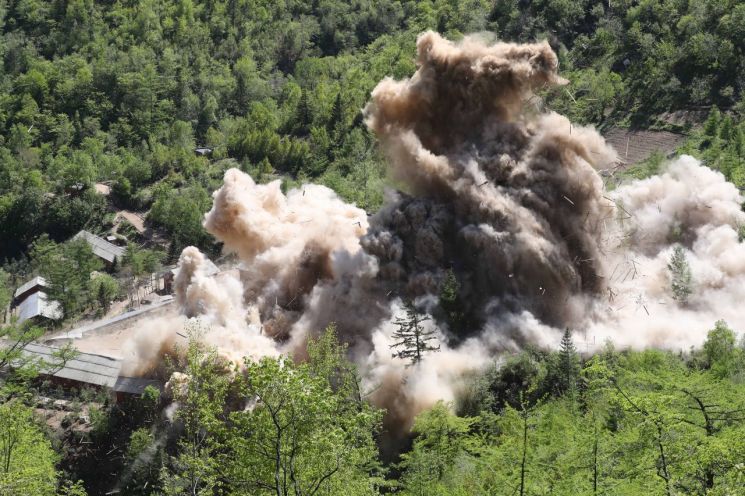 On May 24, 2018, wooden buildings of the Punggye-ri nuclear test command and control facility were blown up and shattered.
 [Image source=Yonhap News]
Among the remaining 15 subjects, five had a 95% confidence interval for exposure dose that included 0.000 Gy, suggesting that there may have been no meaningful exposure, according to the Korea Institute of Radiological & Medical Sciences.
In other words, 10 to 15 individuals may have experienced chromosomal abnormalities due to exposure to radionuclides released into the environment after nuclear tests. However, the institute emphasized that these chromosomal abnormalities could also be caused by medical radiation, toxic substances, or old age.
In this investigation, measurements were compared according to types of drinking water sources to evaluate the association between chromosomal abnormalities and the nuclear test site environment, but it was impossible to estimate a causal relationship between exposure dose and water source.
Regarding cancer, a representative disease that can result from radionuclide exposure, two of the 17 subjects were diagnosed with lung cancer and cervical cancer respectively and have been fully cured. The Korea Institute of Radiological & Medical Sciences explained that a causal relationship with nuclear test exposure could not be inferred.
Since this report does not specify a clear causal relationship between nuclear tests and radiation exposure, there are criticisms that it could provide a clean slate for North Korea’s nuclear tests. Some analyses also suggest that the information disclosed is less comprehensive than in past investigations.
In this regard, an official from the Ministry of Unification explained, "Because factors such as medical radiation and age must be considered, it is limited to view nuclear tests as the sole variable, but nuclear tests are certainly one of the causes of radiation exposure."
© The Asia Business Daily(www.asiae.co.kr). All rights reserved.
![User Who Sold Erroneously Deposited Bitcoins to Repay Debt and Fund Entertainment... What Did the Supreme Court Decide in 2021? [Legal Issue Check]](https://cwcontent.asiae.co.kr/asiaresize/183/2026020910431234020_1770601391.png)

















