Households in the 1st Income Quintile Face 'Deficits' Amid High Inflation
Household income increased by 3.9% in the fourth quarter of last year. Not only did earned income, business income, and transfer income all increase, but property income also surged by a record 80% amid a high-interest-rate environment.
According to the 'Household Trends in the Fourth Quarter of 2023' released by Statistics Korea on the 29th, the average monthly income per household in the fourth quarter of last year was 5,024,000 KRW, marking a 3.9% increase compared to the same quarter of the previous year.
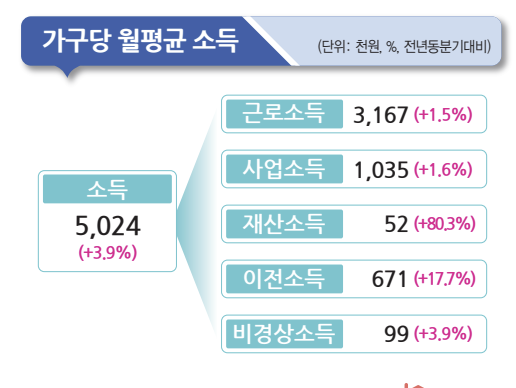
Earned income rose by 1.5% to 3,167,000 KRW, and business income increased by 1.6% to 1,035,000 KRW. Transfer income, which includes subsidies and pensions, increased by 17.7% to 671,000 KRW.
Although the share of property income in total assets is small, it recorded a historic high increase of 80.3%. Property income includes rental income, interest income, and dividend income, which were influenced by last year's high-interest-rate trend. A Statistics Korea official explained, "The rise in interest rates significantly boosted interest income," adding, "However, property income is not received by most households, and when it is received, it often comes in large amounts at once, so the margin of error is relatively high."
The difference in property income is more pronounced when viewed by income quintiles. In terms of total income, the average monthly income for the lowest 20%, the 1st quintile, was 1,178,000 KRW, up 4.5%; the 2nd quintile increased by 3.9% to 2,787,000 KRW; the 3rd quintile rose by 4.7% to 4,222,000 KRW; the 4th quintile increased by 3.8% to 6,120,000 KRW; and the 5th quintile, the top 20%, recorded 10,804,000 KRW, up 3.6%.
While the income growth rates across quintiles were relatively even for total income, when limited to property income, the 1st quintile saw a 5.2% decrease to 11,000 KRW, whereas the 5th quintile experienced a 172% increase to 139,000 KRW.
Amid the high inflation trend, household expenditures rose by 5.2% to 3,813,000 KRW. Spending on fruits and processed fruit products increased by 12.7% due to the rise in fruit prices, often referred to as the "golden apple" effect, while expenditures on vegetables and processed vegetable products rose by 5.3%. Spending on dairy products and eggs also increased by 7% amid rising egg prices. Meanwhile, expenditures on communication and alcoholic beverages/tobacco decreased by 4.3% and 2.8%, respectively.
Disposable income was 4,044,000 KRW, up 3.5% compared to the same quarter last year. The surplus amount, which is disposable income minus consumption expenditure, was 1,210,000 KRW, a 0.1% increase. However, by quintile, the 1st quintile, the lowest 20%, recorded a deficit with a negative surplus of 291,000 KRW.
The income quintile ratio was 5.30 times, down 0.23 points from the same period last year. The Ministry of Economy and Finance stated, "The government will continue efforts to realize virtuous cycles of growth and social mobility to ensure sustained improvement in income and distribution, while also fully responding to stabilize prices and improve people’s livelihoods."
© The Asia Business Daily(www.asiae.co.kr). All rights reserved.

















