16th Nationwide... First for a Single Local Government in Gyeonggi-do
The geological heritage in the Hwaseong-si area of Gyeonggi-do has been certified as a 'National Geopark.' Hwaseong-si announced on the 29th that the Ministry of Environment officially designated and announced 282㎢ of land and marine space within its jurisdiction as a 'National Geopark.'
A National Geopark is an alternative park system certified by the Minister of Environment to conserve geologically important and scenic geological heritage while utilizing it for education, tourism, and other projects to promote sustainable economic development in the region. Previously, the Hwaseong Geopark passed the final review by the Ministry of Environment's Geopark Committee on the 19th.
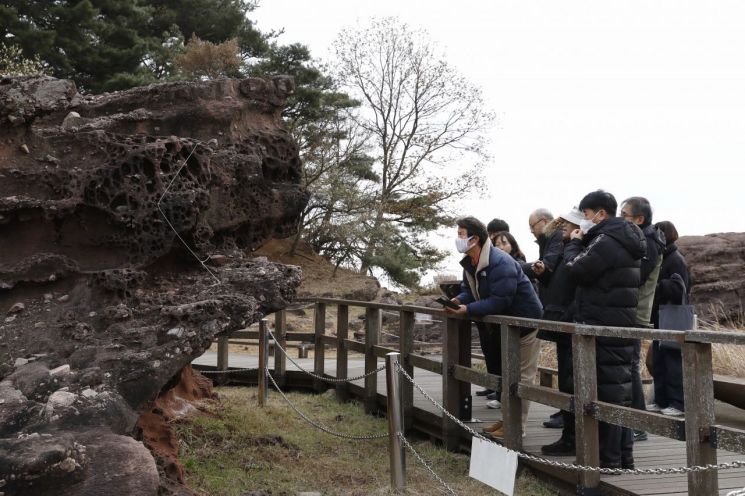 Ministry of Environment staff are conducting an on-site inspection of the historic sites around Hwaseong City National Geopark.
 [Photo by Hwaseong City]
This geopark certification is the 16th nationwide and, according to Hwaseong-si, the first case for a single local government in Gyeonggi-do.
The geological attractions of Hwaseong National Geopark include eight sites: Gojung-ri Dinosaur Egg Fossil Site, Ueumdo, Jeongok Port Stratified Tuff, Jebudo, Baekmiri Coast, Gungpyeong Port, Gukhwado, and Ipado. The certified area totals 282.5㎢, with 165.9㎢ on land and 116.6㎢ at sea.
In particular, Hwaseong National Geopark features a variety of rocks spanning all geological eras and includes the largest dinosaur egg fossil site in Korea, where more than 300 dinosaur eggs have been discovered. It also provides important data for the study of the tectonic structure of the East Asian crust.
Jung Myung-geun, mayor of Hwaseong-si, stated, "We will promote projects utilizing the National Geopark brand so that the valuable geological resources of Hwaseong-si can be widely recognized and strive to revitalize sustainable local tourism."
© The Asia Business Daily(www.asiae.co.kr). All rights reserved.