"Real-Time Changes in Structure, Shape, and Color Possible Over Large Areas"
A technology that can display colors or shapes in real time through changes in nanostructures has been developed, and it is expected to be applied in various fields such as smart polymer particles.
UNIST (President Yong-Hoon Lee) announced on the 29th that Professor Kwanghee Koo's team from the Department of Energy and Chemical Engineering developed a technology that mimics natural phenomena to self-assemble photonic crystal structures using block copolymers over large areas.
This means that, like seeing the wings of a butterfly or the feathers of a bird, the shape and orientation of nanostructures can be visualized in real time.
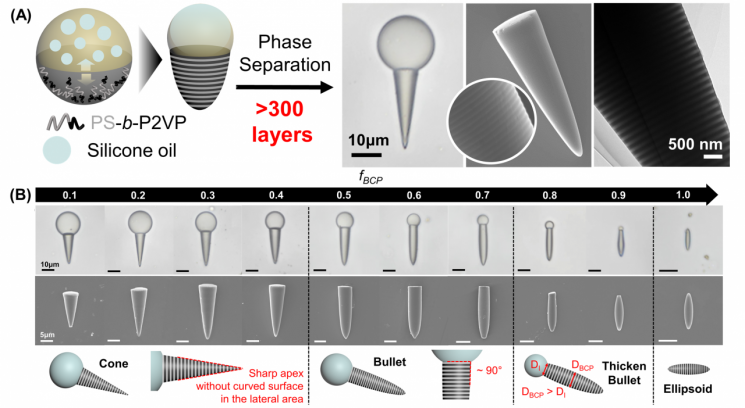 Study on the Preparation and Shape Control of Ice Cream-Shaped Optical Particles through Phase Separation Method in Emulsion.
Block copolymers are forms in which two or more different monomers are covalently bonded in block shapes. The research team promoted phase separation by utilizing immiscible liquids and block copolymers inside liquid droplets.
Professor Kwanghee Koo explained, “Through the self-assembly of block copolymers that spontaneously organize without external manipulation, we created photonic crystal structures free of hundreds of defects.”
This technology creates colors using internal nanostructures, unlike conventional methods. The colors are vivid and sustainable without fading. Because it can be patterned on a large scale, it is also applicable to display technology.
The developed technology uses polymers that can change the size of microstructures formed inside particles according to changes in the external environment. By utilizing the characteristics of polystyrene-poly(2-vinylpyridine) (PS-b-P2VP) block copolymers, which can return to their original state even after changes, the structure, shape, and color of particles are adjusted.
 UNIST research team. (Back row from left: Researchers Oh Hyeong-seok, Jo Gyu-hyeong, Ban Su-hyeon; Front row from left: Researcher Jo Jin-hyeok, first author Researcher Lee Ju-yeong, Professor Gu Gang-hee)
The research team monitored the structural changes in real time. They confirmed that the size of the micro-nanostructures changes and the color shifts according to changes in alcohol concentration or pH value.
The particles created using the developed technology have a ‘cone ice cream’ shaped structure combining solid and liquid. This allows visualization of fluid vibrations and changes in shape and color in response to external stimuli.
Professor Kwanghee Koo said, “We have been able to create optical particles that self-assemble without the complex process conditions typically required for the structure and pattern formation of colloidal crystals,” and added, “It is expected to have practical applications in various fields such as smart coatings and polymer particles.”
This research was published online on February 2 in ACS Nano, a prestigious journal in the field of nanoscience. It was conducted with support from the National Research Foundation of Korea (NRF) under the Ministry of Science and ICT and the Korea Toray Science Foundation.
© The Asia Business Daily(www.asiae.co.kr). All rights reserved.


















