Calcium Carbonate in Water Aggregates Nano and Microplastics
Aggregated Substances Can Be Easily Removed by Wiping or Filtering
Concerns are growing about the harmful effects of nano- and microplastics (NMP), which are tiny fragments of plastic waste, on health. It has now been discovered that simply boiling water can remove up to 90% of nano- and microplastics.
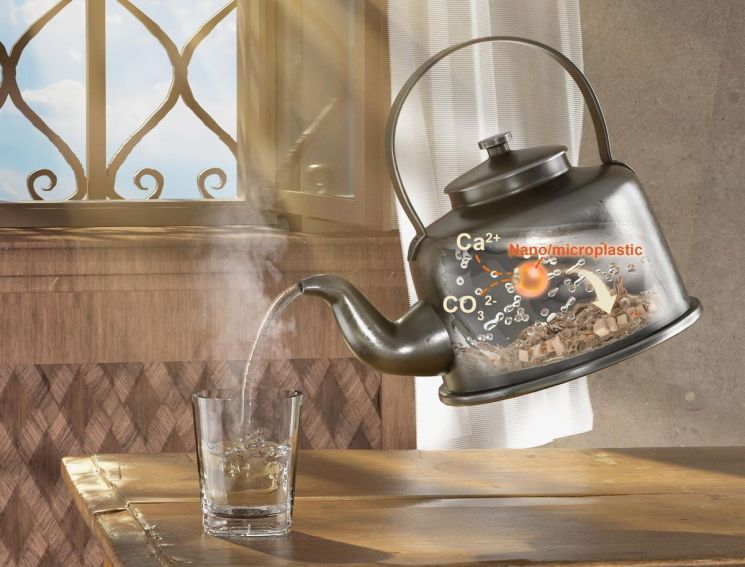 It has been revealed that boiling tap water can remove up to 90% of nano and microplastics due to the action of calcium carbonate particles.
 [Image source=Professor Eddy Zheng's research team]
On the 29th, Professor Eddie Zheng's research team at Jinan University in Guangzhou, China, reported in the American Chemical Society (ACS) journal Environmental Science & Technology Letters that boiling tap water can remove up to 90% of nano- and microplastics due to the action of calcium carbonate (limestone) components.
Inspired by the traditional practice in some Asian countries of boiling water to remove chemical or biological substances, Professor Zheng's team investigated whether this method is also effective in removing nano- and microplastics from tap water. In their experiments, they collected tap water containing 0 to 300 mg/L of calcium carbonate (CaCO₃), mixed it with nano- and microplastics such as polystyrene (PS), polyethylene (PE), and polypropylene (PP), boiled it for 5 minutes, then cooled it down and measured changes in the amount of nano- and microplastics.
When hard water rich in minerals is boiled, components like calcium carbonate clump together to form a white substance. The experiment showed that as the water temperature rises, calcium carbonate surrounds the nano- and microplastic particles, forming a crystalline structure that causes them to coagulate. This encapsulation effect was more pronounced in hard water with higher calcium carbonate content. In water with 300 mg/L of calcium carbonate, up to 90% of nano- and microplastics were removed after boiling. In soft water with less than 60 mg/L of calcium carbonate, about 25% was removed.
Professor Zheng explained that over time, the calcium carbonate containing nano- and microplastics accumulates like ordinary limestone. This material can be wiped away and removed, and any remaining impurities in the water can be filtered out using simple filters like coffee filters. He added, "These results show that the simple method of boiling water has the potential to remove nano- and microplastics from tap water, thereby reducing the risk of ingesting nano- and microplastics through water."
Nano- and microplastics are said to exist everywhere in the environment, including water, soil, and air. In particular, contamination of water supplies by nano plastics smaller than 1/1000 mm in diameter has become frequent, raising health concerns. Recently, a research team at Columbia University in the United States reported detecting 240,000 plastic particles in 1 liter of bottled water, generated during processes such as opening and closing the plastic cap. These nano- and microplastics can enter very deep into the human body upon ingestion. In experiments tracking how far these particles travel inside the human body, they were detected in all placentas tested.
They have also been found in human blood as well as breast milk. Although the harmful effects of nano- and microplastics on health have not yet been clearly defined, they have been shown to damage various cells. They have also been confirmed to embed in tissues and cause inflammation. Medical experts speculate that they may disrupt the endocrine system and potentially have long-term adverse effects on health.
© The Asia Business Daily(www.asiae.co.kr). All rights reserved.

















