2024 Pan-Government Export Expansion Strategy
Strengthening Cooperation for K-Food, Content, and Consumer Goods Growth Effects
Strategies Developed for 20 Key Products and 9 Target Markets
The government will provide export companies with a record-high support, including 360 trillion won in trade finance as well as marketing and certification, to achieve this year's export target of 700 billion dollars. In particular, inter-ministerial cooperation will be strengthened to ensure that Korea's strengths in K-Food, content, and consumer goods lead to synergistic effects.
On the 28th, An Deok-geun, Minister of Trade, Industry and Energy, held the '3rd Public-Private Joint Export Expansion Policy Meeting' to discuss and finalize the '2024 Inter-Ministerial Export Expansion Strategy' based on these points.
Minister An emphasized, "We will provide full support to export companies in finance, marketing, and certification with the largest scale ever, and will promote this swiftly through government-wide collaboration. We have set challenging targets by item, including semiconductors at over 120 billion dollars, automobiles at 75 billion dollars, content at 16 billion dollars, agricultural and marine products at 13.3 billion dollars, and plants at 33 billion dollars. We will fully support domestic production capacity expansion, research and development (R&D), finance, and marketing."
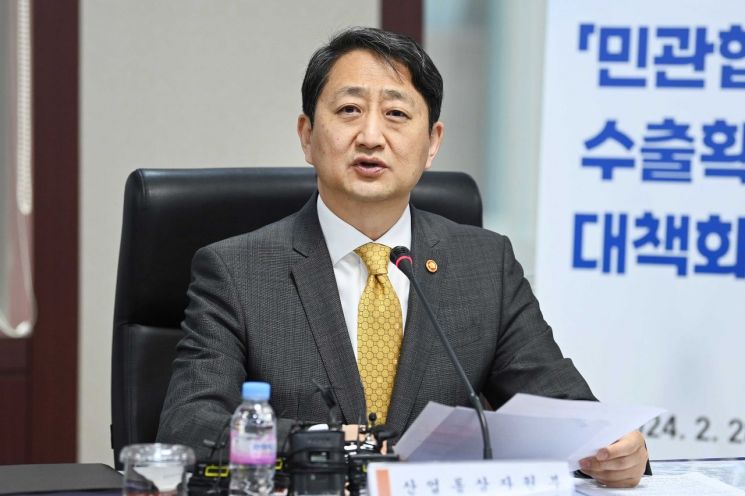 Minister Andeok Geun of the Ministry of Trade, Industry and Energy is speaking while presiding over the "3rd Public-Private Joint Export Expansion Measures Meeting" on the 28th.
'Largest Ever' Trade Finance, Marketing, and Mutual Certification Support
First, to expand export support infrastructure, the government raised trade finance by 5.5 trillion won to 360.2 trillion won, proactively reflecting new demand. Through this, it plans to support orders for promising defense, nuclear power, and plant projects in the Middle East and Africa, expand liquidity support for small and medium export companies amid continued high interest rates, and expand group insurance to build an export safety net for small businesses.
Support for export marketing (about 1 trillion won) and export vouchers (167.9 billion won) will also be expanded. New support will be provided to 100 export tech companies, 5,500 domestic and startup companies, and 40 mid-sized domestic companies to nurture new export players. In addition, a private-sector-led trade delegation for 10 promising markets will be newly launched, starting with the Middle East (Dubai) next month, with intensive dispatches planned to seven markets (India, ASEAN, etc.) in the first half of the year.
Overseas certification testing costs will be reduced by up to 20%, the fast track implementation period will be extended from the first quarter to the second quarter of this year, and the number of mutually recognized items between domestic and overseas testing and certification agencies will be expanded from the current 186 to over 200.
Creating Synergy through Inter-Ministerial Export Support Collaboration
The government views the removal of silos between ministries and strengthening of inter-ministerial collaboration systems as crucial for export expansion and will fully activate four inter-ministerial export collaboration projects.
It will establish a cooperative system with related ministries such as the Ministry of Agriculture, Food and Rural Affairs, Ministry of Oceans and Fisheries, Ministry of Culture, Sports and Tourism, and Ministry of Health and Welfare. Dedicated pavilions for each ministry will be set up at major exhibitions and consultation events such as Boom Up Korea (April at COEX) and Seoul Food Fair (June at KINTEX), and efforts will be made to expand the integrated Korea pavilion at famous overseas exhibitions. Additionally, joint financial support plans will be prepared for large-scale order projects such as defense, nuclear power, and plants; a fresh food cold chain logistics system will be established using overseas joint logistics centers under each ministry’s jurisdiction; and collaboration will be promoted for obtaining overseas certifications for cosmetics, medical devices, halal foods, and more.
Strategies by item and region to achieve export targets were also presented. Considering global mega trends such as supply chain restructuring, carbon neutrality, digital transformation, and demographic changes, as well as the strategic nature of order fields like nuclear power and defense, the government identified 20 key export items expected to yield maximum export results, including semiconductors, secondary batteries, automobiles, content, and agricultural products. Target markets for strategic entry by these key items were also selected.
For the 20 key export items such as semiconductors, automobiles, and agricultural and marine products, the government will fully support production capacity expansion, securing ultra-competitive technologies, responses to trade issues such as the Inflation Reduction Act (IRA) and Carbon Border Adjustment Mechanism (CBAM), as well as finance and marketing. For nine target markets linked to key items, including the United States and ASEAN (Association of Southeast Asian Nations), region-specific customized support such as discovering new cooperation projects and opening sales channels will be significantly strengthened.
The meeting also discussed support measures to expand plant orders this year. The government set a challenging target of 33 billion dollars for overseas plant orders this year, following last year's 30.2 billion dollars. In particular, it plans to realize the follow-up results of last year's summit economic diplomacy in the Middle East and actively support Korean companies’ orders by conducting summit and high-level economic diplomacy in new markets such as Central Asia and Africa. Furthermore, support for orders in the rapidly growing eco-friendly and new industry sectors will be strengthened in response to global trade issues such as greenhouse gas reduction, strengthening of global environmental regulations, and hydrogen economy implementation.
Minister An said, "Despite the global trade downturn caused by high interest rates and inflation last year, our exports played a leading role in a bottom-high growth pattern in the second half of last year. The Ministry of Trade, Industry and Energy has set three major goals: a record-high 700 billion dollars in exports, attracting 35 billion dollars in foreign investment, and 110 trillion won in domestic investment in advanced industries. We will concentrate inter-ministerial policy capabilities to achieve these goals and lead the revitalization of the Korean economy through export and investment expansion."
© The Asia Business Daily(www.asiae.co.kr). All rights reserved.
![User Who Sold Erroneously Deposited Bitcoins to Repay Debt and Fund Entertainment... What Did the Supreme Court Decide in 2021? [Legal Issue Check]](https://cwcontent.asiae.co.kr/asiaresize/183/2026020910431234020_1770601391.png)















