Industry's First SD Express-Based Product Development
Overcoming Heat Generation by Solving Technical Challenges of Existing Products
Introducing 1TB High-Capacity MicroSD Card
Samsung Electronics is introducing two new microSD card products. One is a high-performance product capable of transferring a movie in under 5 seconds, and the other is a 1TB (terabyte) high-capacity product with enhanced durability. Through the product launch, Samsung Electronics plans to overcome the NAND market slump and secure future revenue sources.
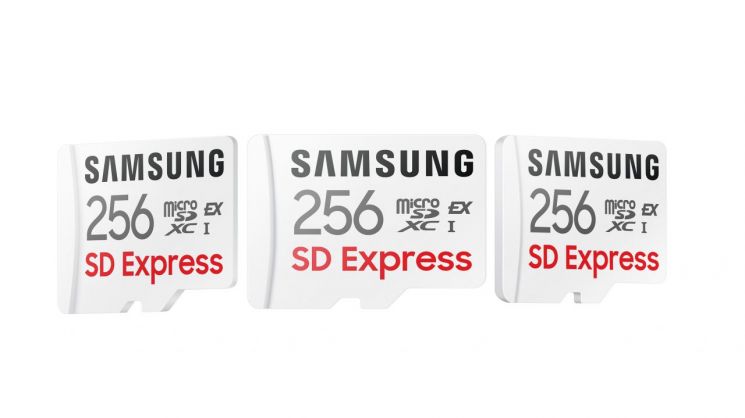 256GB capacity microSD card based on SD Express developed by Samsung Electronics / Photo by Samsung Electronics
On the 28th, Samsung Electronics announced that it has developed microSD cards based on the high-performance SD Express interface and has started providing samples to customers.
MicroSD cards are a type of memory card, a digital storage device based on flash memory. Among memory cards, those mainly used in electronic devices are called SD cards, and microSD cards are smaller in size compared to regular SD cards. MicroSD cards are NAND-based and are mainly used in smartphones and tablet PCs.
Samsung Electronics developed new products based on the SD Express interface, a new interface for SD cards, for the first time in the industry. It features solutions to issues such as heat generation, which was a technical challenge for existing microSD technology, through low-power design technology and firmware optimization.
In this process, Samsung also applied DTG (Dynamic Thermal Guard) technology, previously used in NAND-based solid-state drives (SSDs) as auxiliary storage devices, to microSD cards for the first time. DTG is a technology that gradually adjusts product performance to prevent the temperature from rising above a certain level.
This product supports continuous read speeds of 800MB/s and a capacity of 256GB based on the SD Express 7.1 standard. It offers industry-leading performance and capacity. In particular, 800MB/s is a speed that can transfer a 4GB movie from the memory card to a PC in under 5 seconds. It is four times faster than existing products with continuous read speeds of 200MB/s.
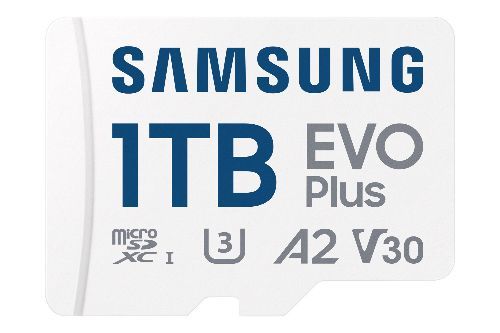
Another microSD card introduced by Samsung Electronics is a 1TB capacity UHS-I microSD card. UHS-I refers to the SD card standard established in 2009.
To introduce a TB-level high-capacity model previously implemented in SSDs, Samsung Electronics stacked the latest 8th generation 1Tb (terabit) high-capacity V-NAND in 8 layers for packaging. Durability was also enhanced to safely protect data under extreme external conditions such as water resistance, drops, and abrasion.
The company plans to mass-produce the 256GB capacity SD Express microSD card next month. Starting with B2B (business-to-business) supply, it will also be introduced to the B2C (business-to-consumer) market within the year. The 1TB capacity UHS-I microSD card will be released in the third quarter.
Samsung Electronics plans to overcome the NAND market downturn and expand its position through these product launches. According to market research firm Omdia, although the NAND market experienced a downturn last year, growth is expected from this year onward. The market size is projected to grow from $51.12 billion this year to $87.032 billion by 2027.
In this process, the memory card market is also expected to grow due to increased demand for new devices and high-capacity content. The share of microSD cards among memory cards is expected to increase from 88.4% this year to 90.5% by 2027.
Han-gu Son, Executive Director of the Brand Product Biz Team at Samsung Electronics’ Memory Business Division, said, "The new microSD cards are only the size of a fingernail but boast high performance and high capacity comparable to PC storage devices like SSDs," adding, "We plan to demonstrate technology leadership in high performance and high capacity that meets the demands of the upcoming mobile computing and on-device artificial intelligence (AI) era."
© The Asia Business Daily(www.asiae.co.kr). All rights reserved.


















