Seongbuk Woori Children’s Hospital and 107 Other Locations
Additional Securing Planned Considering Situation Trends
Support for PA Nurse Medical Pilot Project
The Seoul Metropolitan Government has taken steps to expand the number of hospitals and clinics available for nighttime and holiday medical treatment in response to the prolonged collective action by medical staff. This measure aims to minimize inconvenience to citizens caused by medical service gaps, with plans to secure additional hospitals capable of nighttime and holiday treatment considering the situation's progression.
According to the Seoul Metropolitan Government on the 28th, there are currently a total of 107 hospitals and clinics in the city available for nighttime and holiday treatment. Previously, there were only 73, but 34 were added as part of emergency medical response measures. This includes 105 clinics and 2 hospitals: Seongbuk Woori Children's Hospital located in Seongbuk-gu and Woori Children's Hospital of the Woori Children's Medical Foundation located in Guro-gu. Among these are 10 Woori Children's Safety Clinics and 10 Dalbit Children's Hospitals.
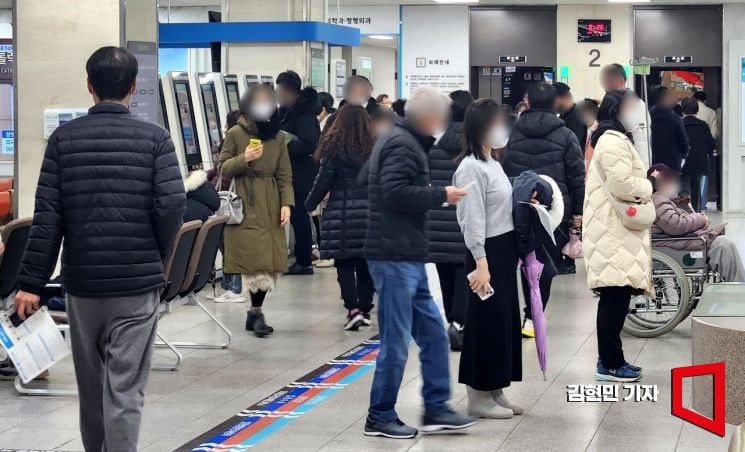 On the 21st, concerns over a medical crisis are growing due to the collective resignation and work stoppage of residents opposing the increase in medical school quotas. A university hospital in downtown Seoul is crowded with visitors. Photo by Kim Hyun-min kimhyun81@
Seoul plans to accelerate securing hospitals and clinics available for nighttime and holiday treatment and the urgent recruitment of medical staff. First, the city has allocated 2.6 billion KRW from the disaster management fund it operates to immediately support the recruitment of medical staff at Seoul Medical Center, Boramae Hospital, and Eunpyeong Hospital, where there are gaps due to the absence of residents. The goal is to recruit a total of 45 medical personnel at these hospitals. Seoul plans to provide budget support in three installments over three months depending on the trend of collective action in the medical community.
The issue of simplifying the recruitment process has also been immediately applied, allowing hospital directors to urgently hire necessary personnel at their discretion. The recruited medical staff will be deployed to the field immediately.
Administrative support for policy implementation by the Ministry of Health and Welfare and other relevant departments is also being expedited. With the government planning to start a pilot project to legally protect Physician Assistant (PA) nurses, Seoul is providing administrative support in cooperation with each autonomous district. Seoul explained that due to the increased burden on nurses caused by the departure of residents, it intends to support the government's pilot project for medical support personnel to establish a protection system for nurses.
Seoul Mayor Oh Se-hoon is also supporting the government's policy implementation. Mayor Oh appeared on the radio the day before and said, "The principle of expanding the number of doctors must be upheld." This aligns with the government's judgment that more medical personnel are needed as society ages, emphasizing that "Ultimately, this is a structure that can only be resolved by expanding the number of doctors."
In particular, Mayor Oh pointed out the "distorted structure," saying, "Because residents are on strike, large hospitals have come to a standstill. In Korea, the proportion of residents is 35% to over 40%, but in other countries, it is about 10%." He added, "We will do our best to minimize the medical service gap," explaining that Seoul has extended weekday treatment hours at eight municipal hospitals, which previously operated until 6 p.m., until 8 p.m., and that the emergency rooms at Seoul Medical Center, Boramae Hospital, Dongbu Hospital, and Seonam Hospital are operating 24 hours to provide emergency medical services.
© The Asia Business Daily(www.asiae.co.kr). All rights reserved.

















