Korea Music Copyright Association Copyright Awards Producer Category
5 Consecutive Years Winner 'BTS Father' Surpasses Pidok
When spring arrives soon, 'Cherry Blossom Ending' will once again play on radios and in cafes. Every time the song is played, money flows into the bank account of its composer, Jang Beom-jun. Approximately 1 billion KRW comes in annually, giving rise to the term 'Cherry Blossom Pension.' At one time, Park Jin-young was renowned in the industry as the king of copyright income. In recent years, the top earner in copyright royalties was Pdogg, who composed songs for BTS. However, this year, someone has dethroned Pdogg and taken his place. That person is singer-songwriter Bumzu (BUMZU, real name Gye Beom-ju).
 This year, the Korea Music Copyright Association selected Seventeen producer Bumzu as the recipient of the Popular Music Composition and Lyrics Award. The photo shows singers Park Jin-young and G-Dragon, who previously won the Copyright Award. Photo by XXX
Bumzu received the grand prize in the popular lyric and composition category at the '10th KOMCA Copyright Awards' held on the 26th. The 'KOMCA Copyright Awards' is the only copyright-related awards ceremony in South Korea. It honors lyricists and composers who have earned the highest copyright royalties in their respective fields over the past year. Last year's prestigious grand prize winner was Pdogg. Bumzu surpassed Pdogg and inherited the throne.
The rise of Bumzu is attributed to the popularity of the group Seventeen. Last year, they won the MAMA grand prize and, after nine years since their debut, lifted their first grand prize trophy at the Golden Disc Awards. Recently, they ranked second on the '2023 Global Artist Chart' released by the International Federation of the Phonographic Industry (IFPI), following Taylor Swift in first place, proving their global influence.
Seventeen's success has also impacted the copyright market. This year, a new figure was named the copyright grand prize winner, dethroning Pdogg, the producer known as the 'father of BTS,' who had held the top spot in domestic copyright income for five consecutive years. The protagonist is Bumzu, Seventeen's producer and singer-songwriter.
With this award, Bumzu announced the emergence of a new powerhouse in the Korean music copyright market. He wrote lyrics, composed, and produced most of the title tracks and album songs for his agency Pledis's groups, including Seventeen and NU'EST. He was recognized for his contribution to K-POP's establishment as a global mainstream genre and Seventeen's expanding global popularity. It is known that his copyright royalty income from many of Seventeen's hit songs amounts to several billion KRW.

With the birth of a copyright powerhouse earning massive income, attention is also focused on how copyright royalties are collected and distributed. According to the Ministry of Culture, Sports and Tourism's 'Music Transmission Usage Fee Collection Regulations,' copyright royalties are distributed between creators such as singers and composers and music distributors at a ratio of 65:35.
The revenue generated from one streaming of a single song is 7 KRW. Dividing this at a 65:35 ratio, creators and record producers receive 4.55 KRW. Among this, singers get 6.25%, about 0.43 KRW; lyricists and composers receive 10.25%, about 0.75 KRW; and record producers take 48.25%, about 3.38 KRW. For example, when listening to Seventeen's 'God of Music,' which Bumzu participated in writing and composing, on Melon, Melon takes 2.45 KRW. Then, Seventeen receives 0.43 KRW, Bumzu gets 0.73 KRW, and the agency Pledis shares 3.38 KRW.
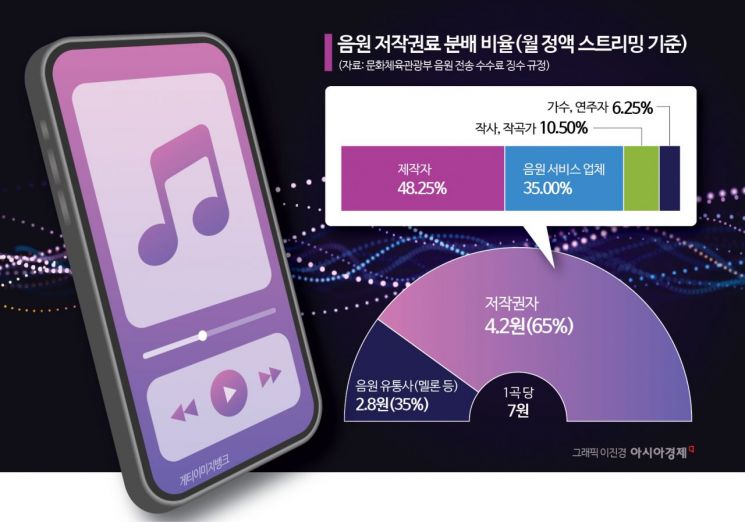 Domestic Music Copyright Royalty Distribution Ratio (Based on Monthly Fixed-Rate Streaming) [Source: Ministry of Culture, Sports and Tourism Music Transmission Fee Collection Regulations] [Graphic by Jin-kyung Lee, Designer]
Is the copyright royalty paid to creators too small? Judging by the results, it is not. According to Mobile Index, an app statistics analysis platform, the number of paid music streaming users in South Korea has exceeded 11 million. If streaming users listen to songs written and composed by Bumzu at least once daily for a month, copyright income exceeding 240.9 million KRW per month would be generated.
Although Pdogg and Bumzu have rapidly risen as copyright powerhouses thanks to BTS and Seventeen's success, the public still associates copyright wealth with Jang Beom-jun, known for the 'Cherry Blossom Pension,' or G-Dragon, who holds many solo hit songs from Big Bang. Every spring, Jang Beom-jun reportedly earns 1 billion KRW annually in copyright income from the 'Cherry Blossom Ending,' which repeatedly climbs the charts.
Park Jin-young is also a traditional powerhouse, having won the copyright grand prize three consecutive years from 2011 to 2013. He wrote and composed many hit songs not only for himself but also for artists under his agency JYP Entertainment. Hits like Wonder Girls' 'Tell Me,' 2PM's 'Heartbeat,' and TWICE's 'What Is Love?' are among his works. Park Jin-young's copyright income was announced as 1.31 billion KRW in 2013 (according to the Korea Music Copyright Association), and it is presumed to have increased over the past decade.

Bumzu's copyright income is naturally expected to be larger than Park Jin-young's 13 years ago. This is due to the global popularity of K-POP and the market's expansion. While the total copyright income collected by KOMCA in 2011 was 108.7 billion KRW, last year it collected 406.1 billion KRW, showing nearly fourfold growth.
An industry insider stated, "Considering that copyright income is generated not only from music streaming but also from usage fees related to album production, reproduction, broadcasting, performances, and other areas, as well as Seventeen's steadily expanding influence in the global market last year, Bumzu's copyright income is estimated to be around 1% of the total copyright income." In other words, this means he received about 4 billion KRW in copyright royalties last year.
© The Asia Business Daily(www.asiae.co.kr). All rights reserved.



















