Application of Wood in Urban Architecture, Housing, and Culture Including Concrete and Plastic Facilities
Promoting Eco-friendliness and Regional Economic Revitalization
The Korea Forest Service will establish wood-friendly cities in 10 locations nationwide.
On the 27th, the Korea Forest Service announced that by 2026, it will create wood-friendly cities in Suseong-gu and Dong-gu in Daegu, Seo-gu and Yuseong-gu in Daejeon, Jecheon and Cheongju in Chungbuk, Chuncheon in Gangwon, Muju in Jeonbuk, Gangjin in Jeonnam, and Bonghwa in Gyeongbuk.
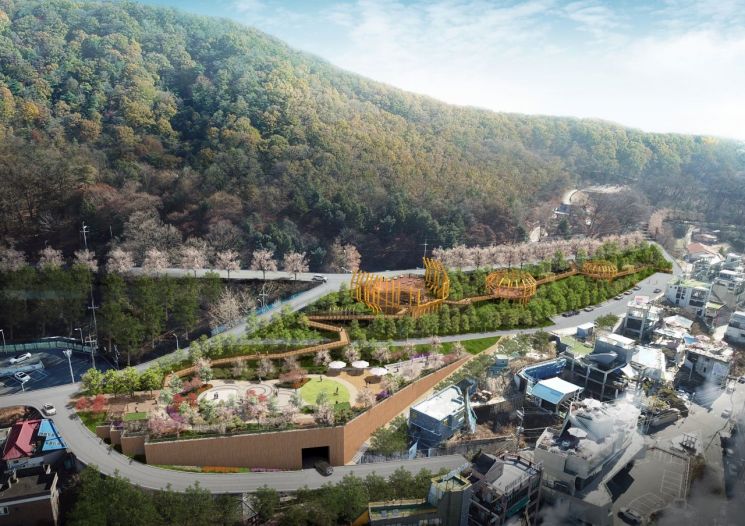 A bird's-eye view of the wood-friendly city development project site. Provided by the Korea Forest Service
The main point of creating wood-friendly cities is to replace urban environments centered on concrete and plastic with domestically produced wood. As a ‘new renewable urban type’ that reorganizes the entire urban environment including architecture, housing, and culture, it is distinguished from the ‘woodenization (木造化)’ projects that involve constructing some buildings and facilities with wood.
The main projects include ▲improving streetscape ▲promoting wood culture ▲improving residential environments ▲revitalizing the local economy.
Improving streetscape involves replacing materials used for benches, streetlights, soundproof walls, bus stops, guardrails, and children’s playground equipment with locally produced wood to create wood-specialized streets, and establishing wooden landscapes within urban forests and gardens.
Promoting wood culture includes establishing wood education infrastructure such as public citizen woodworking experience centers and developing and distributing wood education and cultural programs tailored to different life stages. Improving residential environments involves constructing wooden buildings using local wood and creating wood-based social overhead capital (SOC).
Revitalizing the local economy is focused on strengthening the production base of local wood products for the creation of wood-friendly cities.
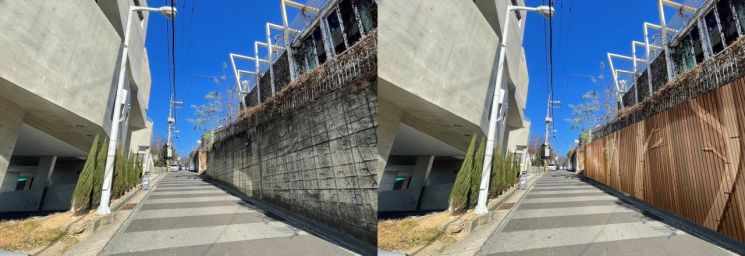 Before (left) and after (right) replacing the exterior walls of urban buildings from concrete to wood. Provided by the Korea Forest Service
The Korea Forest Service plans to increase the utilization of domestic wood through the wood-friendly city project. It will also create educational facilities, experience centers, and wood-specialized streets themed around wood to make wood a familiar material in daily life.
Ultimately, the Korea Forest Service aims for the wood-friendly city project to secure stable demand for domestic wood and lead to regional economic revitalization through the activation of the wood industry.
The wood-friendly city creation project will be implemented with a 50% national budget and 50% local government budget matching. Construction is scheduled to begin in earnest this year. The Korea Forest Service will operate a ‘Wood-Friendly City Creation Advisory Group’ to ensure smooth project progress and provide advice on domestic wood utilization methods, site concepts, design, and construction.
Nam Sung-hyun, Administrator of the Korea Forest Service, said, “Wood-friendly cities will establish themselves as sustainable urban models for carbon neutrality in the future,” adding, “Through the wood-friendly city project, the Korea Forest Service will instill the perception that ‘wood use = carbon neutrality’ among the public and enable the practice of carbon neutrality in daily life through the activation of wood use.”
© The Asia Business Daily(www.asiae.co.kr). All rights reserved.
![Clutching a Stolen Dior Bag, Saying "I Hate Being Poor but Real"... The Grotesque Con of a "Human Knockoff" [Slate]](https://cwcontent.asiae.co.kr/asiaresize/183/2026021902243444107_1771435474.jpg)












