Investor Sentiment Moves as Nikkei Hits Consecutive Record Highs
First Investing in Large-Cap High Dividend Stocks... Top Preference NTT
As the investment sentiment of elderly Japanese investors, who had been holding stocks long-term like deposits, begins to shift, Japanese securities firms are experiencing an unprecedented surge in buy inquiries. With the Nikkei index surpassing the historic high of 39,000 and continuing its upward trend, analysts suggest that Japan's investment sentiment, which was once considered dead during the "Lost 30 Years," is now being revived.
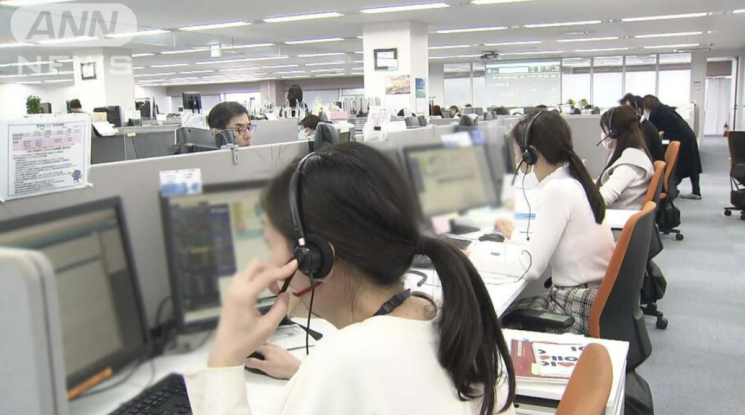
On the 27th, TV Asahi reported that at the Tokyo Mizuho Securities call center, inquiries about investment consultations and orders have been flooding in since before the market opened. Orders surged even more after the Nikkei index set a new all-time high for two consecutive trading days the previous day. A Mizuho Securities official stated, "Compared to the historic high on the 22nd, inquiries have increased by about 1.5 times, and about twice the usual volume," calling it "an unusual occurrence."
During the Lost 30 Years, Japan was known as a country that did not invest in stocks. Most stockholders held onto stocks purchased during the bubble economy period without selling, treating them like deposits, leading to the narrative that the stock market itself was dead. According to a 2022 survey by the Korea Financial Investment Association comparing household financial assets across major countries, the proportion of investment in financial products such as stocks, bonds, and funds was 25.4% in South Korea, whereas Japan's was only 16.3%.
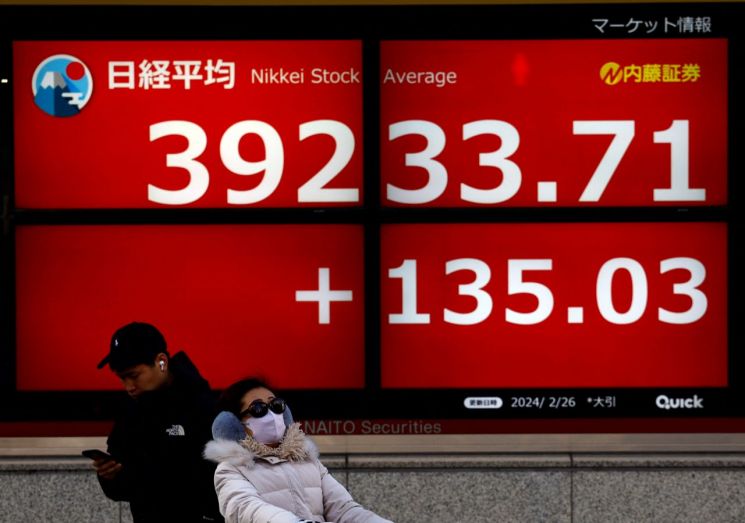
Now, the investment sentiment of Japanese investors is beginning to move in response to the rising market after 30 years. The Japanese government is further stimulating investment sentiment by introducing the Nippon Individual Savings Account (NISA), a tax-exempt small investment scheme to promote individual stock investments.
With the start of the bull market, Japanese investors are currently focusing on stable, large-cap, high-dividend stocks rather than growth stocks. They prefer long-term management over short-term trading. According to a survey by Rakuten Securities on the first Japanese stocks traded by investors aged from their 20s to over 50s, the top-ranked stock across all age groups was Nippon Telegraph and Telephone Corporation (NTT). As Japan's leading telecommunications company, it is a representative high-dividend stock.
NTT recently executed a 25-for-1 stock split, lowering its price and attracting individual investors' attention. Since stocks listed on the Tokyo Stock Exchange can be bought and sold in units of 100 shares, the stock split lowered the entry barrier. The online economic media Gendai Business reported, "It has become a hot topic as 100 shares can now be purchased for less than 20,000 yen (about 176,000 won)." Considering the price per share, some analyses compare it to the price of a convenience store bottled drink, leading to the saying, "Buy NTT shares every time snack prices or bus fares rise."
The second place was the Nikkei Average High Dividend 50 Index, ranking second in stock purchases among investors in their 20s to 40s, excluding those over 50. This stock index consists of 50 stocks with high dividend yields among the components of the Nikkei average stock price. Other popular high-dividend stocks in the rankings included Japan Tobacco, Mitsubishi Corporation, and Mitsubishi HC Capital.
Despite ongoing controversies, Toyota Motor Corporation, which recorded its highest-ever performance, is also a favorite stock among retail investors. According to Rakuten Securities, Toyota's stock ranked within the top 10 across all age groups, indicating its popularity among novice investors.
On the other hand, growth stocks such as Tokyo Electron and Sony Group, which have recently attracted attention due to the semiconductor revival, have not undergone stock splits, resulting in high minimum order amounts and thus losing out in individual investors' choices.
However, despite the rising stock enthusiasm, experts caution that it is still too early to celebrate. At a press conference the previous day, Masakazu Tokura, chairman of Keidanren, emphasized, "To sustain this rise, it is important to realize a virtuous cycle of growth and distribution," stressing that efforts such as wage increases must support the current upward trend.
The Nihon Keizai Shimbun (Nikkei) also stated, "Japan has made two mistakes in handling the stock market," referring to "first dancing to the bubble, and then excessively shrinking the stock market as a reaction." It urged a calm perspective rather than enthusiasm. Nikkei added, "The stock market is a place where companies that grow by gaining customer support through excellent products and services are evaluated in the long term, not a place for dancing."
© The Asia Business Daily(www.asiae.co.kr). All rights reserved.