100 Dollar Bills in Circulation Exceed 1 Dollar Bills by 4.2 Billion
Mostly Held for Storage... Suspected of 'Counterfeiting' When Used
The circulation of $100 bills in the United States has doubled over the past decade, becoming the most widely circulated denomination. However, there are significant limitations to using $100 bills for everyday transactions, making them difficult to use in practice.
On the 25th (local time), the U.S. Wall Street Journal (WSJ) reported that although the circulation of $100 bills has increased significantly in recent years, making them the most circulated denomination, cashiers and economists still tend to avoid using them. As of 2022, there were 18.5 billion $100 bills in circulation, which is 4.2 billion more than the 14.3 billion $1 bills. According to Federal Reserve (Fed) statistics, the circulation of $100 bills increased by about 115% from 2012 to 2022, the largest growth among all U.S. currency denominations.
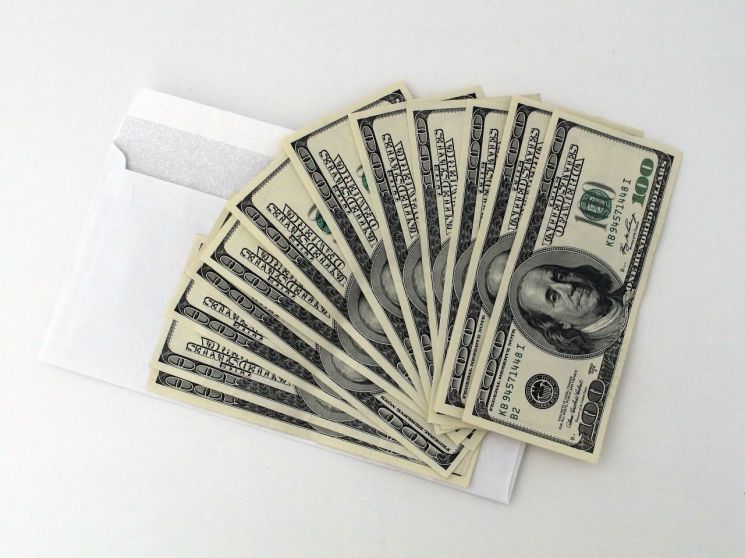
Although $100 bills appear to be widely circulated statistically, they are not easy to use in reality. More than half of these bills are held overseas, and within the U.S., they are mostly kept as reserves rather than used for everyday payments. Reija Saisson (26), who lives in New York, recently tried to use a $100 bill at a flea market in New York but was repeatedly refused. Sellers declined high-denomination payments, citing lack of change or accepting only digital payments. The same was true at cafes and fruit stands.
Presenting a $100 bill often raises suspicion about counterfeiting. Sage Handley (23) said, "Whenever I try to use a $100 bill, everyone questions whether it is legitimate." In fact, when a WSJ reporter tried to pay with a $100 bill at a store in Manhattan, the cashiers became alarmed. One person held the bill up to the light to verify its authenticity, while another used a counterfeit detection pen that turns black upon contact with fake bills. Some stores even used counterfeit bill detectors.
The reason high-denomination bills are not widely accepted is the perception that cards are primarily used for large purchases. American consumers spent an average of $39 when paying with cash, compared to $95 when using credit cards.
South Korea Sees Return of the Previously Disappeared 50,000-Won Bill
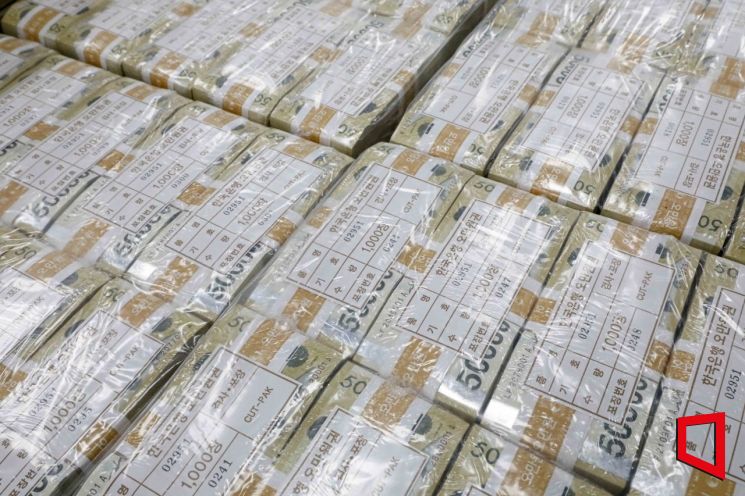 On the 5th, ahead of the Lunar New Year holiday, cash transport personnel are conducting the release of funds for the Lunar New Year to be supplied to commercial banks at the Bank of Korea headquarters in Jung-gu, Seoul. Photo by Joint Press Corps
Meanwhile, in South Korea, the redemption rate of the 50,000-won bill is steadily increasing. Last month, the Bank of Korea announced that the redemption rate for the 50,000-won bill reached 67.1% last year, the highest level since 67.4% was recorded in 2018. The increase in the redemption rate is attributed to the normalization of currency redemption channels following the recovery of face-to-face commerce after COVID-19 and a decrease in demand for reserve currency due to rising interest rates.
Due to the impact of the COVID-19 pandemic, the amount of 50,000-won bills redeemed decreased to between 4 trillion and 6 trillion won from 2020 to 2021 but increased to 14.1 trillion won in 2023. The Bank of Korea sees this as a normalization of currency circulation, especially in industries traditionally reliant on cash sales such as food and lodging, transportation, and leisure services.
The redemption rate of high-denomination bills is also related to interest rates. The recent rise in market interest rates has increased the opportunity cost of holding cash, reducing demand for currency held as reserves or stores of value, leading to the redemption of funds that were massively issued during the COVID-19 period. A Bank of Korea official stated, "In the short term, the redemption rate of the 50,000-won bill will be influenced by market interest rate trends, while in the long term, factors such as the spread of non-cash payment methods and an increase in damaged bills due to the circulation lifespan of the 50,000-won bill will act as upward factors."
Over the past five years, the redemption rate of the 50,000-won bill has shown a declining trend after reaching a record high of 67.4% in 2018: 60.1% in 2019, 24.2% in 2020, 17.4% in 2021, and 56.5% in 2022, before sharply rising again to 67.1% last year.
© The Asia Business Daily(www.asiae.co.kr). All rights reserved.


















