Major Platforms Double Compared to Jeonju
Effectiveness Debated Due to Restrictions on Mild Outpatients
As the government temporarily allows telemedicine to minimize the 'medical crisis' caused by collective actions of doctors, the number of patients using telemedicine instead of visiting hospitals is surging. However, there are voices saying that telemedicine measures are less effective because they cannot accommodate the 'severe patients,' who are the biggest victims of the medical crisis.
According to the telemedicine platform 'DoctorNow' on the 26th, the number of new medical consultation requests increased by 102% on the 23rd, when the government expanded telemedicine, compared to the previous day. On the weekend of the 24th and 25th, the number of consultation requests also rose by 86% compared to the previous week. During the same period, the telemedicine platform 'Namanui Doctor' also saw nearly double the number of consultations compared to the previous week.
A DoctorNow official said, "Since the government fully expanded telemedicine, the average daily number of new consultation requests has increased by 1,000," adding, "Considering the data collected until the morning of the 26th, this trend is likely to become more pronounced."
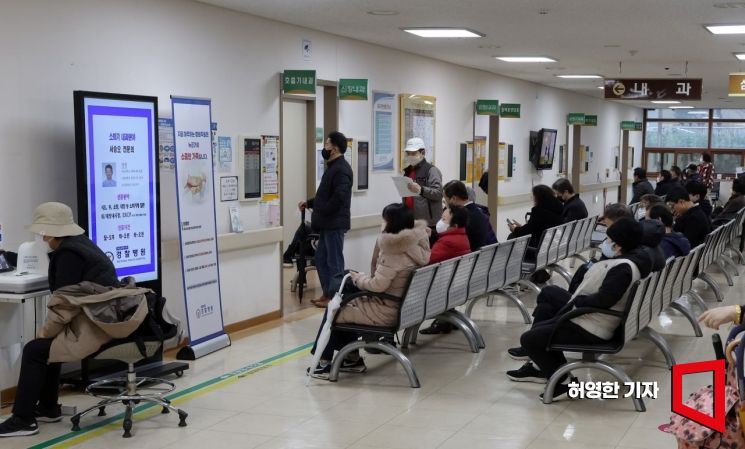 Patients are waiting for their turn in front of the consultation room at the Police Hospital in Songpa-gu, Seoul.
 [Photo by Heo Young-han]
Until now, telemedicine was conducted at 'clinic-level medical institutions' targeting 'returning patients.' This was because conducting initial consultations remotely could lead to incorrect prescriptions due to the lack of prior information about the patient. Initial consultations were only exceptionally allowed in medically underserved areas or on weekends and holidays, and at hospital-level institutions or higher, telemedicine was permitted only for returning patients with rare diseases requiring hospital-level care or those needing continuous management after surgery or treatment.
As the government expanded the scope of telemedicine to include 'hospital-level institutions or higher' and 'initial patients' in response to the medical community's collective actions, actual cases of telemedicine use are increasing. Han (37), a resident of Gwacheon-si, Gyeonggi Province, received a prescription through telemedicine last weekend instead of visiting the emergency room. Han said, "I was worried about whether I should go to the emergency room because I had a fever and felt weak all weekend, but I thought I would have to wait a long time at the hospital, so I looked into telemedicine. It was my first time using it, but it was more convenient than I expected, so I think I will use it occasionally in the future."
However, there are also voices that the expansion of telemedicine is merely a 'desperate measure' or a 'pressure card against the medical community.' The urgent issue in this medical gap is the delay in surgeries and treatments for severe patients due to the collective resignation of residents training at tertiary hospitals (3rd-level hospitals), whereas telemedicine is mainly an issue limited to clinic-level hospitals (1st-level hospitals) frequented by mild outpatient cases, so it cannot be a direct solution.
In fact, according to the Emergency Medical Portal (E-Gen), as of the 26th, the general intensive care unit and general emergency room beds at Seoul St. Mary's Hospital, a tertiary hospital, are in shortage, but general wards still have available beds.
The Health and Medical Organizations Coalition, People's Solidarity for Participatory Democracy, the Korean Confederation of Trade Unions, and the Federation of Korean Trade Unions issued a statement saying, "Telemedicine does not help emergency and severe patients, who are the biggest victims of the medical crisis," and warned, "If private platform companies dominate medical mediation and seek profits through this opportunity, medical costs will skyrocket and could lead to medical privatization."
Professor Jeong Hyeong-seon of the Department of Health Administration at Yonsei University said, "It is impossible to fill the medical gap caused by the departure of residents with telemedicine," adding, "However, if doctors' collective actions spread to private practitioners in the future, telemedicine will be meaningful in terms of improving medical accessibility."
© The Asia Business Daily(www.asiae.co.kr). All rights reserved.
![Clutching a Stolen Dior Bag, Saying "I Hate Being Poor but Real"... The Grotesque Con of a "Human Knockoff" [Slate]](https://cwcontent.asiae.co.kr/asiaresize/183/2026021902243444107_1771435474.jpg)
















