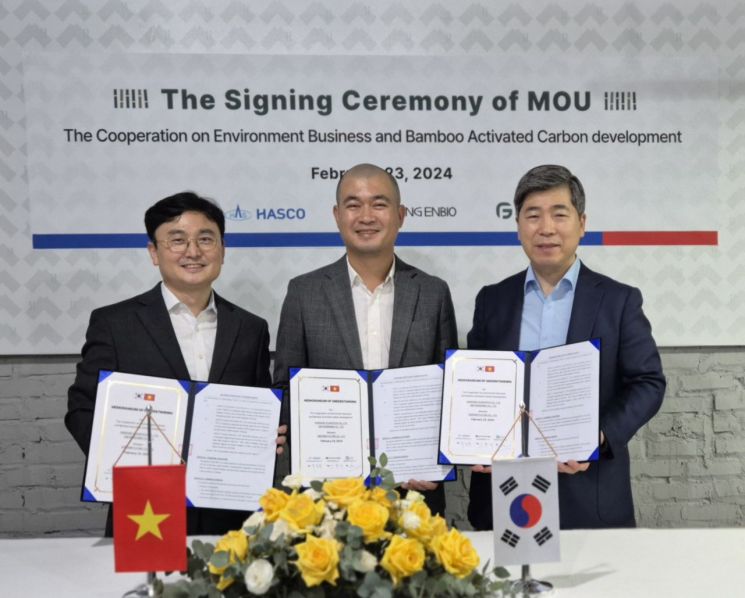
 The first on the left is Kim Mansu, Head of Research at Daeyang Envirobio, the second is Minh Nguyen, President of Greener Future, and the third is Park Jongun, CEO of Hanseong Cleantec. / Photo by Hanseong Cleantec
Hansung Cleantec announced on the 26th that it is entering the activated carbon material business required for pretreatment in ultrapure water production facilities and various industries.
Dr. Kim Mansu's team at Hansung Cleantec’s affiliate Daeyang Envirobio has confirmed an iodine adsorption capacity (standard 950mg/g) required for activated carbon performance at over 1000mg/g from a nationally accredited testing institution, successfully developing the first prototype.
Until now, activated carbon has been made using raw materials such as coconut shells and coal (bituminous coal), but Hansung Cleantec has utilized bamboo, abundant in Vietnam, as a new activated carbon material and applied a new activation process to drastically shorten the production period.
Accordingly, Hansung Cleantec signed a joint business agreement (MOU) on the 23rd at Greener Future’s headquarters in Hanoi, Vietnam, together with Daeyang Envirobio and the Vietnamese environmental company Greener Future for full-scale commercialization.
For commercialization, Hansung Cleantec and Daeyang Envirobio’s Future Technology Research Institute will jointly promote a demonstration plant study. The developed technology will be transferred to Greener Future while assessing demand, and if market demand expands, they plan to establish a joint production plant.
Activated carbon is a special adsorbent widely used in industrial and consumer applications to remove impurities or contaminants. It is a black porous carbon material (similar to charcoal) produced by activating raw materials such as coconut shells and coal. In Korea, coal, the raw material, is not produced domestically, and due to economic reasons related to production costs, the entire supply is dependent on imports.
Due to the possibility of supply instability amid international circumstances, the government designated activated carbon as an emergency supply control item in July 2022, following masks in 2020 and urea and urea solution in 2021. It is especially used in semiconductor ultrapure water, advanced water treatment, and wastewater reuse.
According to Fortune Business Insight, the domestic market size for activated carbon is expected to reach $312.4 million by 2027, and the global market size is projected to reach $7.73 billion by 2030. Due to strengthened environmental regulations, the industrial and automotive sectors are expected to show an annual growth rate of about 11%, which is higher than other sectors. Its applications are expanding in air and water purification filters, electric and electronic components such as supercapacitors, electric vehicles (EV), hybrid electric vehicles (HEV), fuel cell vehicles (FCV), and other eco-friendly vehicles and precision industries.
Jongwoon Park, CEO of Hansung Cleantec, said, “We have launched the Future Technology Research Institute to integrate and manage affiliates as part of preparations to transform into a technology-centered company structure,” adding, “It embodies our commitment that ‘technology is the future.’”
He continued, “As we take the first step into the material business using activated carbon, starting this year, we are additionally preparing for strategic collaborations with domestic and international related companies to secure technological competitiveness not only in ultrapure water production technology materials, parts, and equipment but also in resource reuse related to the semiconductor industry.”
© The Asia Business Daily(www.asiae.co.kr). All rights reserved.

















