US Schmidt Ocean Institute Explores Chilean Seafloor
Sea Sponges, Lobsters, and More... Genetic Analysis Planned
As a result of exploring the deep sea 4,000 meters below the ocean surface using an underwater robot, more than 100 previously unseen new marine species were discovered.
On the 24th (local time), foreign media including the American daily The Washington Post (WP) reported that the Schmidt Ocean Institute (SOI) in the United States conducted an exploration from last month’s 8th to this month’s 11th along the underwater mountain ranges extending from the South American coast to Rapa Nui Island (Easter Island) in Chilean Polynesia, discovering over 100 species presumed to be new biological species.
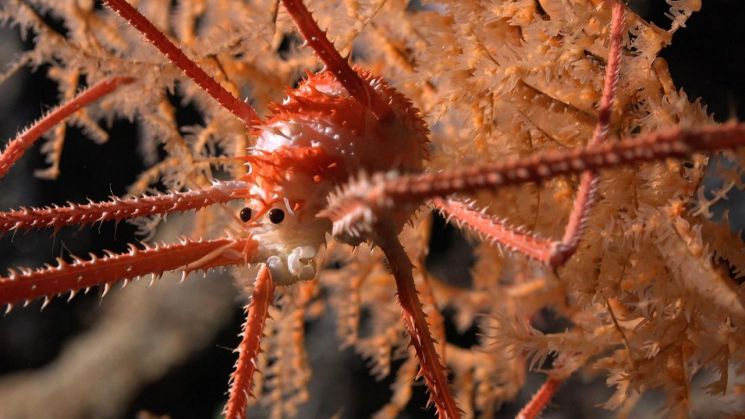 Appearance of a newly discovered lobster in the Chilean seabed
[Image source: Provided by Schmitt Marine Research Institute]
The species discovered by the research team include ghostly white sea sponges and lobsters with sparkling eyes and spiny legs, as well as sea urchins, starfish, and sea lilies that have never been reported in academic circles before. Sea sponges are hexactinellid sponges that live in deep waters. Dr. Javier Sellanes of the Universidad Cat?lica del Norte in Chile, who led the research, stated, "Especially many new sea sponges were found in this area," adding, "Previously, only two species had been reported here, but now we have discovered about 40 different species." The research team collected specimens of the newly discovered organisms and will conduct laboratory analyses of their physical structures and genes to make a final determination on whether they are new species.
The research involved deploying an underwater robot capable of descending to depths of 4,500 meters. Analysis of data collected by the robot from the deep seabed revealed distinct ecosystems along the underwater mountain ranges, with widespread distributions of deep-sea coral reefs and sea sponge habitats. Dr. Sellanes said, "This exploration far exceeded our expectations," and added, "It confirmed that the marine parks designated by the Chilean government effectively protect marine habitats." The exploration area included the Juan Fern?ndez Marine Park and the Nazca-Desventuradas Marine Park.
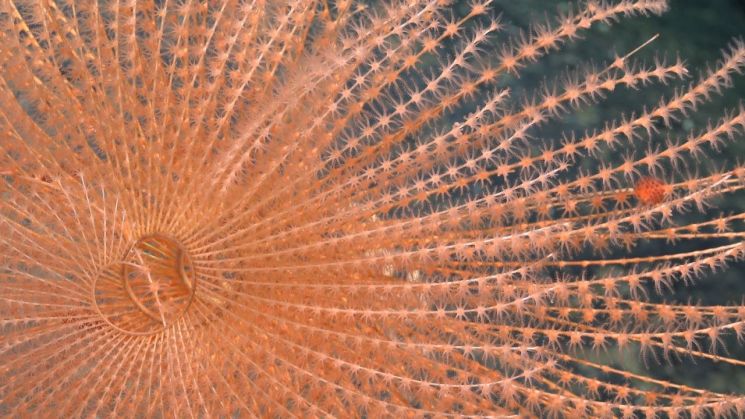 Spiral coral discovered at a depth of 1419m in the Juan Fernandez Marine Park, Chile
[Image source: Provided by Schmidt Ocean Institute]
The Juan Fern?ndez Marine Park is located 665 km west of the Chilean mainland port of San Antonio and is home to endangered, rare, and endemic flora and fauna. The entire archipelago, including Robinson Crusoe, Alexander Selkirk, and Santa Clara Islands, as well as all islands within the marine park, were designated as a UNESCO Biosphere Reserve in 1977.
Designated as a marine park by the Chilean government in 2016, the Nazca-Desventuradas Marine Park is located 911 km west of the Chilean city of Caldera and covers an area of 300,350 square kilometers, making it the largest marine protected area in the Americas. Before the establishment of the marine park, the ecosystem here faced destruction due to threats from illegal fishing, but with mining and industrial activities prohibited and only research allowed within the marine park, biodiversity and endemism can be preserved.
The Schmidt Ocean Institute, which led this exploration, is a nonprofit research foundation established in 2009 by former Google CEO Eric Schmidt and his wife Wendy Schmidt for oceanographic research.
© The Asia Business Daily(www.asiae.co.kr). All rights reserved.


















