Two disciples of the late Father Lee Tae-seok, the protagonist of the film ‘Don’t Cry, Tonj’, who served as a doctor and priest in South Sudan, Africa, have finally passed the specialist qualification exam in Korea.
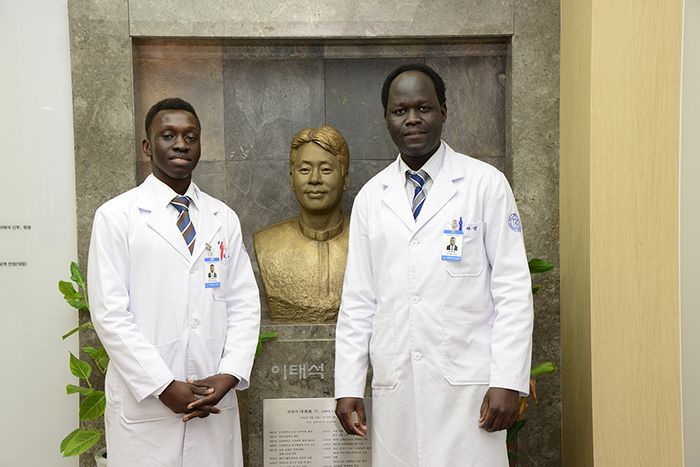 Students taking a commemorative photo in front of the bust of Father Lee Tae-seok during the 2016 clinical practice course at Busan Baik Hospital (left: Thomas Tavan Akot, right: John Mayen Ruben) [Photo by Inje University Baik Hospital]
On the 23rd, Inje University Paik Hospital announced that among the 2,727 successful candidates of the 67th Specialist Qualification Exam in 2024, Thomas Taban Akot and John Mayen Ruben, disciples of Father Lee Tae-seok, were included. The two chose the path of becoming doctors in Korea at Father Lee’s encouragement. They began studying in 2009 with the help of the Sudan Children’s Scholarship Foundation. Father Lee passed away from colon cancer in 2010, shortly after they arrived in Korea. Nevertheless, the two devoted themselves even more to their studies, determined to become doctors and return to their homeland, carrying on Father Lee’s spirit.
Thomas and John entered Inje University College of Medicine, Father Lee’s alma mater, in 2012 and passed the 83rd and 84th Korean Medical Licensing Exams, respectively, becoming doctors. Although it was challenging to study both language and medicine in a foreign country, they reportedly received full scholarships from Inje University covering tuition and dormitory fees. Both completed their internship training at Inje University Busan Paik Hospital. Afterwards, Thomas trained as a resident in surgery at Inje University Sanggye Paik Hospital, and John trained in internal medicine at Inje University Busan Paik Hospital, passing the specialist exam this year.
Their choice of surgery and internal medicine was motivated by their medical activities in South Sudan. South Sudan has been unable to guarantee adequate medical services due to years of civil war. Thomas, who chose surgery, said, "There is a shortage of surgeons in South Sudan, and many people die because they cannot receive timely surgery for simple acute appendicitis or cholecystitis. I chose surgery to help even a little." John, who chose internal medicine, said, "Since childhood, I have seen many people suffer without medical care in a war-torn environment. Most of these cases involve internal medicine diseases such as malaria, tuberculosis, hepatitis, and infectious diseases, so I chose internal medicine."
Going forward, Thomas plans to continue a fellowship program at Inje University Sanggye Paik Hospital to gain more surgical experience. John also plans to complete a fellowship at Inje University Busan Paik Hospital before returning to South Sudan to engage in medical activities and train future doctors.
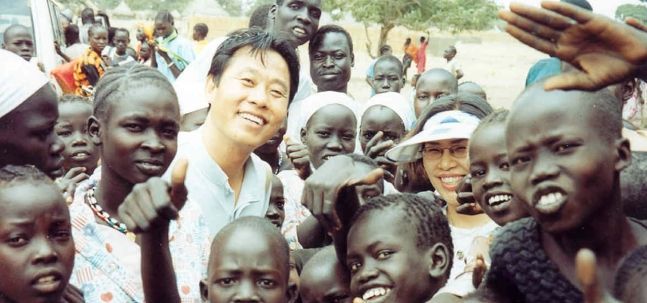 The late Father Lee Tae-seok during his missionary medical education activities in Tonj, Sudan [Photo by Busan Sarami Lee Tae-seok Memorial Association]
The two disciples expressed their gratitude, saying, "Everything that allowed us to know Korea and become doctors through medical studies was thanks to Father Lee Tae-seok." They also said, "We were able to achieve good results thanks to the staff at Inje University Paik Hospital who helped us undergo residency training without difficulties."
Meanwhile, Father Lee Tae-seok graduated from Inje University College of Medicine in 1987 and became a doctor. After choosing the path of priesthood, he went to the remote area of Tonj in South Sudan, Africa, in 2001, where he built hospitals, schools, and dormitories and devoted himself to medical service until he passed away from colon cancer at the age of 48 in 2010. The documentary film about his life, ‘Don’t Cry, Tonj’, was released in 2010 and attracted 440,000 viewers, ranking fifth among all-time documentary film hits. His life and activities are included in South Sudan’s primary and secondary school textbooks, and it is reported that about 50 graduates of the school he founded are now pursuing careers as doctors.
© The Asia Business Daily(www.asiae.co.kr). All rights reserved.


















