"Government Measures, the Medical Delivery System Advocated by the Medical Community for Decades"
The Korean Medical Association Emergency Response Committee criticized the government's plan to fully allow 'non-face-to-face medical consultations' in response to the resignation crisis among resident doctors. They also claimed that the medical delivery system proposed by the government as a countermeasure is a system that the medical community has been advocating for decades.
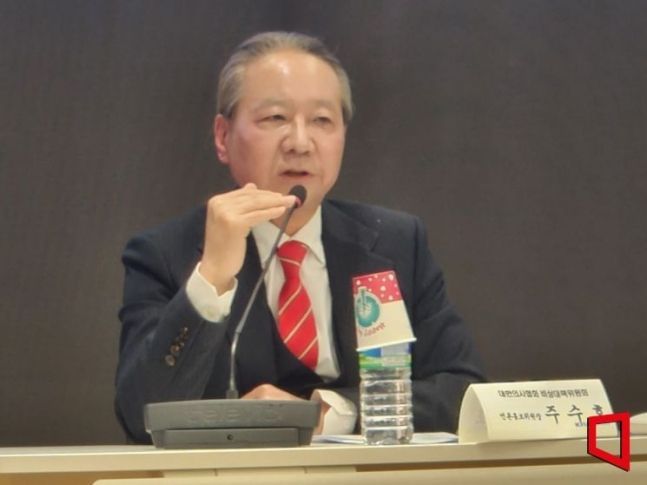 Joo Suho, Chairman of the Emergency Response Committee Public Relations Committee of the Korean Medical Association. / Photo by Choi Taewon peaceful1@
On the 23rd at 2 p.m., Joo Su-ho, the Korean Medical Association Emergency Response Committee's Public Relations Officer, stated at a regular briefing held at the KMA headquarters in Yongsan-gu, Seoul, "The places experiencing disruptions in medical care are training hospitals, including tertiary general hospitals that focus on treating severe and emergency patients," adding, "It is logically inconsistent to try to solve this problem through non-face-to-face consultations, which are suddenly inapplicable to severe and emergency diseases."
He continued, "The government is the one that forced a populist policy and pushed the previously stable medical system into a disaster situation," and added, "We hope the government apologizes to the public for enforcing a flawed policy."
He also criticized the government's plan to concentrate the capabilities of tertiary general hospitals on treating severe and emergency patients. Chairman Joo said, "The government's plan to have university hospitals treat severe emergency patients and clinics treat mild cases is a system that doctors have advocated for decades," and added, "The government only presented the medical delivery system that doctors have been advocating as an alternative after reaching a disaster situation."
Earlier that morning, the government announced that it would raise the health and medical disaster alert level from 'caution' to 'serious.' Accordingly, non-face-to-face consultations will be fully allowed. Non-face-to-face consultations, which were previously prohibited in principle for 'first-time' patients and medical institutions of 'hospital level or higher,' will now be permitted. Additionally, tertiary general hospitals will focus their capabilities on treating severe and emergency patients, while secondary hospitals in the region will treat moderate and mild patients, and clinics will treat mild outpatients, according to the announced plan.
Meanwhile, on the 25th, a nationwide emergency meeting of medical representatives protesting the government's plan to increase medical school admissions will be held. A nationwide medical community rally is expected to take place on the 3rd of next month.
© The Asia Business Daily(www.asiae.co.kr). All rights reserved.

















