'Medical Reform Misunderstandings and Truths Q&A' Post
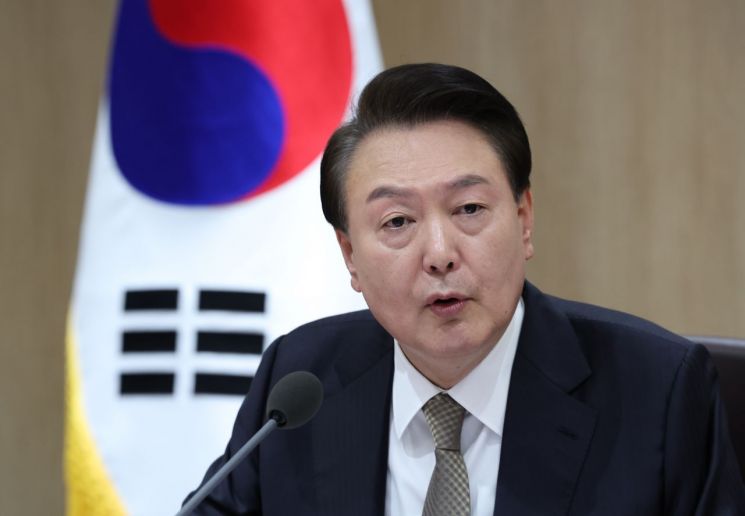 President Yoon Suk-yeol is speaking at the Cabinet meeting held on the 20th at the Yongsan Presidential Office Building in Seoul. [Image source=Yonhap News]
The Presidential Office emphasized that the medical community's claim that the expansion of medical school quotas is a unilateral government decision is unfounded, stating that "there have been over 130 communications to establish essential medical innovation strategies and policy packages." Regarding concerns that increasing medical school quotas by 2,000 would lower the quality of medical education, the office expressed the position that quality improvement is still possible despite the increase.
On the 22nd, the Presidential Office posted a 'Misunderstandings and Truths about Medical Reform Q&A' in the 'This is the Fact' section on its website, directly refuting the medical community's claims.
First, addressing the medical community's claim of 'lack of communication,' the Presidential Office explained, "The government formed an official communication channel with the Korean Medical Association and held 28 discussions," adding, "We have sufficiently communicated over 130 times with various sectors of society, including medical professionals, experts, and consumer groups, through diverse methods."
It further stated, "On the 15th of last month, the government formally requested the Korean Medical Association's opinion on the scale of the medical school quota increase via official letter, but the association did not respond until the end."
"5,000 Doctors Shortage in Medically Underserved Areas"
Regarding criticisms that the quota increase is excessive, the office said, "An annual increase of 2,000 is actually insufficient," explaining, "According to expert projections from the Korea Institute for Health and Social Affairs, the Korea Development Institute, and Seoul National University, based on 2035, there is an estimated shortage of 10,000 doctors compared to the current number, and even now, there is a shortage of 5,000 doctors in medically underserved areas."
It also explained that despite the future population decline, the demand for medical care is expected to increase significantly due to the aging population, while the number of young doctors is decreasing, which further underscores the need for quota expansion. The Presidential Office added, "Over the past 10 years, the proportion of doctors in their 20s has halved from 10.55% to 4.79%, while the proportion of doctors aged 60 and over has doubled from 10.12% to 19.03%."
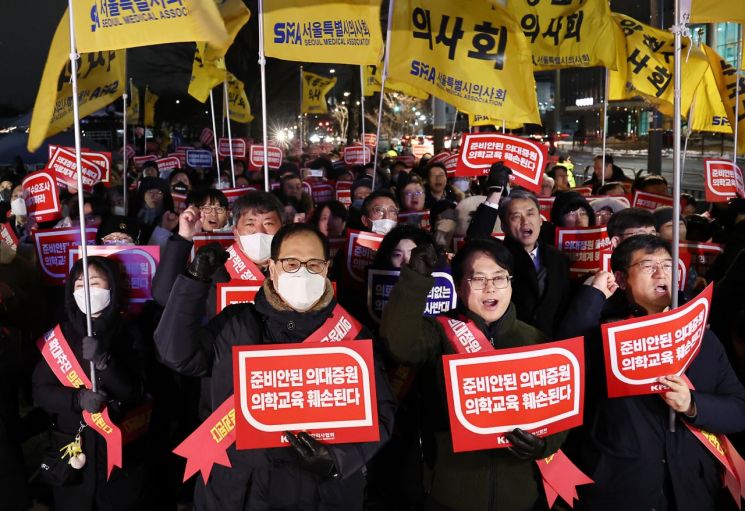 Doctors affiliated with the Seoul Medical Association are holding a rally on the afternoon of the 22nd in front of the Presidential Office in Yongsan-gu, Seoul, opposing the government's plan to increase the admission quota for medical schools.
 [Image source=Yonhap News]
Regarding concerns that the quality of education will decline due to the increase in medical school quotas, the office stated, "As a result of on-site inspections of medical schools conducted late last year, it was confirmed that even with an increase of about 2,000 students, all medical education accreditation standards can be met." It also countered, "Among the current 40 medical schools, 17 have fewer than 50 students per class. Even small medical schools must allocate a certain number of professors, so when the admission quota is too small relative to the resources invested in running the school, inefficiencies arise, making it difficult to improve the quality of education."
Addressing the criticism that an increase in doctors will not lead to more regional or essential medical care, the office said, "The increased personnel can be trained as regional and essential medical staff, and if educated in their training regions, they can grow into regional doctors." It added, "An analysis of the 2020 work locations of specialists who obtained their qualifications in 2017 showed that 82% of those who graduated from and trained at non-metropolitan medical schools remained in non-metropolitan areas." The Presidential Office emphasized, "We will select more local talents (over 60%) and introduce a contract-based regional essential doctor system linked with exceptional residential support to nurture them as regional medical experts."
"If Doctors Are Short, Medical Prices Rise"
Finally, regarding claims that increasing the number of doctors will raise medical costs, the office explained, "An analysis of health insurance medical expenses and active doctor statistics over the past 10 years shows a minimal correlation between the number of doctors and medical expenses, and the case in Germany is similar," adding, "In fact, when doctors are scarce, labor costs rise, and health insurance medical prices (fees) also increase."
This is the first time in five months since October 10 of last year, when a post about the 'National Interest Effects of Diplomatic Tours' was published, that the Presidential Office has posted in the 'This is the Fact' section. It is interpreted that the post was made to clear misunderstandings and reiterate the necessity of medical reform to the public amid strong opposition and collective actions from the medical community following the recent announcement of the 2,000 medical school quota expansion.
© The Asia Business Daily(www.asiae.co.kr). All rights reserved.


















