Financial supervisory authorities will complete on-site inspections next week of sales companies dealing with Hong Kong H-Share Index (Hang Seng China Enterprises Index·HSCEI)-based equity-linked securities (ELS) and begin preparing a full-fledged 'responsibility-sharing guideline.' While banks are cautious about the voluntary compensation mentioned by the authorities, citing concerns over breach of trust, the financial sector is closely watching the upcoming inspection results and the responsibility-sharing guideline based on them.
According to the financial sector on the 23rd, the Financial Supervisory Service (FSS) plans to complete the second round of on-site inspections as scheduled next week for major ELS sales companies (5 banks and 6 securities firms). Earlier, the FSS confirmed signs of incomplete sales during the first inspection last month and has been reviewing individual cases through the second inspection since the 16th.
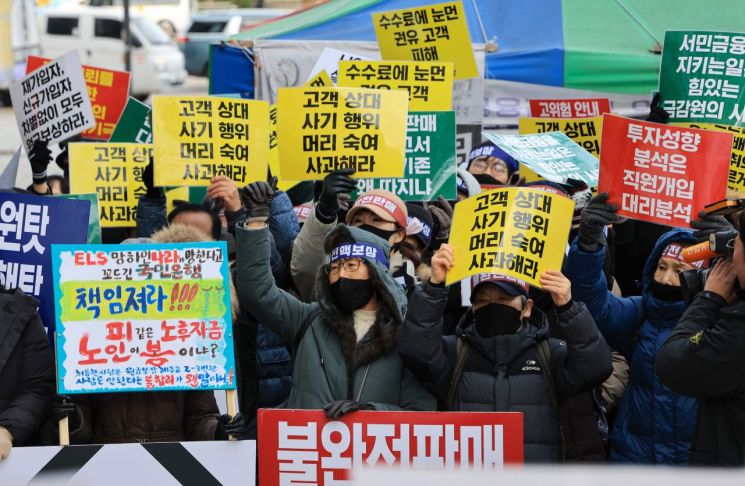
A senior FSS official stated, "We are still conducting simultaneous inspections on several sales companies," adding, "If necessary, the inspection team may decide to extend the inspections, but so far, we expect to complete the second inspection by next week as planned. The results could be announced as early as next week or by early March at the latest."
The biggest focus thereafter is the 'responsibility-sharing guideline,' which will effectively serve as a voluntary compensation guideline and is expected to be released by the authorities no later than next month. Looking at similar cases such as the overseas interest rate-linked derivative-linked fund (DLF) incident, a private settlement process is followed based on the compensation guideline after the on-site inspection. If the seller and the victim fail to reach a private settlement, the dispute will be mediated by the Dispute Mediation Committee (DMC), and if the mediation is rejected, the case proceeds to court litigation.
Currently, the contents of the responsibility-sharing guideline reportedly include measures such as applying differentiated compensation ratios based on factors like whether the ELS product is re-subscribed and whether the investor is elderly. The financial sector expects that considering the characteristics of ELS, the minimum compensation ratio may be lowered further or even eliminated entirely. Given that 90% of ELS victims are re-subscribers, the impact is expected to be significant.
However, the banking sector is opposing the voluntary compensation proposed by the authorities, citing concerns over breach of trust. A representative from a commercial bank said, "If there is a clear major shareholder, some form of decision to accept prior compensation to a certain extent could be made, but given that foreign ownership accounts for 60-70% in domestic banks, it is difficult to decide this without concrete grounds such as confirmed sanctions from supervisory authorities or court rulings," adding, "Foreign shareholders are also likely to view this as a breach of trust."
There is also concern that this could be seen as an admission of incomplete sales. In such a case, under current law, fines amounting to trillions of won could be imposed. Another banking sector official said, "For example, if voluntary compensation is made to some extent, and later in lawsuits regarding the remaining responsibility sharing, the court does not recognize incomplete sales, it would be difficult to recover the compensation," adding, "One of the concerns is that voluntary compensation could inadvertently be seen as an admission of incomplete sales."
Therefore, the financial sector views whether any systemic issues arise from the inspections concluding next week that could compel sales banks to undertake voluntary compensation as a key factor determining the direction of the situation. Banks argue that from a product perspective, Hong Kong H-Share Index-based ELS has been sold as a public fund for about 20 years without defects in the product itself, and except for some isolated deviant cases, related procedures have been followed since the enforcement of the Financial Consumer Protection Act, so individual cases should be examined.
Some predict that if such a significant issue is not resolved, even if the responsibility-sharing guideline is released, banks will not accept the recommendations and will proceed with individual lawsuits. A financial sector official said, "The ELS issue is completely different from the Lime and DLF incidents, which involved poor internal controls at the head office level and clear incomplete sales in specific cases," adding, "Except for some extreme cases such as selling ELS to dementia patients, banks have made efforts to comply with the Financial Consumer Protection Act, so there will be many points to consider in each case, such as suitability and breach of explanation obligations."
Meanwhile, losses from Hong Kong H-Share Index-based ELS have been expanding recently. Thanks to the Chinese authorities' willingness to support the stock market, the Hong Kong H-Share Index showed some recovery to 5,642.78 as of the previous day's closing price, but it remains far below the 2021 peak of 12,228.63. The industry expects that if this sluggish situation continues, losses will accumulate to 1 trillion won by the end of this month and expand to 6 to 7 trillion won by the end of the year. A financial sector official predicted, "Fundamentally, without an early interest rate cut by the U.S. Federal Reserve (Fed), a dramatic index rebound sufficient to recover ELS losses will be difficult."
© The Asia Business Daily(www.asiae.co.kr). All rights reserved.

















