Statistics Korea 'Quality of Life 2023 Report'
21.2% of Elderly Population Lacking Economic and Emotional Support
Suicide Rate Improved but Remains High Among Elderly
In South Korea, where 25 out of every 100,000 people take their own lives, the suicide rate (number of deaths by suicide per 100,000 population) is significantly higher than in other OECD countries. Among these, those aged 70 and above stand out with particularly high suicide rates.
According to the Statistics Korea report "Quality of Life 2023" released on the 23rd, the total number of suicides in South Korea in 2022 was 12,906, which corresponds to 25.2 per 100,000 people. Compared to the previous year, this is a decrease of 0.8 per 100,000, but the suicide rate tends to increase with age. The suicide rate for those in their 40s to 60s is within 30 per 100,000, but it rises to 37.8 for those in their 70s and 60.6 for those aged 80 and above. In particular, the suicide rate for men aged 70 and older was overwhelmingly high at 78.8 per 100,000.
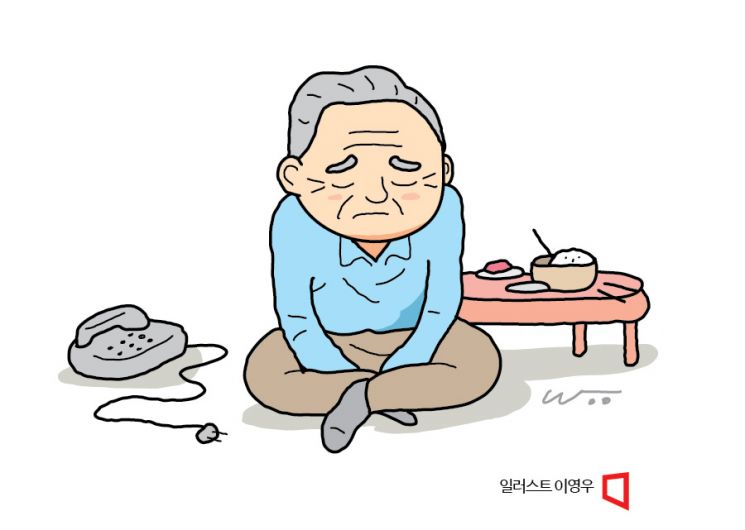
In South Korea, where the suicide rate is high, elderly people often live in isolation from society and mostly lead lonely lives. Among the total elderly population aged 65 and above, the number of elderly living alone in 2023 was approximately 1,993,000, accounting for 21.1% of the total elderly population. This is an increase of 0.2 percentage points from the previous year (about 1,875,000). By region, the proportion of elderly living alone was higher in Jeolla and Gyeongsang provinces. Especially, the proportion of elderly living alone in Jeonnam was the highest at 26.3%. In contrast, the Gyeonggi region had the lowest rate at 17.8%, followed by Sejong (18.2%), Seoul (18.3%), and Jeju (19.3%).
Elderly people living alone are considered a particularly vulnerable group among the elderly population. They are less likely to receive economic and material support from family and are more exposed to feelings of loneliness and depression emotionally. In fact, the level of social isolation felt by the elderly was the highest among all age groups. The overall average social isolation rate in 2023 was 33.0%, down 1.1 percentage points from 34.1% the previous year. However, among those aged 60 and above, the rate was 40.7%, higher than that of 19-29-year-olds (24.5%), 30-39-year-olds (27.5%), 40-49-year-olds (30.1%), and 50-59-year-olds (35%).
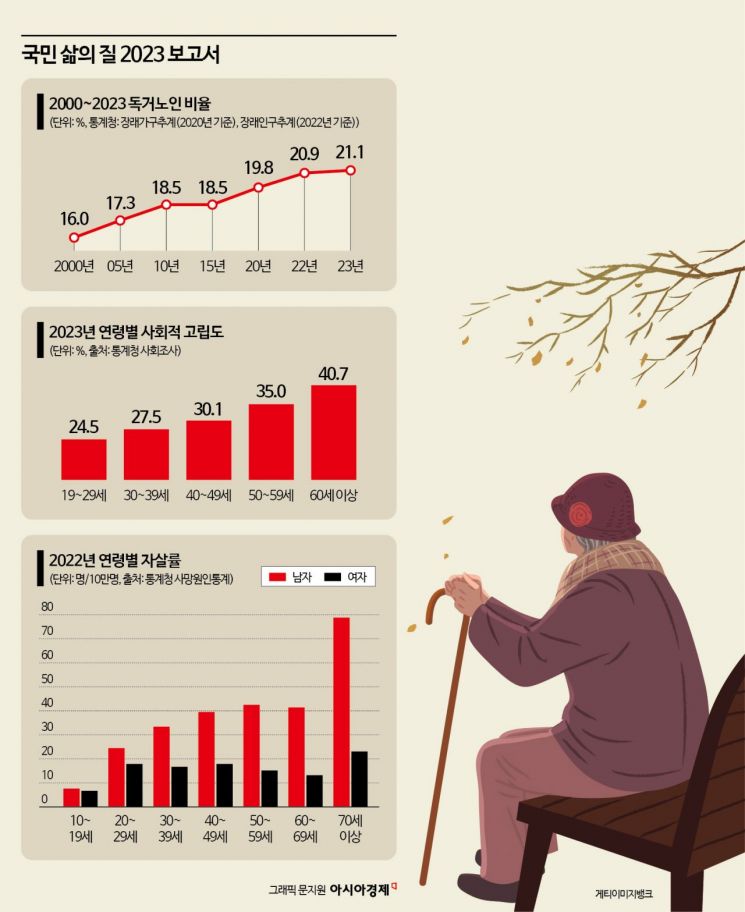
Especially among those aged 60 and above, 26.9% reported that they had no one to talk to when they needed someone, compared to 14-20% in other age groups, indicating that they are relatively more vulnerable to receiving emotional support.
The older the elderly, the lower their job satisfaction and the less leisure time they seem to enjoy. While job satisfaction has steadily increased since 2015 (25.3%) to reach 35.1% in 2023, the satisfaction rate for those aged 60 and above was the lowest at 31.4%. The highest satisfaction was among those aged 13-19 at 42.3%, followed by 40-49 (39.2%), 30-39 (36.2%), 20-29 (35.8%), and 50-59 (34.7%).
The elderly population has the most leisure time that can invigorate life. In 2022, the percentage of those who felt they had enough leisure time was lowest among 15-19-year-olds at 52.6%, followed by those in their 40s at 53.4%. In contrast, those aged 70 and above reported 79.5%, and those in their 20s and 60s about 66%. However, despite having enough time, many elderly people do not actively enjoy travel or leisure activities.
Leisure satisfaction among those aged 60 and above is only 25.2%. The average number of domestic tourism days per person by age, which can gauge the level of leisure enjoyment, was 3.2 days for those aged 70 and above and 6.6 days for those in their 60s, both below the overall average of 8.29 days. Although the elderly have much more leisure time than other age groups, their participation in active leisure activities such as cultural arts or sports viewing is very low, and their leisure satisfaction is very low as well.
© The Asia Business Daily(www.asiae.co.kr). All rights reserved.


















