Statistics Korea 'Quality of Life 2023 Report'
Various Leisure Indicators
Notable Activities Among Young Adults in Their 20s and 30s
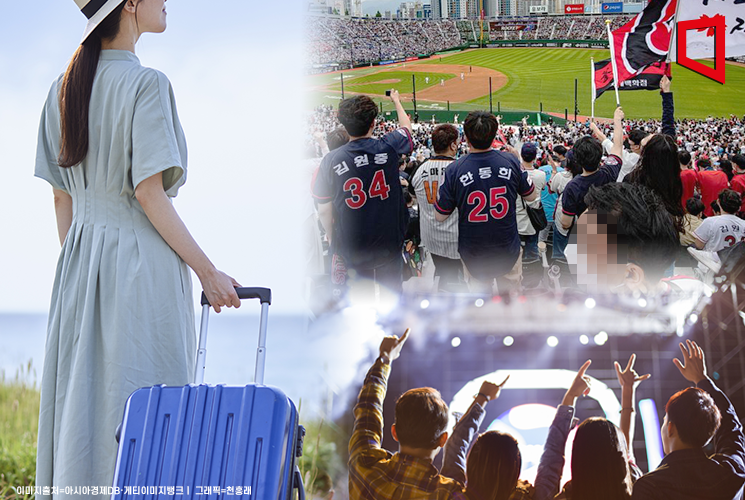
Spending on culture and leisure activities, which had contracted due to the spread of COVID-19, has shown a significant recovery, especially among the younger age group under 39. Not only overall consumer spending but also various leisure indicators such as the number of cultural and sports event attendances and travel days per person highlighted the activities of people in their 20s and 30s.
According to the "Quality of Life in Korea 2023" report released by Statistics Korea on the 23rd, the cultural and leisure expenditure rate (based on 2022, Statistics Korea's Household Income and Expenditure Survey) was highest at 6.26% for households with a head aged 39 or younger. In contrast, households with a head aged 60 or older had the lowest rate at 3.45% among all age groups.
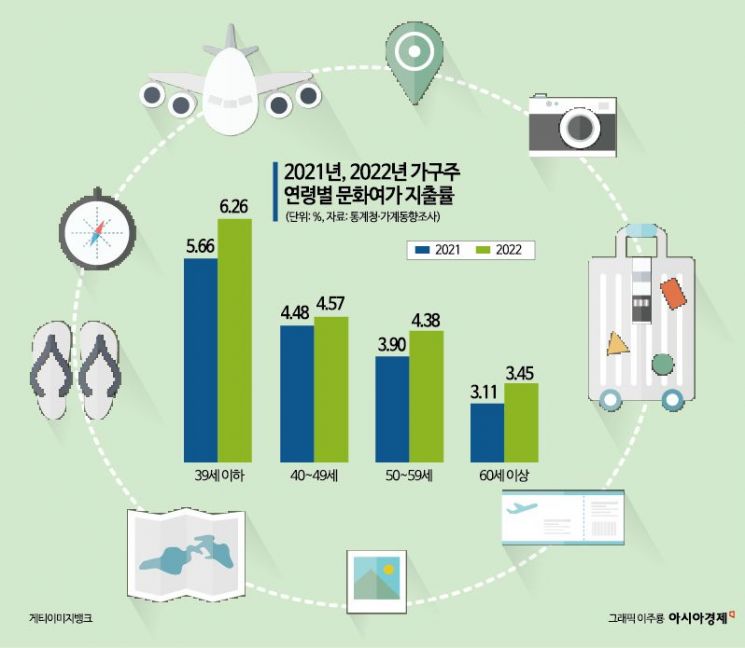
The increase in cultural and leisure expenditure rate compared to 2021 was also most prominent among the population under 39. This group increased their cultural and leisure spending by 0.6 percentage points in one year, the largest growth. Meanwhile, those aged 40-49 increased by only 0.09 percentage points (from 4.48% to 4.57%), showing the least growth in cultural and leisure spending among all age groups. The 50-59 age group (0.48 percentage points) and those 60 and older (0.34 percentage points) showed increases in the range of 0.3 to 0.5 percentage points. As leisure-related consumption, which had been suppressed by COVID-19, was stimulated by the easing of social distancing, it is interpreted that the younger generation under 39 was the most active in leisure consumption spending.
The cultural and leisure expenditure rate does not correlate proportionally with income levels. As of 2023, the net asset amount by household head age is highest among those in their 50s at 497.37 million KRW, with those 60 and older having a similar amount at 486.30 million KRW. People in their 20s have 99.54 million KRW, and those in their 30s have 273 million KRW, showing that the net assets of the 20s and 30s age groups are smaller than those of other age groups. Although they have less money, people in their 20s and 30s are living a life they can enjoy.
In terms of travel days per person, the activities of people in their 20s and 30s were also prominent. According to the "National Travel Survey" (based on 2022) conducted by the Ministry of Culture, Sports and Tourism, the number of domestic tourism travel days was highest for people in their 30s at 11.0 days, followed by those in their 20s (10.4 days), 40s (9.8 days), 50s (8.9 days), 60s (6.6 days), and 70 and older (3.2 days).
Regarding the number of cultural, arts, and sports event attendances, people in their 20s had the highest average attendance at 8.5 times. This indicator, which represents the average number of attendances at concerts, recitals, plays, traditional Korean theater, musicals, dance performances, movies, museums, sports, and literary events over the past year (based on 2023, Statistics Korea Social Survey), showed a pattern of decreasing attendance with increasing age: 13-19 years (7.8 times), 30-39 years (7.2 times), 40-49 years (6.7 times), 50-59 years (6.3 times), and 60 and older (5.7 times).
Meanwhile, the overall cultural and leisure expenditure rate has steadily increased from 4.16% in 2006 to 4.25% in 2010 and 4.44% in 2015. This rate is a flexible indicator influenced by economic conditions, having dropped to 4.00% and 4.04% during the global financial crisis in 2008 and 2009. It decreased to 4.23% in 2021 from 4.31% in 2020 but rose again to 4.70% in 2022.
© The Asia Business Daily(www.asiae.co.kr). All rights reserved.


















