Resolution of the February Monetary Policy Direction Meeting
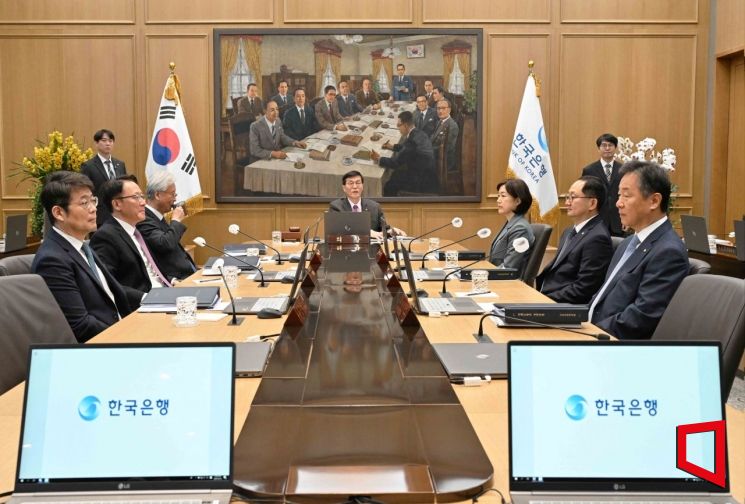 Lee Chang-yong, Governor of the Bank of Korea, is presiding over the Monetary Policy Committee meeting to decide the direction of monetary policy at the Bank of Korea in Jung-gu, Seoul, on the morning of the 22nd. Photo by Joint Press Corps
The Monetary Policy Committee of the Bank of Korea announced on the 22nd that it has kept the base interest rate steady at 3.5% for the ninth consecutive time, stating that "it is expected to take a considerable period for the rate to stabilize at the target level" and that "it is appropriate to maintain the current tightening stance."
In the resolution from the monetary policy direction meeting held that morning, the committee explained, "Although the inflation rate is expected to continue its slowing trend, it is still too early to be confident that inflation will stabilize at the target level, and there are significant domestic and international uncertainties."
Regarding this year's growth, the committee newly mentioned the impact of restructuring in real estate project financing (PF). It stated, "This year's growth rate is expected to be 2.1%, in line with the forecast made last November, but there is high uncertainty in the outlook related to the effects of major countries' monetary policies, the pace of improvement in the IT sector, and the restructuring of real estate project financing (PF)."
The core inflation rate is expected to be 2.2%, slightly below the November forecast of 2.3%, due to factors such as a slow recovery in consumption.
The committee also addressed the recently diminished expectations for an early rate cut in the United States. It explained, "In international financial markets, government bond yields have risen and the US dollar has strengthened due to weakened expectations for an early rate cut by the Federal Reserve. Going forward, the global economy and international financial markets are expected to be influenced by trends in international oil prices and global inflation, the operation and ripple effects of major countries' monetary policies, and the development of geopolitical risks."
The phrase regarding the "need for additional rate hikes," which was first removed in January of this year, was not included in this resolution either.
Regarding the future direction of monetary policy, the committee stated, "We will maintain the monetary tightening stance sufficiently and for a long period until we are confident that the inflation rate converges to the target level." It added, "In this process, we will monitor the slowing trend of inflation, risks related to financial stability and growth, trends in household debt increase, the monetary policies of major countries, and the development of geopolitical risks."
© The Asia Business Daily(www.asiae.co.kr). All rights reserved.

















