KCCI SGI Report
US, EU Reduce Dependence on China
"Introduction of Direct Refund System for Investment Tax Credit"
South Korea ranks first in exports of ternary cathode materials but is only seventh in its position within the global supply chain. There is advice that the current system, which grants tax credits only when operating profits are made, should be changed to allow investment tax credits to be refunded in cash to support companies.
On the 22nd, the Korea Chamber of Commerce and Industry's SGI (Sustainable Growth Initiative) stated this in its report titled "Study on the Possibility of Establishing South Korea as a Global Battery Supply Chain Hub." It noted that as major overseas countries such as the United States and the European Union (EU) reduce their dependence on China within the battery supply chain, an opportunity has arisen for South Korea to replace China's role.
The report said South Korea has the potential to become a global supply chain hub instead of China in the future. First, in the global market for key battery materials, cathode materials, companies like Ecopro (7%), LG Chem (5%), and L&F (4%) hold high market shares.
South Korea is the largest exporter of ternary cathode materials, which are made by adding lithium to nickel, cobalt, manganese, and aluminum. The export share reaches 76.8%.
Many of the key minerals, which China supplies significantly, are mostly found outside China. Cobalt is primarily mined in Congo, nickel in Indonesia, and lithium in Australia.
The problem is that South Korea's "position" within the supply chain is low compared to its export performance. SGI calculated the "betweenness centrality," an indicator of intermediary roles within the supply chain, to compare the supply chain positions of different countries.
South Korea, the top exporter of ternary cathode materials, ranked only seventh in betweenness centrality. China, the second-largest exporter, ranked first in betweenness centrality. China also ranked first in both export value and betweenness centrality for lithium iron phosphate cathode materials. South Korea ranked third in lithium-ion battery exports but only 21st in betweenness centrality.
Kim Kyunghoon, a researcher at SGI, evaluated, "South Korea's supply chain position is lower than that of China, the United States, Germany, and France, which trade with a variety of countries, because its exports are concentrated in a few countries."
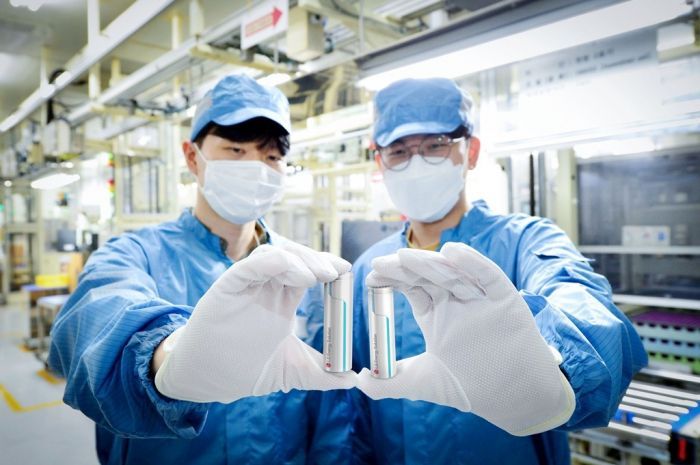
SGI emphasized that to raise South Korea's position within the battery supply chain, a national-level strategy to establish supply chains for five key minerals?nickel, cobalt, manganese, aluminum, and lithium?must be prepared.
The report argued that increasing domestic production is necessary. South Korean battery companies hold a 24% share of the global market, but South Korea's production share is only in the 1% range. A domestic electric vehicle production ecosystem must be established to enable mass production of batteries.
A strategy to diversify imports of minerals with high dependence on China is also essential. For example, graphite can be produced domestically as artificial graphite. Lithium, nickel, and cobalt imports should be diversified to countries other than China to reduce transportation costs.
Jo Cheol, a senior researcher at the Korea Institute for Industrial Economics and Trade, said, "Recently, domestic investment and production of artificial graphite, anode materials using it, and lithium hydroxide, which have high dependence on China, are increasing," adding, "Active investment support is needed to make South Korea a supply base for these items."
The report proposed solutions such as introducing a direct refund system for investment tax credits, establishing a domestic mother factory, creating a public-private partnership for overseas mineral development, and promoting corporate technology development.
The direct refund system is a measure to promote domestic investment. It allows companies to receive tax credit amounts for investments in cash. The United States introduced this system through the Inflation Reduction Act (IRA).
South Korea provides tax credits for facility investments related to national strategic technologies such as batteries, but companies must make operating profits to receive the credits. Given the battery industry's characteristics, which require high initial investment costs and take time to generate profits, it is difficult to receive tax credits. The effect on promoting corporate investment is also low.
Since countries require battery production within their own borders, building overseas factories is inevitable. However, battery cell production should retain core functions such as research and development (R&D) and product design in domestic mother factories.
As the lithium-based secondary battery market has high growth potential, securing mines is necessary. Researcher Kim said, "Mine development requires long-term plans such as overseas networks and large-scale capital, so there are limits to individual company efforts," and added, "A public-private partnership for overseas mineral resource development must be established."
Since supply chains can change depending on technological development directions, domestic companies must accelerate technology development. Senior researcher Jo said, "All-solid-state batteries are being discussed as future batteries, and adoption of lithium iron phosphate batteries, which are cheaper and have improved stability, is increasing," adding, "Attention should be paid to trends in related technological development."
© The Asia Business Daily(www.asiae.co.kr). All rights reserved.

















