UNIST Professor Kwon Oh-hoon’s Team Develops Nanometer-Scale Local Measurement Method
Provides Thermodynamic Information for Real-Time Analysis Method... Published in ACS Nano
A method to measure the temperature of minute areas using a nano thermometer smaller than pollen has been developed. This research achievement is expected to be applied to the development of advanced materials by analyzing the thermodynamic characteristics of tiny samples.
UNIST (President Yong-Hoon Lee) announced on the 22nd that Professor Oh-Hoon Kwon's team in the Department of Chemistry has developed a technology called a ‘nano thermometer’ that can measure the temperature of nanometer-sized samples inside a transmission electron microscope using cathodoluminescence (CL) spectroscopy.
A transmission electron microscope transmits an electron beam with a short wavelength through a tiny sample, allowing observation by magnifying the sample more than hundreds of thousands of times.
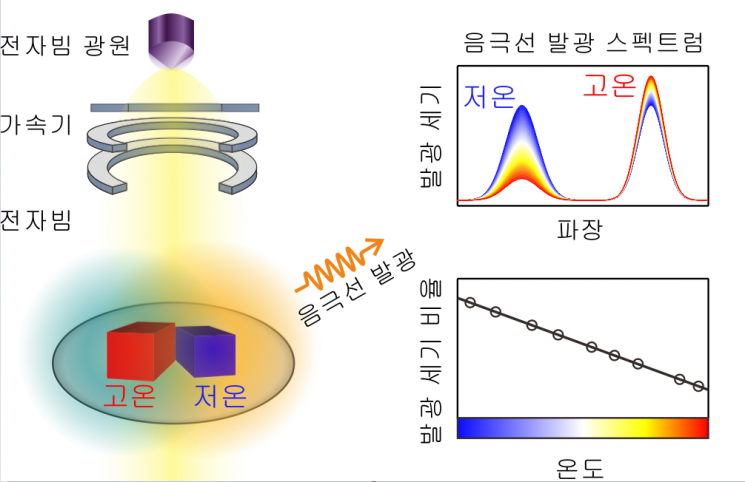
According to the research team, the cathodoluminescence spectroscopy technique using a transmission electron microscope detects light emitted from the sample as a result of interactions between electrons and the sample when electrons pass through the sample. It can measure and analyze the physical and optical properties of the sample with nanometer-scale spatial resolution.
When external stimuli such as applying force to the sample are given, the structural and chemical characteristics of the sample change, and the temperature in the micro-area of the sample also varies. By analyzing this, the thermodynamic characteristics of reactions occurring in localized areas can be identified, which can be applied to core material research for various advanced devices.
Professor Oh-Hoon Kwon explained, “The samples in a transmission electron microscope are extremely small, on the nanometer scale, and the inside of the microscope is maintained at a high vacuum level, so observing the temperature of micro-areas was very difficult.”
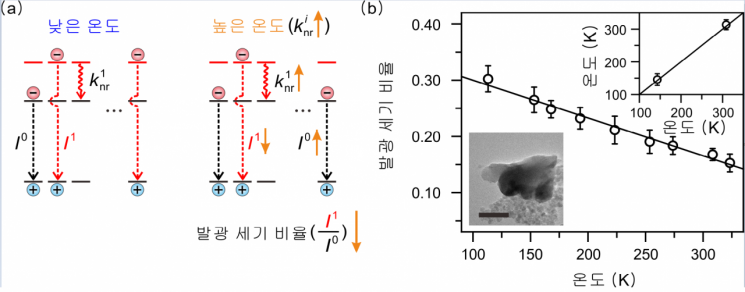
The research team developed the nano thermometer based on the observation that the intensity of a specific cathodoluminescence band of europium ions (Eu3+) changes with temperature.
First, they synthesized nanoparticles doped with europium ions in gadolinium oxide (Gd2O3). Nanoparticles composed of gadolinium oxide have low damage from electron beams, allowing long-term experiments under electron beam irradiation conditions.
Then, they applied the cathodoluminescence detection technique. They confirmed that the intensity ratio of the luminescence bands emitted from europium ions in the nanoparticles strongly depends on temperature. Through kinetic analysis, they also revealed the principle of temperature dependence of the luminescence intensity. Based on this, they used the intensity ratio of the luminescence bands as an indicator for temperature measurement.
The research team measured the surrounding temperature using nano thermometer particles approximately 100 nanometers in size and observed a measurement error of about 4℃. This is more than twice as accurate as existing temperature measurement methods using transmission electron microscopes and is known as a temperature measurement method with improved spatial resolution.
Additionally, the team induced temperature changes by irradiating a localized area with a laser inside the transmission electron microscope and measured this using the nano thermometer. This demonstrates the possibility of simultaneously observing temperature and structural changes in real time due to external stimuli, enabling discrimination and analysis of thermodynamic properties in localized areas at the nanometer scale.
 (Back row from left) Researcher Noh Hak-won, Professor Kwon Oh-hoon, First author Researcher Park Won-woo, (Front row from left) First author Researcher Pavel Olshin, Researcher Kim Ye-jin.
First author Researcher Wonwoo Park said, “A major advantage of the developed nano thermometer is that the temperature measurement process does not interfere with conventional transmission electron microscope analysis,” adding, “Because temperature is measured using light, a byproduct generated from the interaction between the transmission electron beam and the nano thermometer particles, real-time temperature detection is possible simultaneously with image measurement in the transmission electron microscope.”
Professor Oh-Hoon Kwon stated, “We presented an indicator for temperature measurement through systematic analysis and combined it with real-time imaging techniques,” and added, “It can be used to observe local temperature changes in samples that vary according to external stimuli, greatly contributing to the development of advanced materials such as secondary batteries and displays.”
This research was published online on January 30 in ACS Nano, a world-renowned international academic journal. The research was conducted with support from the Samsung Future Technology Development Project.
© The Asia Business Daily(www.asiae.co.kr). All rights reserved.



















