MBC '100 Minutes Debate' Features Gyeonggi Medical Association President's Remarks
Questions Whether the Public Wants Low-Performing Doctors
At a TV debate on the topic of increasing medical school quotas and collective action by doctors, a controversial remark was made by a medical professional stating that "the public does not want doctors who rank 20th to 30th in their class."
On the 21st, during MBC's '100-Minute Debate,' Lee Dong-wook, president of the Gyeonggi-do Medical Association, representing the doctors, said, "If the regional doctor system selects students with low grades and forces them to work mandatory service, their motivation to work will decline, and would anyone want to be treated by such doctors?" He continued, "With the regional doctor system, we inevitably have to select candidates with significantly lower grades," and argued, "Try selecting 80% of local talents. Even if they are from the region, the public does not want medical students who rank 20th to 30th in their class to attend medical school and be forced into mandatory service." This statement was made in the context of criticizing the government for trying to compensate with quantity (increasing medical school quotas) when the public wants the best medical care.
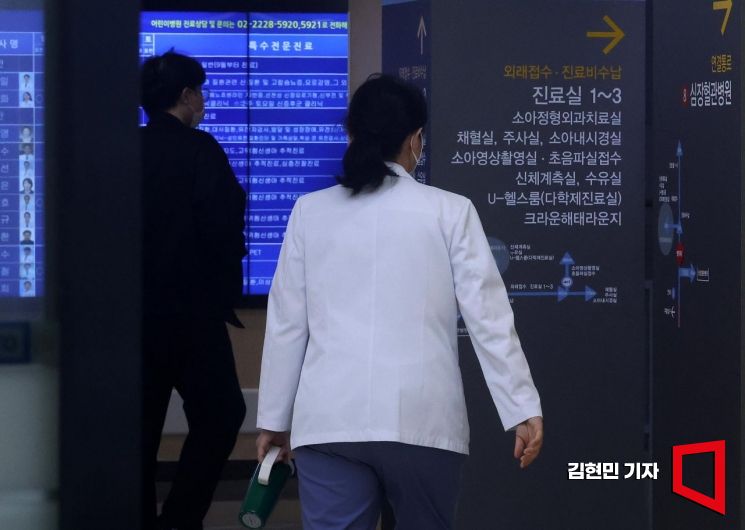 On the 19th, concerns over a 'medical crisis' due to collective opposition from doctors, including the mass resignation of residents at the five major hospitals in Korea in protest against the government's expansion of medical school quotas, were rising. This photo shows a university hospital in downtown Seoul. Photo by Hyunmin Kim kimhyun81@
Previously, concerns have been consistently raised within the medical community that significantly increasing medical school quotas would lower the quality of medical school entrants. However, in reality, even if medical school quotas are increased, it is difficult for students ranking "20th to 30th in their class" to enter medical school. As of last year, there were 2,379 high schools nationwide. Even if you sum up the top three students from each school, the total exceeds 7,000. Even if the government increases medical school quotas to about 5,000 as announced, students must rank within the top three in their school to enter medical school. Additionally, due to the low birthrate, the number of students per class recently is only about 20 to 30, so ranking 20th to 30th, as mentioned by Lee, would be considered the bottom tier.
Therefore, even if the government raises the proportion of 'regional talent selection' for medical school freshmen from over 40% to over 60%, it is expected to be difficult to enter medical school unless the student is among the top ranks.
Regarding Lee's remarks, some criticize that the doctors' 'elite consciousness' was revealed in a public setting. Park Min-soo, Vice Minister of Health and Welfare, pointed out at a briefing the day before, "The expression '20th to 30th in the class' seems to evoke the sentiment that 'students in rural areas are poor at studying,' and the claim that expanding the proportion of regional talent selection lowers the quality of medical care is absolutely unacceptable."
© The Asia Business Daily(www.asiae.co.kr). All rights reserved.
!["The Woman Who Threw Herself into the Water Clutching a Stolen Dior Bag"...A Grotesque Success Story That Shakes the Korean Psyche [Slate]](https://cwcontent.asiae.co.kr/asiaresize/183/2026021902243444107_1771435474.jpg)
















