Regional Strategic Projects, GB Release Total Exceptions Allowed
Environmental Assessment Grade 1 and 2 Areas Released and Development Permitted
Prohibition of New Land Use Regulations and Introduction of Sunset Clause
The government is easing Greenbelt (GB) regulations in non-metropolitan areas for the first time in over 20 years to revitalize regional investment. Exceptions will be made for total Greenbelt release limits when promoting strategic projects outside the metropolitan area, and environmental evaluation grade 1 and 2 zones will be released. New land use regulations will be principally prohibited, and the allowable building-to-land ratio for factories in planned management zones will be raised from the current 40% to 70%.
The Office for Government Policy Coordination, Ministry of Land, Infrastructure and Transport, and related ministries revealed these details of the "Plan to Resolve Land Use Regulations and Revitalize the Regional Economy" at the 13th Public Livelihood Forum held in Ulsan on the 21st.
Flexible Greenbelt Release... Development Allowed in Environmental Evaluation Grade 1 and 2 Zones
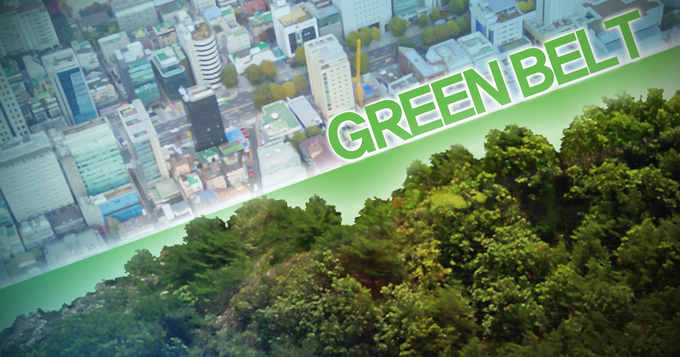
The Greenbelt system restricts development to prevent disorderly urban sprawl and preserve the urban peripheral ecosystem. It was first introduced in 1971, designating 5397㎢, equivalent to 5.4% of the national land area, across 14 metropolitan areas as Greenbelt. Since the late 1990s, regulations have been eased for reasons such as housing supply and industrial complex development.
According to the innovation plan, strategic projects led by non-metropolitan regions can now release Greenbelt areas without reducing the total allowable release volume. This improves the regulation that required phased release within the total volume reflected in 20-year metropolitan plans. It is a measure to revitalize the regional economy and foster specialized industries. The scope of regional strategic projects will not be uniformly listed but applied according to regional characteristics through deliberations such as the State Council. Greenbelt release for selected projects will be completed within one year from application through prior consultation and review by the Central Urban Planning Committee.
Greenbelt release will also be allowed in environmental evaluation grade 1 and 2 zones, where it was previously prohibited in principle, if national or regional strategic projects are promoted in non-metropolitan areas. Currently, 79.6% of the nationwide Greenbelt is grade 1 and 2 zones. However, in such cases, an equivalent area of newly designated Greenbelt must be set aside as a substitute to preserve environmental value.
The environmental grade evaluation system, which has been uniformly maintained for 20 years, will also be revised. Currently, if even one of the six environmental evaluation indicators is grade 1 or 2, the entire area cannot be released. Going forward, environmental grades can be adjusted and applied according to regional natural environment and infrastructure characteristics.
Improving Greenbelt regulations does not require legislative amendments. Related ministries plan to complete administrative preparations in the first half of this year and select regional strategic projects within the year. The government expects that this regulatory easing will expand releasable regional projects (such as industrial complexes) within the Ulsan area Greenbelt, generating up to approximately 10 trillion won in direct investment effects.
Preventing Excessive Land Use Regulations... Resolving Factory Expansion Difficulties
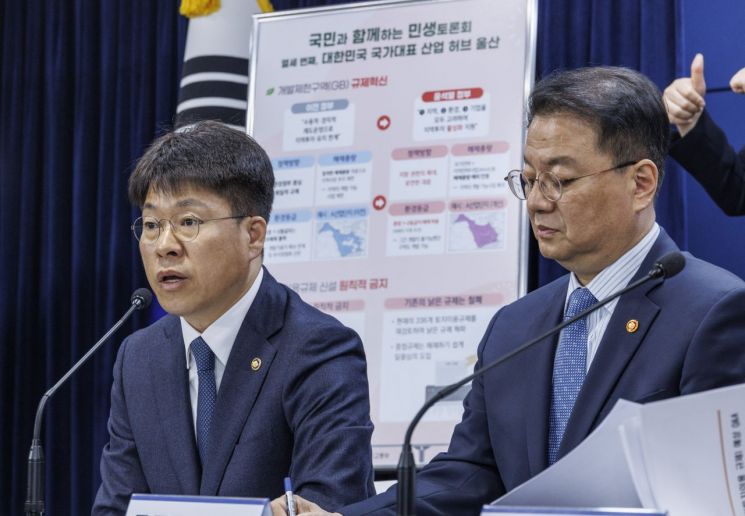 Jin Hyun-hwan, First Vice Minister of the Ministry of Land, Infrastructure and Transport (left), is explaining the topic of the thirteenth public discussion forum held on the morning of the 20th at the Government Seoul Office, titled "Directions for Improving the Greenbelt System to Expand Freedom of Land Use." / Photo by Yonhap News
Land use regulations restricting citizens' property rights will also be eased. The creation of new regulations not registered under the Basic Land Use Regulation Act will be principally prohibited, and existing regulations will adopt a sunset clause to decide their continuation every five years. This aims to prevent unnecessary regulation proliferation. Until last year, there were 336 regulated areas and districts. The government plans to introduce an integrated review process to quickly lift overlapping unnecessary regulations and mandate appropriateness reviews when overlapping other regulations in existing regulated areas.
The innovation plan also includes measures to ease difficulties in expanding production facilities. To systematically develop planned management zones, development promotion districts will be designated, and the maximum building-to-land ratio for factories will be relaxed from the current 40% to 70% upon securing infrastructure, along with easing regulations on expansions of existing factories. Previously, expansions or reconstructions of existing factories were prohibited when conservation forest areas in agricultural and forestry zones were released, but local governments will now be able to change agricultural and forestry zones to planned management zones where factory sites are permitted. Additionally, if expansions are restricted due to changes in land use zones, expansions will be allowed according to the building standards at the time of completion within 10 years from the regulation application date.
To improve residential environments, rest area restaurants will also be allowed in production management zones. This responds to criticisms that attracting tourists to create jobs and income is difficult. However, only small-scale cafes, bakeries, and similar rest area restaurants under 300㎡ with minimal environmental impact will be permitted.
© The Asia Business Daily(www.asiae.co.kr). All rights reserved.


















