Regional Strategic Projects Excluding Total Greenbelt Release
Major Overhaul in 20 Years... Development of Environment Grade 1 and 2 Areas
Purpose to Foster Specialized Industries like Ulsan Industrial Hub
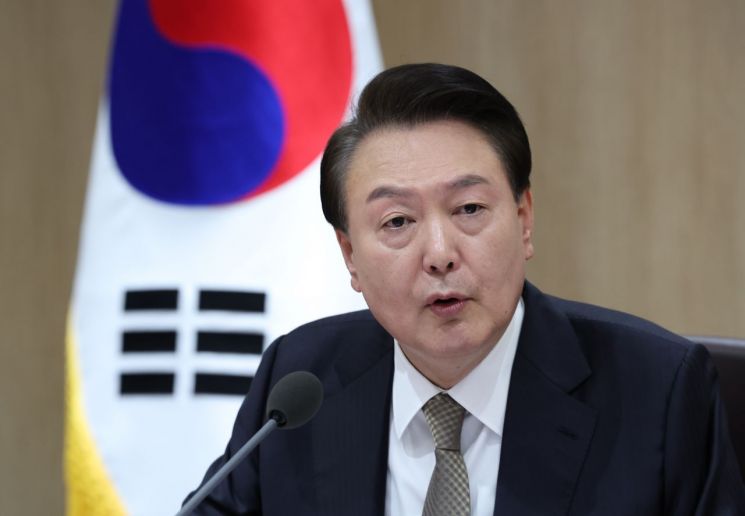
The government has decided to broadly allow the lifting of development restriction zones (Greenbelt) only in non-capital regions. Additionally, it plans to relax the rigid environmental grading system that has been in place for the past 20 years and establish a principle that new land use regulations will generally be prohibited.
On the 21st, the government announced these regulatory relief measures at a public discussion hosted by President Yoon Seok-yeol in Ulsan. The discussion proposed significantly easing representative land regulations such as the Greenbelt and farmland use restrictions to expand citizens' freedom of land use and foster Ulsan as an industrial hub.
Broad Lifting of Greenbelt in Non-Capital Regions
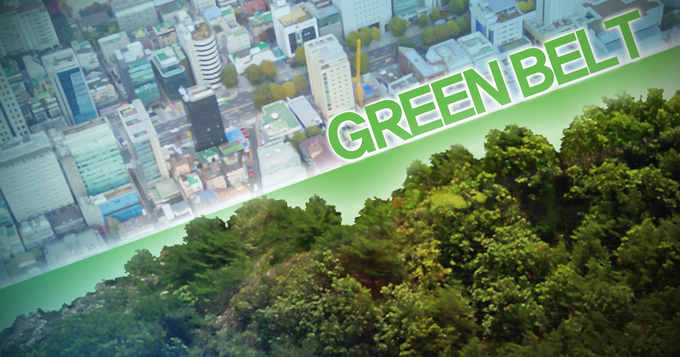
First, the government will allow broad lifting of the Greenbelt in non-capital regions and operate it more flexibly.
This easing of Greenbelt regulations is the first in over nine years since May 2015 during the Park Geun-hye administration. The plan aims to promote regional investment and land development by loosening regulations outside the capital area and to slow down regional extinction.
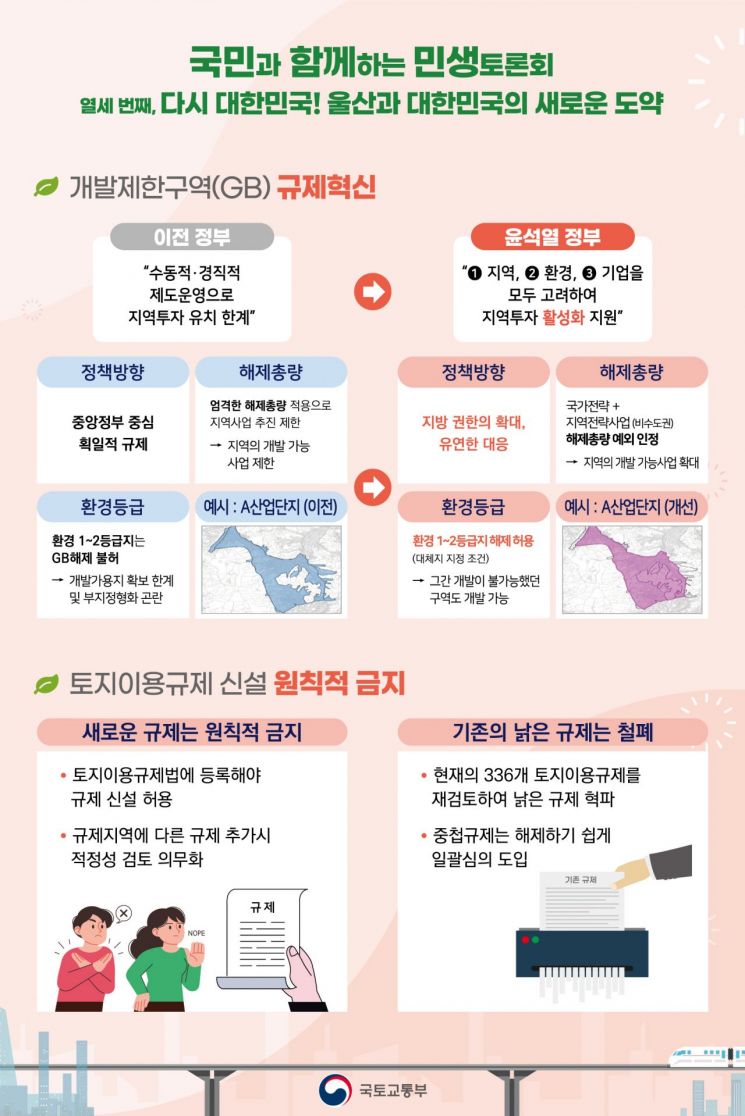
For strategic projects led by non-capital regions aimed at revitalizing local economies and fostering specialized industries (regional strategic projects), Greenbelt areas can be lifted without reducing the total allowable amount for lifting.
Instead of listing possible project scopes uniformly, regional strategic projects will be flexibly applied according to regional characteristics through deliberations such as at the Cabinet meeting.
Moreover, even for environmental evaluation grade 1 and 2 zones where Greenbelt lifting was generally not allowed, lifting will be permitted in non-capital regions when national or regional strategic projects are pursued. However, to preserve environmental value, replacement sites equivalent to the area of lifted grade 1 and 2 zones must be newly designated as Greenbelt.
The environmental grading evaluation system, which has been strictly operated for the past 20 years, will also be relaxed. Currently, if even one of the six environmental evaluation indicators is grade 1 or 2, lifting is entirely prohibited, but going forward, environmental grades can be adjusted and applied flexibly according to regional characteristics.
Principled Ban on New Land Use Regulations
In particular, the government plans to amend the Framework Act on Land Use Regulation to abolish outdated regulations while establishing a principle that new regulations will generally be prohibited.
All regulations registered under the Framework Act on Land Use Regulation will adopt a sunset clause to regularly determine their continuation, and an integrated review process will be introduced to promptly lift multiple overlapping unnecessary regulations.
Regulations not registered under the Framework Act on Land Use Regulation will not be newly designated, and if new overlapping regulations are added in areas where other regulations already exist, an appropriateness review will be mandatory.
Additionally, for development promotion districts within planned management areas where infrastructure such as roads and water supply/sewerage is secured, the factory building coverage ratio will be relaxed from the current 40% to 70%. Small-scale (under 300㎡) cafes and other food service establishments will be allowed in production management areas where environmental pollution concerns are low.
Even if regulations are strengthened unexpectedly after factory completion due to zoning changes or legal amendments, extensions will be allowed for 10 years based on the approval standards at the time of completion. The lodging facility location regulation in planned management areas, which uniformly restricts a 50m setback from roads, will be abolished to activate tourism demand.
The government explained, "This innovation in development restriction zones and land use regulations is expected to establish a proactive regional investment foundation," adding, "Through Greenbelt lifting, the creation of industrial complexes, research complexes, logistics complexes, etc., will be revitalized in regions, leading to expanded corporate investment."
© The Asia Business Daily(www.asiae.co.kr). All rights reserved.



















