Expansion to 70 Top Family-Friendly Companies
Reduction in Emergency Care and Service Application Times
Relaxation of Income Criteria for Single-Parent Family Childcare Support
The Ministry of Gender Equality and Family plans to expand the number of family-friendly top companies to 70 this year in response to the low birthrate issue and is considering introducing additional benefits for small and medium-sized enterprises. The target for childcare support will be expanded to 110,000 households, and additional support measures for families with multiple children will also be implemented.
On the 21st, the Ministry of Gender Equality and Family announced the '2024 Low Birthrate Policy' containing these details through a press release.
The Family-Friendly Certification System is a program where the Ministry evaluates and certifies companies and public institutions that exemplary operate family-friendly systems such as childbirth and childcare support and flexible work arrangements. Among these, large companies that have maintained certification for 15 years and small and medium-sized enterprises that have maintained it for 12 years are designated as family-friendly top companies.
The Ministry explained that it plans to expand the current 22 top companies to 70 by the end of this year. Along with this, to expand certification for small and medium-sized enterprises, it plans to support pre-consultations and discover incentives.
Regarding the 'Childcare Service' to alleviate the childcare burden for dual-income families, the government plans to expand the number of supported households from 85,000 to 110,000. Additionally, families with two or more children will receive an extra 10% support on their out-of-pocket expenses. For youth single parents, the government will cover 90% of the childcare service usage fees.
To reduce care gaps, the 'Emergency Care' service application time will be shortened from at least 4 hours before care starts to 2 hours before. For the 'Short-term Care' service, the minimum usage time will be reduced from 2 hours to 1 hour.
The income criteria for child-rearing support for single-parent families will be relaxed from 60% to 63% of the median income, and the eligible child age will be expanded from under 18 to under 22 if attending high school. The support amount will be increased to 210,000 KRW per month. For youth single parents aged 24 or younger raising infants aged 0 to 1, the child-rearing support amount will be raised from 350,000 KRW to 400,000 KRW per month.
Youth pregnant women in crisis will have eased admission criteria for single-parent family welfare facilities by excluding the application of the median income 100% or below standard. For low-income single-parent families, the supply of communal living-type purchased rental housing will be expanded from 266 units last year to 306 units this year.
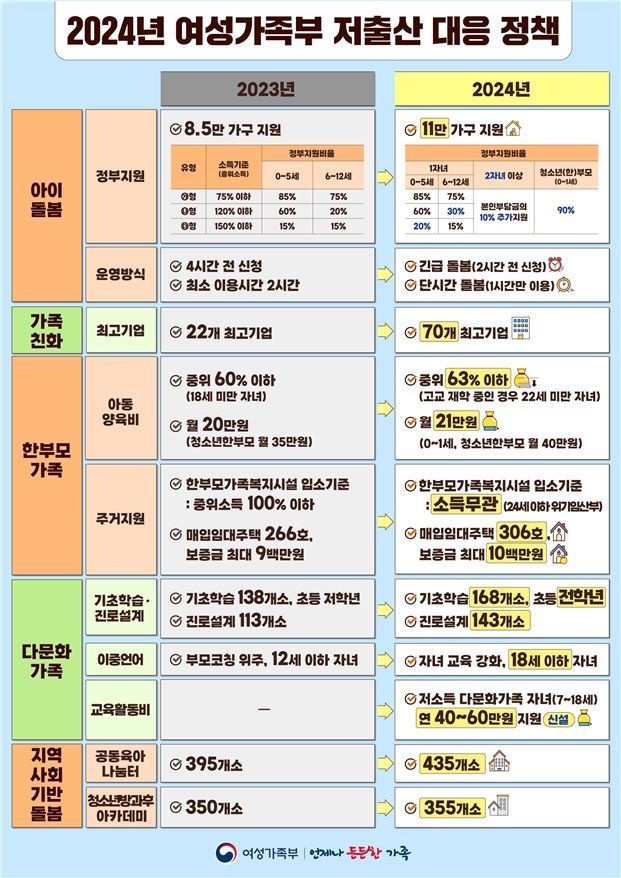
For children of multicultural families, basic learning education, which was provided last year to preschool and lower elementary students at family centers nationwide, will be expanded to upper elementary grades. The bilingual education, which was piloted last year, will be organized as a regular program this year and conducted at 130 locations. Educational activity expenses of 400,000 to 600,000 KRW annually will be supported for about 60,000 children of low-income multicultural families in elementary, middle, and high school.
The communal childcare sharing centers, where neighbors can care for children together, will be expanded from the current 395 locations to 435 by the end of this year, and support methods such as neighborly care exchanges and after-school, nighttime, and weekend operations will be diversified.
The Youth After-School Academy will open at 355 locations starting this year. It will provide learning, meals, and various after-school care services and strengthen community-based care services.
© The Asia Business Daily(www.asiae.co.kr). All rights reserved.


















