Communication with the Nucleus and the Role of Mitochondria in Cell Survival Presented
Published in the Recent Issue of ‘Experimental & Molecular Medicine’
Dong-A University (President Lee Hae-woo) announced that a paper by Professor Kim Kyung-hwa's research team from the Department of Health Management has been published in the latest issue of ‘Experimental & Molecular Medicine’ (IF 12.8), a journal listed in ‘Korea’s People Who Shined (Hanbitsa)’.

‘Hanbitsa’ plays a role in informing domestic researchers about outstanding papers, including those published in life sciences journals with an impact factor above 10, journals ranked in the top 5% by field, papers recommended by experts, and highly cited papers.
Professor Kim Kyung-hwa’s team analyzed the importance and mechanisms of action of a newly emerging field of mitochondria known as ‘Mitonuclear communication’ (mitochondria-nuclear communication), which had been little known until now, and published their findings as an invited review paper.
The title of the paper is ‘Socialized Mitochondria: Mitonuclear Crosstalk in Stress’.
This paper was conducted under the Korea Research Foundation’s Outstanding Scientist Support Project, with graduate student Lee Cho-bi participating as a co-author.
In this paper, Professor Kim’s research team deeply presented the role of mitochondria as nuclear regulators that directly control the nuclear genome in various ways, instead of the previously known ‘nucleus-dependent mitochondria’ recognized only as the cell’s energy factories.
They also reported how mitochondrial stress, previously known only as harmful substances like reactive oxygen species (ROS), regulates the nucleus and activates signaling pathways that suppress aging and promote health.
Professor Kim explained, “Mitochondrial stress does not act solely as a cause of disease and aging. Mitochondria are key organelles that regulate cell fate, and their primary function is to maintain various aspects of biological homeostasis. If the mitonuclear communication mechanisms that respond to various stresses that can cause disease and aging are activated, it could provide a new approach for treating aging and diseases.”
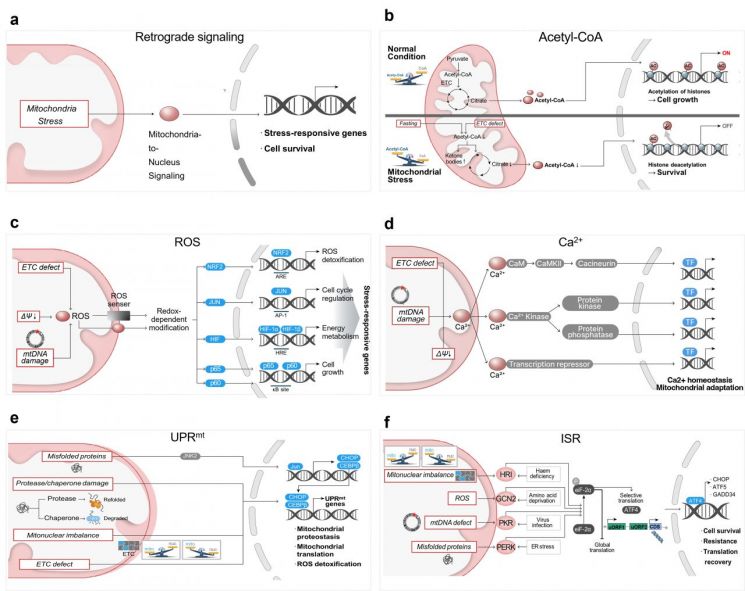 A molecular mechanism in which mitochondria release a series of signaling molecules under various mitochondrial stress conditions, and nuclear genome expression is altered by this signaling, ultimately enhancing the cell's stress defense capability.
Professor Kim’s team is participating in the Dong-A University BK21 Future Environment Bio-defense Convergence Project Group.
© The Asia Business Daily(www.asiae.co.kr). All rights reserved.


















