"Doctors and Government Both Ignore Patients' Voices"
"Government Measures Do Not Help from Patients' Perspective"
As the medical crisis becomes a reality due to the collective departure of residents opposing the increase in medical school admissions, concerns are rising over the damage to patients with severe illnesses who urgently need treatment and surgery. On the 21st, Ahn Sun-young, director of the Korea Severe Disease Patients Association (Severe Disease Patients Association), appealed, "Medical organizations and the government are only trying to use patients' voices but are not willing to listen." The Severe Disease Patients Association is a coalition of groups including the Korea Cancer Patient Rights Council, Korea Multiple Myeloma Patients Association, Korea Lou Gehrig's Disease Federation, Korea Atopic Severe Disease Association, Korea Pulmonary Fibrosis Patients Association, and Korea Pancreatic Cancer Patients Association.
On the same day, Ahn appeared on KBS Radio's 'Jeon Jong-cheol's Jeongyeok Sisa' and stated, "There has never been a proposed communication channel between medical organizations and severe patients," adding, "The government has neither made proposals nor notifications or official documents regarding countermeasures." He criticized, "The government says it will operate emergency rooms 24 hours a day, open military hospitals to civilians, and provide non-face-to-face medical care to respond to the medical vacuum, but I have not heard of any control tower being introduced or other measures being devised," and pointed out, "Although the government plans to announce detailed plans today, it will not be of much help from the perspective of patients and caregivers." He further questioned, "There are many severe patients and cancer patients who need long-term care by specialists, but can all of this be resolved at military hospitals or emergency rooms?"
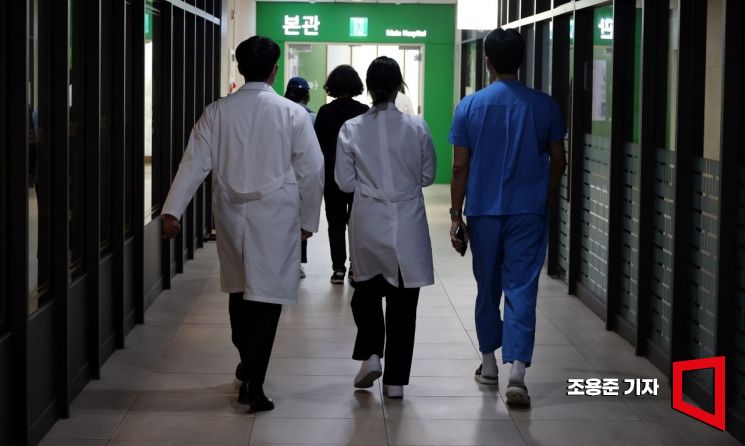 On the 20th, medical staff are moving at a large hospital in Seoul, where residents at training hospitals nationwide, including the 'Big 5' hospitals, have submitted resignation letters, and the exodus from hospitals is expected to continue in earnest. Photo by Jo Yongjun jun21@
Ahn said that during the 2020 medical crisis, severe patients suffered amid conflicts between medical organizations and the government. He criticized, "There were deaths in 2020 as well, but there is no data on cases where patients died due to delayed treatment or surgery or died through emergency rooms," adding, "Doctors blamed the government, and the government blamed the medical organizations, and it ended there." He emphasized that even if health deteriorates or death occurs due to the medical crisis, no one can be held accountable, saying, "Yesterday, someone inquired about legal responsibility, but since we experienced this once in 2020, we could not give a clear answer."
Currently, patients with severe illnesses are experiencing significant psychological anxiety about the medical vacuum. Ahn said, "Taking cancer as a representative example, even though I can receive treatment and was clearly within the queue, it has been postponed as if it were natural," adding, "If treatment is delayed with just one text message or phone call, resentment toward one's body and society arises, which negatively affects health."
Concerns about medical expenses are as significant as the delay in treatment and surgery. Ahn said, "Surgical procedures are also very urgent, but the burden of medical expenses is substantial," explaining, "Because if the illness continues for more than a year, it becomes a huge burden on the family." He also mentioned, "Each disease has its own difficulties," giving an example, "Atopic disease is not often treated as a severe disease, but patients must undergo re-examination every six months to confirm severity to receive benefits such as hospital fee support."
The medical crisis has become a reality due to the collective resignation of residents. As residents leave medical sites, patient harm is occurring in various places, such as delays in emergency surgeries. According to the Ministry of Health and Welfare (MOHW), as of 11 p.m. on the 19th, 6,415 residents belonging to 100 major training hospitals submitted resignation letters. This accounts for about 55% of the residents at these hospitals. Although these resignation letters have not been accepted, about 1,630 residents, approximately 25% of those who submitted resignation letters, have left their workplaces. The MOHW plans to inspect 50 of the 100 major training hospitals and impose administrative measures such as 'license suspension' on residents who do not return despite orders to resume work.
© The Asia Business Daily(www.asiae.co.kr). All rights reserved.
![User Who Sold Erroneously Deposited Bitcoins to Repay Debt and Fund Entertainment... What Did the Supreme Court Decide in 2021? [Legal Issue Check]](https://cwcontent.asiae.co.kr/asiaresize/183/2026020910431234020_1770601391.png)