The Supreme Court has ruled that applying the provision of the Act on the Aggravated Punishment, etc. of Specific Crimes (hereinafter referred to as the Specific Crimes Aggravated Punishment Act), which imposes heavier penalties for recidivism when a person who has been sentenced to imprisonment three or more times for theft commits theft again, to a person sentenced to imprisonment for robbery was incorrect.
The ruling clarifies that the recidivism aggravation provision under the Specific Crimes Aggravated Punishment Act should only be applied when the same type of crime is committed.
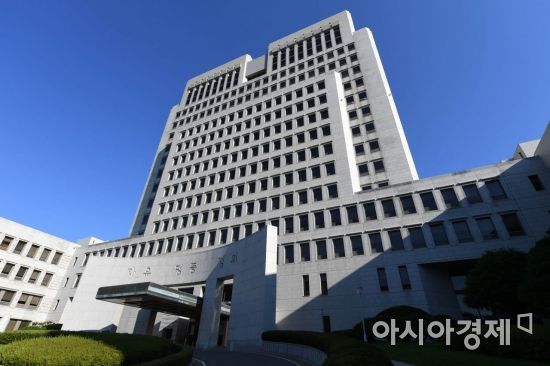
According to the legal community on the 21st, the Supreme Court's First Division (Presiding Justice Oh Kyung-mi) overturned the original ruling that sentenced Lee Mo to 1 year and 2 months imprisonment on charges of violating the Specific Crimes Aggravated Punishment Act (theft) and remanded the case to the Seoul Western District Court.
Lee was indicted on charges of committing theft (nighttime residential intrusion theft) eight times at the same location, including stealing 100,000 won in cash owned by university students from a student lounge at a university in Seodaemun-gu, Seoul, between September 24 and 28, 2022.
Lee had a prior record of being sentenced to 3 years imprisonment in August 2007 for theft under the Specific Crimes Aggravated Punishment Act, 2 years imprisonment in May 2012 for the same charge, and 1 year and 6 months imprisonment in May 2015 for habitual theft. Additionally, he was sentenced to 2 years imprisonment in October 2018 for theft under the Specific Crimes Aggravated Punishment Act and was released on December 12, 2019.
The prosecutor applied the recidivism aggravation provision of the Specific Crimes Aggravated Punishment Act to Lee, who committed theft again within three years after completing his last sentence.
Article 35 (Recidivism) Paragraph 1 of the Criminal Act states, "A person who has been sentenced to imprisonment or a heavier punishment and commits a crime punishable by imprisonment or heavier within three years after the execution or exemption of the sentence shall be punished as a recidivist." Paragraph 2 of the same article states, "The punishment for recidivism may be increased up to twice the maximum term prescribed for the crime."
For example, the statutory penalty for theft is "imprisonment for up to 6 years or a fine of up to 10 million won," but if recidivism applies, the statutory penalty can be increased up to "imprisonment for up to 12 years or a fine of up to 20 million won," allowing for harsher punishment.
The Specific Crimes Aggravated Punishment Act, a special law that takes precedence over the Criminal Act, in Article 5-4 (Aggravated Punishment for Habitual Robbery, Theft, etc.) Paragraph 5, states, "If a person who has been sentenced to imprisonment three or more times for crimes under Articles 329 to 331, 333 to 336, 340, and 362 of the Criminal Act or their attempts commits these crimes again and is punished as a recidivist, the punishment shall be aggravated according to the following classifications."
Paragraph 1 states, "If the crime committed is one under Articles 329 to 331 of the Criminal Act (including attempts), the person shall be punished by imprisonment for not less than 2 years and not more than 20 years."
Article 329 of the Criminal Act is theft, Article 330 is nighttime residential intrusion theft, and Article 331 is special theft. In other words, a person who has been sentenced to imprisonment three or more times for theft, nighttime residential intrusion theft, special theft, or their attempts and commits "these crimes" again shall be severely punished with imprisonment for not less than 2 years and not more than 20 years under the Specific Crimes Aggravated Punishment Act.
In this case, the issue was whether robbery could be included in "these crimes" under the above provision.
The first trial court found Lee guilty of violating Article 5-4 Paragraph 5 Item 1 of the Specific Crimes Aggravated Punishment Act and sentenced him to 1 year and 4 months imprisonment.
The court stated, "Despite the defendant having a prior record of multiple imprisonment sentences for the same type of crime, he committed the offenses during the recidivism period, and some victims did not reach a settlement, which are unfavorable factors. However, the defendant confessed and showed remorse, reached amicable settlements with some victims, returned the victims' earphones, and the amount stolen was not large, which are favorable factors," explaining the sentencing rationale.
The appellate court also found Lee guilty but accepted his appeal claiming the sentence was excessive and reduced the sentence to 1 year and 2 months.
The court explained, "The damage to each victim was not significant, three out of seven victims reached a settlement during the first trial and do not wish for the defendant's punishment, and the defendant made efforts to restore the victims' damages by depositing all or part of the compensation for the remaining four victims during this trial. The defendant also belatedly showed remorse, which are favorable factors," as reasons for the sentence reduction.
However, the Supreme Court's judgment was different. The Supreme Court held that Lee did not meet the requirements to apply the heavier penalty provision of the Specific Crimes Aggravated Punishment Act.
The court stated, "The purpose of Article 5-4 Paragraph 5 of the Specific Crimes Aggravated Punishment Act is to punish with the statutory penalty prescribed in the same item when a person repeatedly commits crimes listed in the same item three or more times and commits the same crime again during the recidivism period."
It continued, "Therefore, in the phrase 'committing these crimes again and being punished as a recidivist' in Article 5-4 Paragraph 5 Item 1, 'these crimes' need not be identical to the previous crimes but must be the same type of crime as those enumerated in the same item, specifically crimes under Articles 329 to 331 of the Criminal Act or their attempts, and the previous crimes in the recidivism relationship must be of the same type as 'these crimes.'"
Article 5-4 Paragraph 5 of the Specific Crimes Aggravated Punishment Act covers theft, robbery, and receiving stolen goods, among others. It means that a person sentenced to imprisonment three or more times for theft-related crimes, including theft, special theft, and attempted theft, who commits theft-related crimes again is subject to aggravated punishment under this provision. However, a person who committed theft twice and robbery or theft twice and receiving stolen goods cannot have this provision applied simply because they committed theft again.
The court noted, "The lower court recognized that the defendant was sentenced to 3 years imprisonment in August 2007 for theft under the Specific Crimes Aggravated Punishment Act, 2 years imprisonment in May 2012 for the same charge, 1 year and 6 months imprisonment in May 2015 for habitual theft, and 2 years imprisonment in October 2018 for theft under the Specific Crimes Aggravated Punishment Act, and that he committed nighttime residential intrusion theft and theft again during the recidivism period, applying the provision of the Specific Crimes Aggravated Punishment Act and finding him guilty."
However, "According to the records, the defendant was sentenced to 2 years imprisonment for attempted quasi-robbery by the Seoul High Court in October 2018, and the theft charge under the Specific Crimes Aggravated Punishment Act was acquitted," the court pointed out.
Finally, the court stated, "Nevertheless, the original ruling applied Article 5-4 Paragraph 5 Item 1 of the Specific Crimes Aggravated Punishment Act to the defendant and found all charges guilty, which misinterpreted the legal principles regarding the interpretation of 'committing these crimes again and being punished as a recidivist' under this provision and failed to conduct necessary investigations, affecting the judgment," explaining the reason for overturning and remanding the case.
In other words, the provision of Article 5-4 Paragraph 5 Item 1 of the Specific Crimes Aggravated Punishment Act applied by the prosecutor is a regulation that applies when a person sentenced to imprisonment three or more times for theft-related crimes commits theft again within the recidivism period (3 years). Since Lee's last crime in 2018 was robbery, not theft, the Supreme Court concluded that this provision cannot be applied to impose aggravated punishment.
© The Asia Business Daily(www.asiae.co.kr). All rights reserved.
![Clutching a Stolen Dior Bag, Saying "I Hate Being Poor but Real"... The Grotesque Con of a "Human Knockoff" [Slate]](https://cwcontent.asiae.co.kr/asiaresize/183/2026021902243444107_1771435474.jpg)
















