MOU Signed on the 20th for Establishing Local Government Associations... Promoting Private Investment Attraction
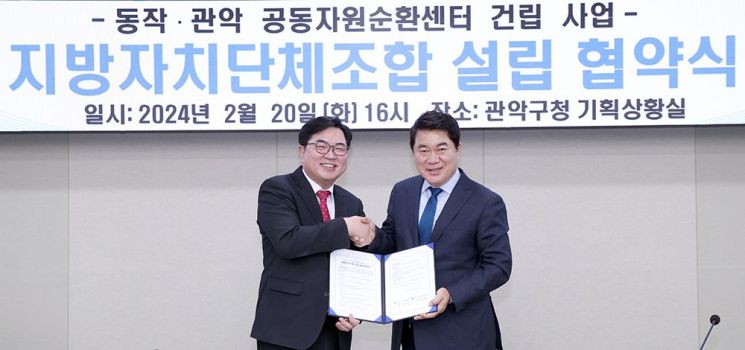
The waste treatment facility, which has caused inconvenience such as foul odors to local residents while being above ground, is finally beginning its transition underground with the establishment of a cooperative as the first step.
Dongjak-gu (Mayor Park Il-ha) announced that on the 20th, it signed a memorandum of understanding with Gwanak-gu to establish the ‘Dongjak-Gwanak Joint Resource Circulation Center Local Government Cooperative’ (hereinafter referred to as the Joint Resource Circulation Center Cooperative).
The signing ceremony was attended by Park Il-ha, Mayor of Dongjak-gu, Park Jun-hee, Mayor of Gwanak-gu, and officials from both organizations.
Until now, the district had been pursuing the construction of the ‘Dongjak-Gwanak Joint Resource Circulation Center’ as a financial project, which was so delayed that it would have taken 15 years to start construction. Considering that this has been a long-standing wish of local residents since 2014, various measures such as establishing a cooperative and attracting private investment were devised.
As a result of continuous efforts to persuade central government ministries and the Seoul Metropolitan Government through consultations with Gwanak-gu last year for the establishment of the local government cooperative, the project bore fruit with final approval in December.
The district plans to drastically shorten the project period and reduce the budget by attracting private investment.
This agreement has given momentum to the promotion of the local government cooperative, the first dedicated organization in Seoul for the construction of a joint resource circulation center.
A ‘local government cooperative’ is a legal entity formed by two or more local governments to jointly handle affairs.
The Joint Resource Circulation Center Cooperative will establish an office with a total of 21 members and launch a cooperative council composed of 12 members to ensure financial soundness and efficiency.
Both districts will set up the cooperative office within Dongjak-gu in March. The Director of the Safety and Environment Bureau of Dongjak-gu will be appointed as the cooperative head, and each district will dispatch three employees to carry out cooperative tasks, with additional personnel to be deployed depending on future workload.
The cooperative will perform tasks such as ▲construction-related guidance and supervision ▲approval of implementation plans and changes/management of implementation agreements ▲attraction of private investment and cooperation with the private sector.
Operating and project promotion costs of the cooperative will be shared by both districts according to the cooperative regulations.
The Dongjak-Gwanak Joint Resource Circulation Center is a waste treatment facility that will underground the current Boramae waste transfer station. It will be built with two basement floors, a total floor area of 40,000㎡, and a daily household waste treatment capacity of 580 tons. A park, serving as a convenience facility for local residents, is planned to be created on the upper part.
Park Il-ha, Mayor of Dongjak-gu, emphasized, “The establishment of this cooperative is significant as it presents a leading model for resource circulation facilities through cooperation between autonomous districts for the first time in Seoul. Through this agreement, we will take the first step toward attracting private investment and accelerate this long-awaited project for residents.”
© The Asia Business Daily(www.asiae.co.kr). All rights reserved.

















